
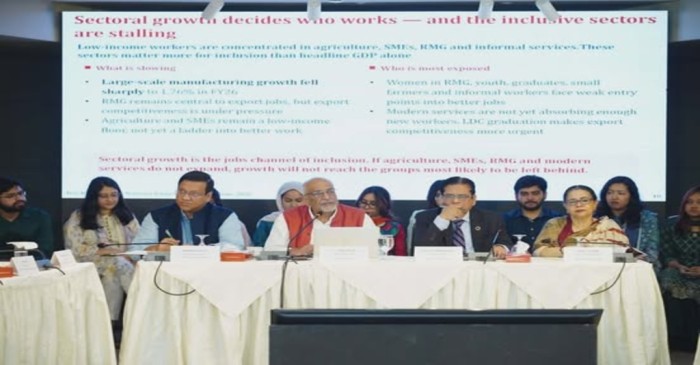

The proposed national budget for the financial year 2026-27 reflected a degree of policy ‘sensitivity’ toward low-income, marginalised and disadvantaged groups, but concerns remain over its weak framework and implementation capacity, said economist Debapriya Bhattacharya on Monday.
Debapriya, also a distinguished fellow at the Centre for Policy Dialogue, said that the budget had been built on a fiscal foundation that was neither robust nor effective, and an advanced policy framework has been placed on an underdeveloped financial structure.
He was presenting the keynote at a media briefing titled ‘National Budget 2026-27: What Is There for the Disadvantaged?’, organised by Citizen’s Platform for SDGs, Bangladesh, at a hotel in Dhaka.
People were currently struggling under a threefold burden of persistently high inflation, declining real wages, and the erosion of savings, he added, questioning the budget’s inflation target of 7.5 per cent, while actual inflation remained close to 10 per cent.
He also alleged that the data used in preparing the budget contained gaps, inconsistencies, and, in some cases, deliberate distortions.
Manipulated data raises serious concerns. The previous government overstated growth, understated inflation, and often failed to assess the impact of development projects properly,’ he added.
If the current government follows the same path, that would be unfortunate, he said.
‘Preparing projections based on flawed assumptions about the economic reality will only deepen the crisis facing ordinary citizens,’ he added.
He also criticised the growing reliance on indirect taxation, saying that increased VAT burdens on products and services ranging from LPG cylinders and restaurant meals to construction materials would disproportionately affect lower-income groups.
He called for greater emphasis on direct taxation, including wealth and inheritance taxes, arguing that reducing income inequality alone would not be sufficient.
The economist also urged caution regarding the government’s plan to borrow approximately $9.5 billion from the International Monetary Fund, the World Bank, and the Asian Development Bank.
He said policymakers must carefully examine whether the performance indicators and conditions attached to those loans adequately protect the interests of marginalised communities.
Referring to the government’s proposed recovery, restoration, and reconstruction strategy, Debapriya said expectations of a full economic recovery within a year were unrealistic and that a two-year timeframe would have been more practical.
‘The budget included several investment-friendly tax and tariff measures; however, their intended benefits might not materialise without broader reforms in the financial sector, energy sector, and public administration,’ he added.
He also said that the real test of the budget would be its ability to contain inflation, generate productive employment, and protect household savings.
‘Without progress in these areas, low-income people are unlikely to experience meaningful improvements in their living standards,’ he added.
He emphasised the importance of assessing both the strengths and weaknesses of the budget through effective implementation and evidence-based monitoring.
He pointed out the necessity of greater institutional accountability, regular progress reviews, and transparent data disclosure.
He also called for periodic reporting on budget implementation and parliamentary oversight to ensure that the budget’s commitments, particularly those aimed at public welfare and vulnerable groups, are translated into tangible outcomes.
He also urged the government to provide special allocations and balanced regional development initiatives for northern districts, the Chattogram Hill Tracts, and coastal regions.
However, he welcomed the continuation of tax exemptions for freelancers and content creators, along with several investment-friendly tax and tariff measures.