
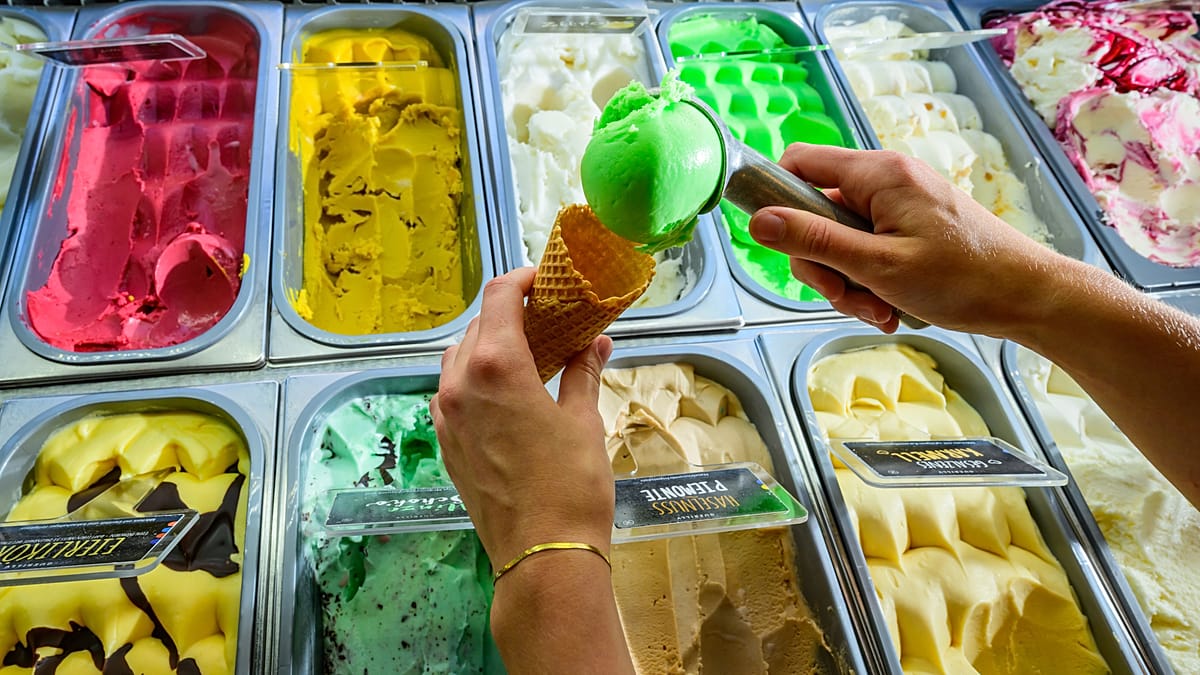
Based on prices reported by Euronews journalists and on recently published surveys, the UK had the highest comparison figure in the sample, while Türkiye had the lowest.

ADVERTISEMENT
ADVERTISEMENT
Across the 10 countries examined, the indicative price of a scoop ranged from around €1.15 to €4.10.
Prices varied considerably depending on location, the type of establishment, portion size and flavour. Currency movements also affect the comparison when prices are converted into euros.
Based on information collected by Euronews journalists and recent market surveys, the highest comparison price was found in the United Kingdom, while the lowest was recorded in Turkey.
The findings are indicative and do not constitute official national price statistics.
Tourist prices can leave a bitter taste
Although the comparison focuses on ordinary shops, some tourist prices are too striking to ignore.
Though the price across much of mainland Greece is around €2.60, on popular tourist islands, the cost per scoop can go up to €4 to €6.
Prices have also risen sharply in Turkish tourist destinations, going up to TL100–120, equivalent to approximately €1.85–€2.20. This is a hefty markup compared to a midpoint of TL62.50 for ordinary shops in Istanbul.
In the UK, Euronews found that the evidence is less directly comparable. Buying individual scoops from an ice cream parlour is less representative of British habits, as most consumers tend to buy soft-serve cones or packaged products from ice cream vans.
A recent survey, commissioned by Aldi and conducted by OnePoll among 2,000 UK parents, found that respondents paid an average of £2.65 — approximately €3.10 — for an ice cream from a van.
How much working time pays for an ice cream?
The cheapest scoop in euro terms does not necessarily place the smallest burden on local consumers.
To estimate how long people must work to pay for one scoop, Euronews Business combined the comparison prices with earnings and working-hour data.
For European Union countries, annual net earnings came from Eurostat. The measure represents the estimated take-home pay of a single person without children earning 100% of the national average wage. Comparable take-home-pay figures for Türkiye and the UK came from the OECD.
Euronews converted annual take-home pay into an estimated per-minute rate using average working-hours data from Eurostat. The corresponding UK figure came from the Office for National Statistics.
The calculation is illustrative: it reflects neither individual tax circumstances nor differences in working patterns, salaries and paid leave. In other words, it is a useful yardstick — not an official statistic or a measurement of anyone’s personal finances.
So, how much of the working day does one scoop swallow up?
In Germany, the answer is around 7.4 minutes of net working time.
That rises to 9.3 minutes in the United Kingdom and 11.4 minutes in Belgium. In Italy, the estimated working time is 13.2 minutes, followed by France at 14.5 minutes.
Türkiye, Poland and Spain are closely grouped at around 15 minutes. The figure rises to 16.6 minutes in Portugal and 20.9 minutes in Greece.
This means that, under the assumptions stated above, a worker in Greece needs to work almost three times as long as a worker in Germany to pay for the comparison-price scoop.
Ice-cream inflation begins to melt
Ice cream has become significantly more expensive in Greece over the past several years.
Glykos told Greek media Ta Nea that prices had risen by around 20% since 2020, largely because of the accumulated effect of higher energy costs. He said energy remained the industry’s principal concern, while oil prices played a smaller role.
However, in a subsequent interview with ERT News Radio 105.8, Glykos said production costs had not increased further in 2026 and that most of the latest increases had occurred in 2025.
Ingredient costs also depend on the flavour. Glykos said good-quality pistachios could cost between €40 and €80 per kilogram, while standard flavours such as vanilla and strawberry had not experienced significant increases. Rents and shop locations also affect the final price.
The latest official inflation figures similarly suggest that price pressures have recently eased, although with substantial differences between countries.
Eurostat’s harmonised index for ice, ice cream and sorbets declined by 0.4% across the EU in the year to June 2026. It fell by 0.2% in the eurozone.
Portugal recorded the sharpest decline, at 8.3%, followed by Sweden at 4.6% and Denmark and Luxembourg at 2.8%. Prices fell by 2.6% in Greece and 2.3% in Belgium.
At the other end of the scale, prices rose by 7.9% in Lithuania, 6.4% in Romania, 3.8% in Slovakia and 2.6% in Austria. Among the countries included in the price comparison, inflation in this category reached 1.2% in Spain, 0.8% in Germany and 0.2% in Poland. The index fell in France, Belgium, Greece and Portugal.
A negative annual inflation rate does not mean ice cream has returned to its pre-2020 price. It means only that the relevant price index was lower in June 2026 than it had been one year earlier.