
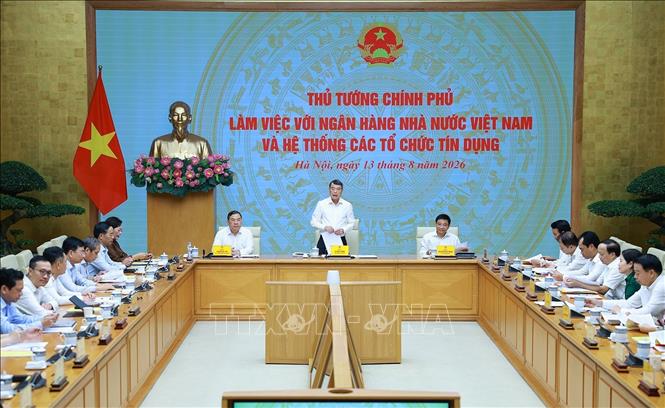
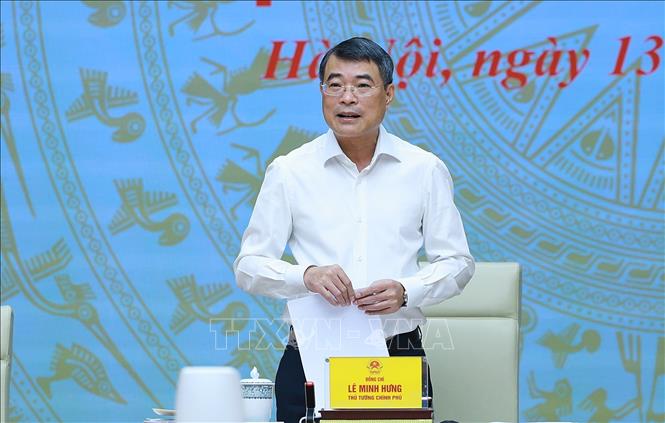
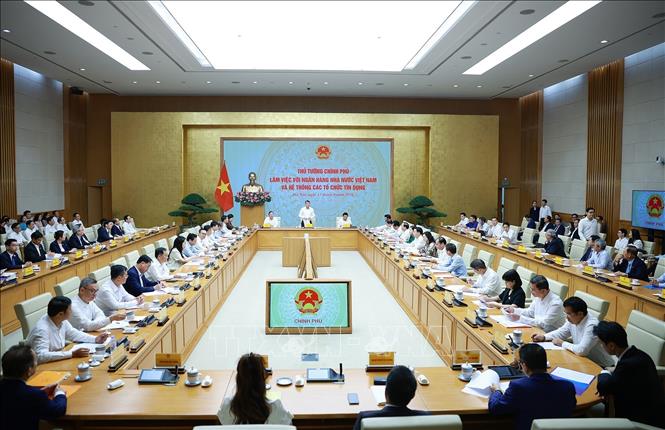
Attending the working session were Politburo member and Standing Deputy Prime Minister Pham Gia Tuc; Central Committee member and Deputy Prime Minister Nguyen Van Thang; Central Committee member and Vice Chairwoman of the National Assembly Nguyen Thi Hong ; Central Committee members, leaders of ministries and central agencies, and representatives from several localities.
The meeting assessed the implementation of monetary policy and the operations of credit institutions during the first seven months of the year; thoroughly analyzed the achievements, shortcomings, limitations, difficulties, and challenges, while also identifying key directions, tasks, and solutions for the coming period.
In his concluding remarks, Prime Minister Le Minh Hung stated that in recent times, the global situation has continued to change rapidly, complexly, and unpredictably, having a very large and rapid impact, both directly and indirectly, on our country’s economy , including exchange rates, interest rates, liquidity, capital mobilization, and credit for the economy. Implementing the resolutions and conclusions of the Party, State, and Government, the State Bank of Vietnam has led, directed, and managed the banking system, contributing to promoting economic growth while maintaining macroeconomic stability, controlling inflation, and ensuring the major balances of the economy.
The State Bank of Vietnam has proactively, flexibly, and promptly managed monetary policy, coordinating relatively closely and synchronously with fiscal policy and other policies to ensure macroeconomic stability; actively reviewing and improving the institutional framework for monetary and banking affairs. The institution has promptly identified and resolved obstacles and inadequacies in mechanisms and policies to support the development of important markets and economic activities; actively supported businesses and individuals in developing production and business, promoting economic growth through various solutions and policies; and achieved positive results in credit growth, focusing on production and business and growth drivers. The institution has effectively played its managerial role, maintaining the stability and safety of the credit institution system, resolutely restructuring the credit institution system in conjunction with handling bad debts, and actively implementing plans to address weak credit institutions. Pioneering in digital transformation and administrative reform, contributing to improving the business environment, actively applying science and technology, and promoting innovation.
On behalf of the Government, the Prime Minister acknowledged and commended the efforts, high determination, and achievements of the banking sector in the past period, which have made a significant contribution to the overall achievements of the country.
Strongly innovate the thinking and methods of monetary policy management.
Besides the achievements, Prime Minister Le Minh Hung spent considerable time analyzing in detail the difficulties, challenges, shortcomings, and limitations related to the proactive, decisive, and creative approach in policy management; ensuring capital for high and sustainable economic growth based on a solid macroeconomic stability; inadequacies in institutions and policies; the effectiveness and efficiency of inspection and supervision; the quality of operations of credit institutions; administrative procedures and business conditions; risks of high-tech crime, online fraud, and financial scams…
Looking ahead, the Prime Minister stated that the Government considers the monetary system, banks, and credit institutions as the lifeblood of the economy, playing a crucial role in macroeconomic stability, inflation control, and promoting rapid and sustainable growth. The first priority of the State Bank of Vietnam is that all mechanisms, policies, and operational activities must aim at consolidating macroeconomic stability, ensuring major economic balances, strengthening resilience, ensuring a safe, sound, transparent, and efficient banking system operating according to market principles; focusing on unlocking and effectively allocating capital to the economy; ensuring convenient access to credit and banking services for people and businesses; and promoting digital transformation, innovation, and improving the governance capacity and competitiveness of credit institutions. The Prime Minister urged the entire banking sector to strongly promote the spirit of “proactive, timely, flexible, creative, safe, efficient, responsible, and decisive,” closely monitoring the situation and strongly innovating in thinking and management methods.
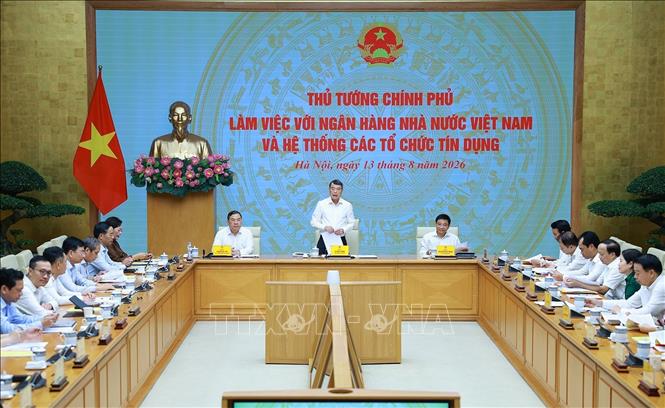
Regarding future tasks and solutions, the Prime Minister requested the State Bank of Vietnam and credit institutions to focus on effectively implementing the Resolution of the 14th National Congress of the Party, the Resolutions, conclusions, and directives of the Central Committee, the Politburo, the Secretariat, the National Assembly, and the Government, especially Conclusion No. 18-NQ/TW dated April 2, 2026 of the Central Committee, the specialized resolutions of the Politburo, and the directives of the Prime Minister. Monetary policy management must ensure the objectives of controlling inflation, maintaining macroeconomic stability, ensuring major economic balances, system safety, and supporting growth, promoting double-digit economic growth based on accurate assessments, forecasts, and data with specific scenarios.
The State Bank of Vietnam needs to quantify and regularly assess the “balance point” between the requirements of controlling inflation, supporting growth, and updating solutions for managing monetary policy tools such as interest rates, exchange rates, money supply, liquidity, and credit with specific scenarios; determine warning thresholds; policy responses must be timely, rapid, and effective; policy proposals must be specific; and management solutions must be flexible, proactive, harmonious, timely, and appropriate; proactively adjust the intensity, dosage, and timing of the use of policy tools under its authority to maximize effectiveness and strive to achieve the set targets. This is a key task, demonstrating the capacity and leadership of the State Bank of Vietnam in 2026 and the 2026-2030 period; the institution needs to strongly innovate its thinking and management methods to be proactive, creative, modern, and decisive. Credit institutions strictly comply with the regulations of the law and the directives of the State Bank of Vietnam.
The Prime Minister requested that interest rate, exchange rate, and credit policies be managed proactively, flexibly, safely, and effectively in accordance with the set objectives. In recent macroeconomic management, the Government has primarily used fiscal policy (reducing and deferring taxes and fees), while also decisively cutting procedures, implementation time, and compliance costs for the economy, people, and businesses, including banks, without putting pressure on the State Bank of Vietnam and the banking system regarding credit and interest rates. The State Bank of Vietnam and the banking system need to act with a high sense of responsibility and more decisively in mobilizing resources for growth on the foundation of macroeconomic stability. In particular, they must share responsibility with the people and businesses through specific measures to stabilize interest rates, reduce lending rates, direct credit to the right sectors, serve growth, and tightly control risks.
The State Bank of Vietnam maintains policy interest rates and strengthens liquidity supply to the market, thereby supporting credit institutions in accessing capital at low costs. The exchange rate management unit operates flexibly, in line with market developments, coordinating synchronously with monetary policy tools and flexibly intervening in the market to stabilize the foreign exchange market; it continues to tightly manage the gold market. Credit institutions continue to reduce costs, stabilize interest rates, and substantially reduce lending rates.
Deliver credit to the right sector, at the right time, and to the right people.
Regarding credit, the State Bank of Vietnam manages credit growth closely aligned with the 2026 target, but does not consider this a “rigid ceiling” at all times. Management must be proactive and flexible according to actual developments, ensuring that capital reaches the right sectors, at the right time, to the right recipients, for the right purposes, and at reasonable costs; focusing credit on production, exports, high technology, supporting industries, agriculture, innovation, social housing, rental housing, essential infrastructure, important national projects, priority sectors, and growth drivers…
Prime Minister Le Minh Hung requested a continued comprehensive review, amendment, and supplementation of regulations and the improvement of institutions related to currency and banking; proactive coordination with ministries, agencies, localities, business associations, and banks to propose mechanisms and policies in areas such as capital market development, corporate bonds, and priority sectors of the economy.
The State Bank of Vietnam is working closely with agencies of the National Assembly to receive feedback, finalize, and submit to the National Assembly for approval the draft Law amending and supplementing a number of articles of the Law on the State Bank of Vietnam, the Law on Anti-Money Laundering, and the Law on Credit Institutions at the August 2026 session; ensuring the issuance of full guiding documents as soon as the Law comes into effect, avoiding any legal vacuum. Credit institutions should proactively report difficulties and actively participate in the process of building and perfecting the legal framework.
The Prime Minister directed the State Bank of Vietnam to focus on finalizing the plan to further modernize the banking system, address weak credit institutions, and enhance access to capital for businesses, especially small and medium-sized enterprises, to be completed by August 2026. The unit is urged to urgently and strongly innovate inspection and supervision methods; strengthen early and remote supervision, early warning systems, and thematic inspections; proactively coordinate with relevant agencies to warn, proactively address, and strictly handle violations in banking operations, ensuring system safety, especially regarding ownership, credit granting, loan management, and compliance with operational safety regulations; and increase charter capital for state-owned commercial banks.
Credit institutions need to focus on improving governance capacity, risk management, internal control, financial capacity, and strictly complying with legal regulations. They should promote the development of science and technology, innovation, and digital transformation; ensure the security, safety, confidentiality, and continuous operation of information technology systems and payment operations. The Prime Minister requested that the State Bank of Vietnam and credit institutions continue to contribute more actively and responsibly to ensuring social security; and innovate communication towards a more professional and effective approach, providing accurate information based on scientific principles.
Prime Minister Le Minh Hung also gave his opinions on the proposals and recommendations at the working session and directed the tasks of ministries, sectors, and localities, including the Ministry of Finance to effectively and on time implement the assigned tasks on the overall reform of Vietnam’s financial market associated with achieving the goal of high and continuous growth until 2045 (approved by the Prime Minister in Decision No. 1413/QD-TTg dated July 27, 2026); and to implement solutions to develop the capital market to supply capital to the economy in the medium and long term.
Relevant parties should effectively implement policies on tax, fee, and land rent exemptions, reductions, and extensions in 2026, as well as VAT refunds to support people and businesses; accelerate the disbursement of public investment; develop financial products and promptly bring the International Financial Center into safe, transparent, efficient, and internationally competitive operation; and research and advise on increasing the mobilization of international capital, including ODA funds, bilateral loans, and the issuance of international bonds with appropriate terms and interest rates, creating additional resources for socio-economic development.
Ministries, relevant agencies, and localities, according to their functions and duties, shall coordinate closely and synchronously with the State Bank of Vietnam, especially in improving institutions; strengthening connectivity and data sharing; preventing, combating, and strictly handling crimes, fraud, and violations in the financial and banking sector, contributing to unlocking resources and ensuring the safe, transparent, stable, and sustainable operation of the financial and monetary markets.
As the lifeblood of the economy, the tasks and requirements placed on the banking sector in 2026 and beyond are extremely challenging but crucial. The Prime Minister stated that the Government leadership believes that with unity, consensus, high determination, and strong innovation in thinking and action, the banking sector will continue to build on its achievements, strive to overcome difficulties and challenges, and work towards excellently fulfilling the tasks and responsibilities entrusted by the Party, the State, and the people.
Source: https://baotintuc.vn/thoi-su/thu-tuong-chinh-phu-le-minh-hung-dieu-hanh-chinh-sach-tien-te-phai-bao-dam-on-dinh-vi-mo-ho-tro-tang-truong-20260813164958597.htm