
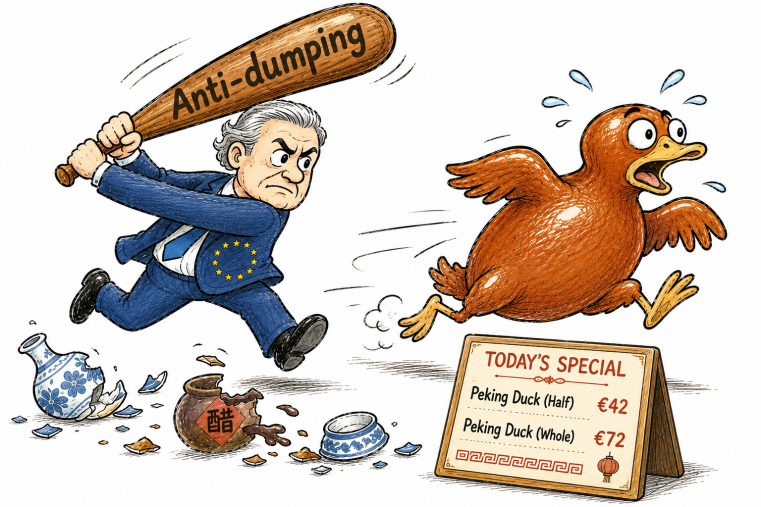
Having graduated from Nanjing University for almost two decades, one of my fondest memories of the city is not about the lecture hall or the library, but the dinner table.
It was there that I first realized how completely we Chinese people can utilize a duck:
A whole duck could become the centerpiece of a banquet;
Legs, wings and heads could each be transformed into separate dishes;
Necks, feet, tongues and livers found their way into shelves of savory snacks;
Even duck blood, an ingredient that surprises many foreigners, became the soul of a comforting bowl of duck blood vermicelli soup.
Beijing follows the same philosophy. A proper Peking Duck is first carved into thin slices and wrapped in pancakes with sweet bean sauce, while the remaining bones still covered with bits of meat become either a rich duck soup simmered with Chinese cabbage or, my personal favorite, crispy pepper-and-salt duck rack.
As the Chinese saying goes, not a single gram of protein or fat on a duck should be wasted. That’s our precious.
Now living in Europe has shown me that things are very different here —— duck meat still makes a good dish, yet duck gizzards seldom appear on the menu. Occasionally, one also finds gésiers de canard, or duck gizzards in English, especially in southwestern France plus some other places, but that’s all and no more.
There are many reasons. Labor costs are considerably higher, making the processing of small organs economically unattractive. Equally important, Europe never developed the same culinary traditions of eating virtually every edible part of the bird, which is why a much smaller proportion of a duck ultimately reaches consumers’ plates.
At first glance, this sounds like nothing more than a cultural difference. But the longer I have lived in Europe, the more I have come to see it as an economics lesson.
Economists have long puzzled over a seemingly impossible question: how can a whole duck sometimes sell for little more, even less, than the cost of raising it in China?
The answer lies in the industrial chain.
Consumers are not all buying the same product from the duck. One family buys duck breast. Someone else buys duck legs. Others purchase duck necks, duck feet or duck tongues as snacks. The feathers become down jackets and quilts. Fat is rendered into cooking oil. Bones become soup.
In a sense, Chinese consumers are collectively crowdfunding the value of a duck. Everyone buys a different piece, allowing producers to extract value from almost every part of the animal while individual consumers still enjoy relatively low prices — a rare example in which both producers and consumers are happy.
That was exactly why the European Commission’s announcement on July 9 to initiate an anti-dumping investigation into imports of Chinese Pekin duck looks somewhat ironic.
The investigation notice says there is sufficient evidence to justify a probe into Chinese exporters’ alleged dumping Pekin duck on the European market.
Yet despite allegations, the publicly available documents do not actually demonstrate that the export prices of Chinese Pekin duck are below the costs of production in China.
China’s duck industry is remarkably transparent. Production statistics, feed costs and industry reports are not difficult to obtain. Apparently, however, the available data did not provide enough support for the complainants’ argument, so the investigation constructs a “normal value” using Brazil as a surrogate country instead.
Which immediately raised another question. Brazil certainly raises Pekin ducks, but its duck industry is tiny compared with China’s — Its annual production is measured in only thousands of tonnes, while China’s annual duck meat production approaches six million tonnes.
The way Brazilians consume duck also resembles Europe much more than China. The nation’s famous duck dish, Pato no Tucupi, features duck meat simmered in fermented cassava broth. Like Europe, duck offal occupies only a very small niche in the market.
Can the production costs of such a small industry, with a completely different consumption structure, really serve as a meaningful benchmark for China’s highly integrated duck industry? It’s Economics 101 that a bigger industry means lower costs.
That question stayed with me, so I called my friend Professor Jian Junbo at Fudan University’s Center for European Studies, who advised me to take a closer look at another piece of the puzzle: Europe’s agricultural policy.
Browsing through the European Commission’s website, we have found that under the Common Agricultural Policy for 2023-27, the European Union plans to spend about 95.5 billion euros in market support and related agricultural measures during the period. A substantial share of that support ultimately benefits animal production directly or indirectly, including livestock farming and animal feed.
Agriculture has always been one of the sectors enjoying the greatest policy support within the European Union.
European agricultural products are, after all, highly respected around the world, including in China, where many consumers willingly pay premium prices for European cheese, wine, olive oil and other specialty foods.
“If European producers still struggle to compete with Chinese products despite such extensive support, perhaps the EU should reflect on its own competitiveness,” Jian told me.
Later that evening, I found myself staring at a plate of duck. Trade disputes often revolve around percentages, methodologies and legal definitions. They generate thousands of pages of technical documentation and countless meetings among lawyers, economists and officials.
But for ordinary people, things are much simpler. All European consumers want is good food at affordable prices — on that point, it is hard to argue they have done anything wrong.