
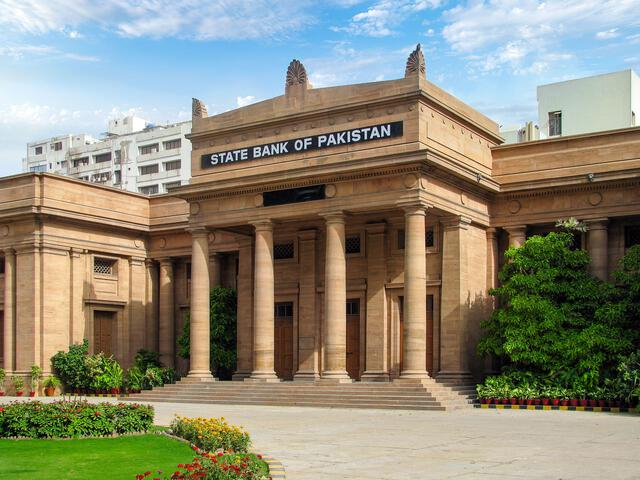
Pakistan’s macroeconomic position has strengthened faster than expected in the current fiscal year, with key indicators improving under a tight monetary and fiscal policy stance, according to State Bank of Pakistan Governor Jameel Ahmad.
He said inflation averaged 5.7 per cent in the first nine months of FY26, while the external current account remained in surplus. Foreign exchange reserves held by the central bank rose to $16.4 billion, supported mainly by purchases from the interbank market.
Governor Ahmad said reserves are projected to rise further to around $18 billion by June 2026, backed by continued central bank activity in the foreign exchange market and expected inflows, including bilateral support arrangements.
Real GDP expanded by 3.8 per cent in the first half of FY26, compared with 1.8 per cent in the same period last year, reflecting what he described as a broad-based and sustainable recovery in economic activity.
He said the improved macroeconomic fundamentals have strengthened Pakistan’s resilience compared to earlier external shocks, including the 2022 Russia–Ukraine conflict. However, he warned that the ongoing Middle East conflict has introduced fresh uncertainty, particularly through higher global energy prices, freight costs and insurance premiums.
The governor said Pakistan is now in a comparatively stronger position to manage external shocks, supported by tighter policy coordination. He noted that monetary policy remains cautiously restrictive, with real interest rates kept significantly positive to anchor inflation expectations.
On the fiscal side, he said the government has maintained primary surpluses while deploying targeted subsidies and demand-management austerity measures in response to external pressures.
Ahmad made these remarks during meetings with global investors and financial institutions, including JP Morgan, Barclays, Citibank, Jefferies and Franklin Templeton, alongside credit rating agencies Fitch, Moody’s and S&P Global. He also held discussions with senior leadership of the IMF and World Bank during the Spring Meetings in Washington held from April 13 to 18.
He said Pakistan’s stabilisation trajectory was already evident before the latest geopolitical disruptions, driven by coordinated monetary and fiscal adjustments that helped stabilise inflation and rebuild external buffers.
He also referred to the staff-level agreement with the IMF covering the third review of the Extended Fund Facility and the second review of the Resilience and Sustainability Facility, describing it as external validation of reform progress. A recent credit rating reaffirmation by a major agency was also cited as supporting evidence of improved macroeconomic stability.
Separately, the governor highlighted strong inflows through the Roshan Digital Account, which have surpassed $12.4 billion across more than 917,000 accounts.
He said recent regulatory enhancements, including the inclusion of non-resident entities, are aimed at expanding participation and further integrating Pakistan into global financial markets while attracting broader foreign investment flows.