
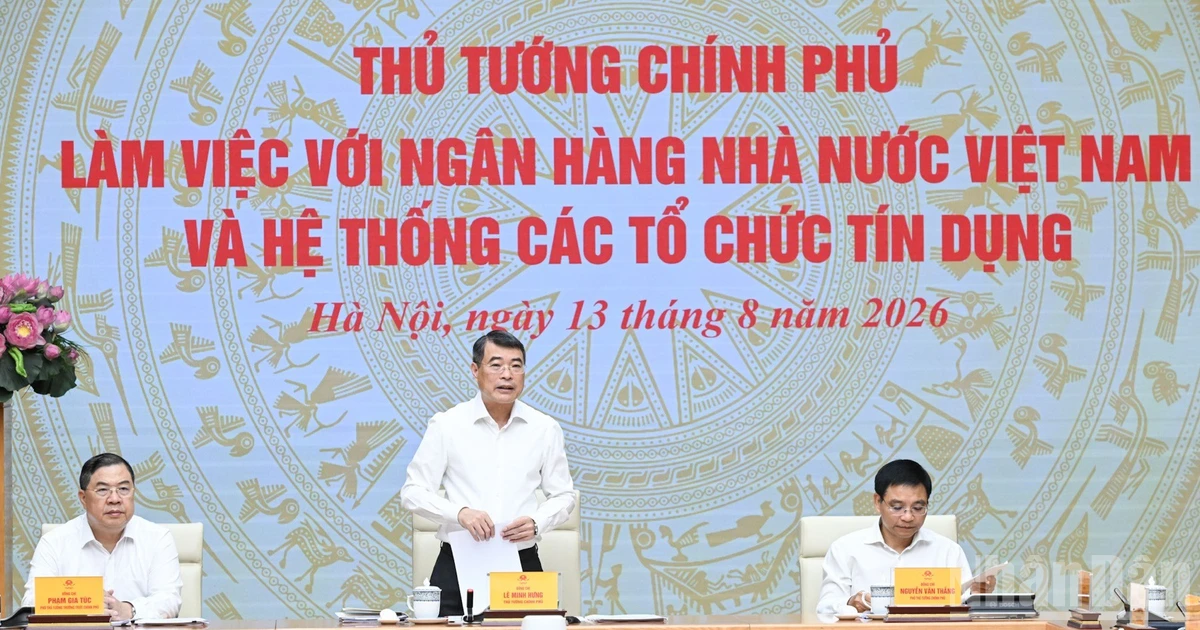
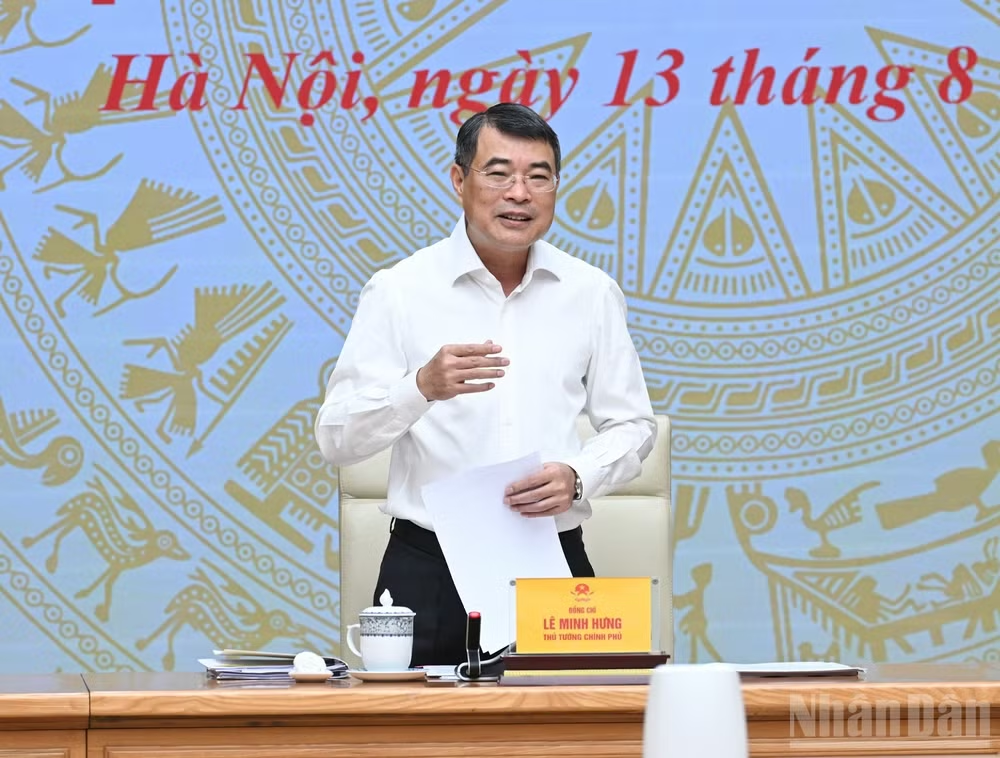
On August 13, 2026, at the Government Headquarters, Prime Minister Le Minh Hung chaired a working session with the State Bank of Vietnam and the system of credit institutions.
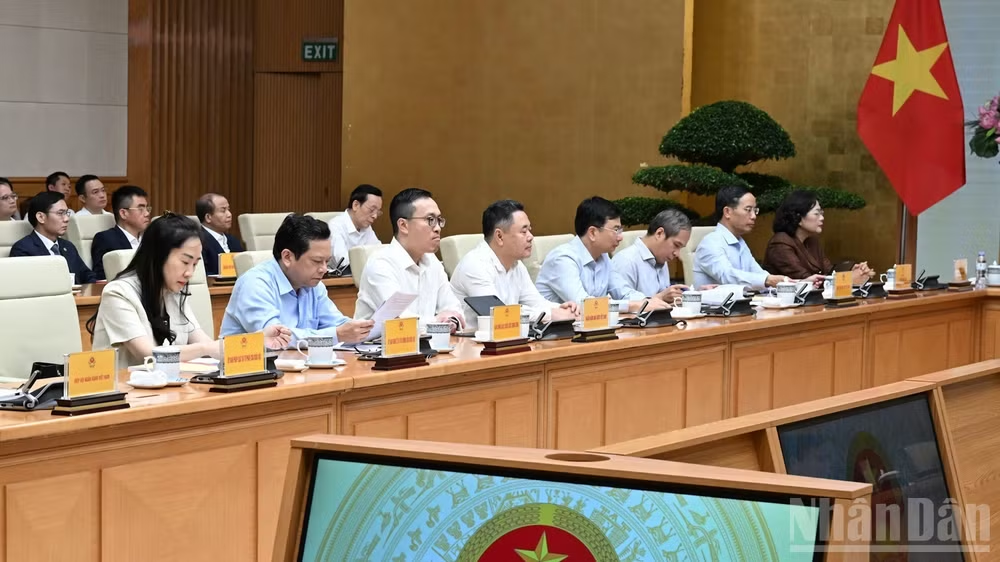
Attending the working session were Deputy Prime Minister Pham Gia Tuc, Deputy Prime Minister Nguyen Van Thang , Vice Chairwoman of the National Assembly Nguyen Thi Hong, Governor of the State Bank of Vietnam, Minister of Justice, Minister of Agriculture and Environment, Minister and Head of the Government Office; Deputy Governors of the State Bank of Vietnam, leaders of ministries and agencies: the Central Policy and Strategy Committee, the National Assembly’s Economic and Financial Committee, the National Assembly’s Law and Justice Committee, the Public Security, Finance, Industry and Trade, Construction, Government Inspectorate, Government Office, People’s Committees of Hanoi, Ho Chi Minh City, and Da Nang; representatives of the Vietnam Banking Association, and the Chairmen and General Directors of 30 credit institutions. After hearing reports from the State Bank of Vietnam and the delegates attending the meeting, the Prime Minister concluded as follows:
1. REGARDING THE RESULTS ACHIEVED
Recently, the global and regional situation has continued to change rapidly, complexly, and unpredictably, significantly impacting our country’s economy , monetary policy management, inflation control, especially regarding exchange rates, interest rates, and liquidity.
Against this backdrop and in response to the aforementioned requirements, and in implementing the resolutions, conclusions, and directives of the Party, State, and Government , the State Bank of Vietnam has led, directed, and managed to achieve a number of important results:
Firstly, effective monetary policy management, in harmonious coordination with fiscal policy and other policies, ensures macroeconomic stability and the value of the Vietnamese Dong. The foreign exchange market operates smoothly, and the legitimate foreign currency needs of the economy are fundamentally met.
Secondly, the State Bank of Vietnam has actively reviewed and improved the institutional framework for monetary and banking affairs; promptly identifying and resolving obstacles and inadequacies in mechanisms and policies to support the development of important markets and economic activities. It has focused on developing and finalizing the draft Law amending and supplementing several articles of the Law on the State Bank of Vietnam, the Law on Anti-Money Laundering, and the Law on Credit Institutions; while simultaneously continuing to improve the system of implementing guidelines. The quality of policy-making has been gradually improved, focusing on practical application, consistency, feasibility, and increased transparency. Policy communication has been emphasized, contributing to consensus and building trust among the people and businesses.

Thirdly , actively support businesses and people in developing production and business, and promote economic growth through various specific solutions and policies: (i) Achieving positive credit growth, focusing on production and business and growth drivers; (ii) Reducing costs, striving to maintain stability and reduce lending interest rates, simplifying and making processes transparent to increase access to capital for businesses and people; (iii) Effectively implementing priority credit programs; (iv) Strengthening credit guarantee measures for important sectors.
Fourth, effectively promote the role of management and maintain the stability and safety of the credit institution system: (i) Manage credit growth in both scale and quality, and capital utilization efficiency; (ii) resolutely restructure the credit institution system associated with handling bad debts; actively implement plans to handle weak credit institutions and restructure commercial banks under special control; (iii) steadfastly implement the requirement to ensure system safety, minimize chain reactions, and prevent uncontrolled collapses; (iv) gradually improve the business results, financial capacity, and governance quality of the credit institution system; (v) ensure the legitimate rights of depositors.
Fifthly, the State Bank of Vietnam has been a pioneer in digital transformation and administrative reform, contributing to improving the business environment. It has actively applied science and technology, innovation, and digital transformation to core banking products and services; promoted cashless payments, public service payments, and digitized many processes, products, and services. For many years, the State Bank of Vietnam has consistently ranked among the top ministries and agencies in the Public Administration Reform Index (PAR Index). Payment infrastructure and banking data have developed rapidly; the connection and verification of customer information and the exploitation of population data have been expanded; and the ability to prevent and combat fraud has been enhanced.
Overall, the Vietnamese banking sector has experienced strong growth in recent years in terms of scale, quality, financial capacity, management capabilities, and the modernization of its products and services.
On behalf of the Government, the Prime Minister acknowledged, commended, and highly appreciated the efforts, endeavors, and achievements of the State Bank of Vietnam and the entire banking sector in the past period; the results achieved are very important, making practical contributions to the overall results of the country, especially the socio-economic development results in the first seven months of 2016.
2. DIFFICULTIES, CHALLENGES, EXISTING PROBLEMS, LIMITATIONS
2.1. The global situation continues to be complex, unpredictable, and difficult to forecast; the need to innovate the growth model, the goal of macroeconomic stability, and double-digit growth are enormous challenges, requiring the planning and management of monetary policy and domestic banking operations to continue to accurately and realistically assess developments and causes in a timely manner, and especially to have strong and innovative solutions within their authority.
2.2. Innovation in thinking and management methods, and increased proactiveness, decisiveness, and creativity in governance remain limited. Forecasting, planning, and policy responses are sometimes not proactive enough and do not keep pace with the actual situation. Coordination between monetary, fiscal, and other macroeconomic policies is sometimes not timely or harmonious. A segment of small and medium-sized enterprises, startups, and household businesses still face difficulties accessing capital due to limitations in financial capacity, collateral, creditworthiness, and business plans.
2.3. The effectiveness and efficiency of banking inspection and supervision have not fully met the requirements of state management in the context of increasingly diverse and complex banking activities, a growing economy, and the emergence of many new financial products; at times, risks and violations have not been assessed, identified, and handled in a timely manner.
2.4 . The operational quality and legal compliance awareness of credit institutions remain limited; cross-ownership and signs of insecurity at some credit institutions have not been thoroughly addressed; risks from real estate, corporate bonds, and asset quality need to continue to be closely monitored and controlled.
2.5. The legal framework for monetary and banking matters needs further improvement. Administrative procedures and business conditions in the banking sector need to be drastically reduced and simplified. Risks from high-tech crime, online fraud, and financial scams are becoming increasingly sophisticated.
3. ORIENTATION AND PERSPECTIVE
3.1 . The monetary system, banking system, and credit institutions are the lifeblood of the economy, playing a crucial role in macroeconomic stability, inflation control, and promoting rapid and sustainable growth. The Government requires the State Bank of Vietnam to clearly define its top priority: all mechanisms, policies, and operational solutions must be geared towards consolidating macroeconomic stability, ensuring major economic balances, strengthening resilience, ensuring a safe, sound, transparent, and efficient banking system operating according to market principles, and effectively channeling and allocating capital to the economy to meet the set target of sustainable double-digit growth; ensuring convenient access to credit and banking services for citizens and businesses; and simultaneously promoting digital transformation, science and technology, innovation, and enhancing the governance capacity and competitiveness of credit institutions.
3.2 . During the period 2026-2030, the requirements for the banking sector are not only to develop in scale but also to be safer, more efficient, and more modern. Scale must go hand in hand with quality; credit growth must go hand in hand with risk control; digital transformation must go hand in hand with data security; and international integration must go hand in hand with governance capacity according to international standards. In particular, monetary policy management must ensure the objectives of controlling inflation and supporting growth.
3.3. The State Bank of Vietnam and the banking system need to act with a high sense of responsibility and more decisively in mobilizing resources for growth on the foundation of macroeconomic stability. In particular, they must share responsibility with the people and businesses through specific measures to stabilize interest rates, reduce lending rates, direct credit to the right sectors, serve growth, and tightly control risks.
3.4. The entire banking sector will strongly promote the spirit of “proactiveness, timeliness, flexibility, creativity, safety, efficiency, responsibility, and decisiveness”.
4. KEY TASKS AND SOLUTIONS FOR THE COMING PERIOD:
In the coming period, the State Bank of Vietnam, ministries, agencies, and credit institutions will focus on decisively implementing the following groups of tasks:
4.1. The State Bank of Vietnam shall preside over and coordinate with relevant ministries, agencies, and localities:
a) Focus on thoroughly understanding and effectively implementing the Resolution of the 14th National Congress of the Party, the resolutions and strategic conclusions of the Politburo, the Secretariat, the National Assembly, the Government, and the directives of the Prime Minister, especially Conclusion No. 18-KL/TW dated April 2, 2026 of the Central Committee, and the specialized resolutions of the Politburo; concretize scenarios and solutions for management.
b) The monetary policy must be steadfastly managed with the goal of controlling inflation, maintaining macroeconomic stability, ensuring major economic balances, system safety, and supporting and promoting double-digit economic growth based on accurate assessments, forecasts, and data, with specific scenarios and policy tools; coordinating harmoniously, closely, and regularly with fiscal policy and other macroeconomic policies to mobilize and meet the resources needed for development; forecasting, planning, and policy responses must be quick, effective, and closely aligned with international, regional, and domestic situations. The State Bank of Vietnam needs to closely monitor the situation, strongly innovate its thinking and methods of management, and be proactive, creative, modern, and decisive.
– Quantify and regularly assess the “balance point” between the need to control inflation and support growth, thereby updating operational solutions with monetary policy tools: interest rates, exchange rates, money supply, liquidity, and credit, linked to specific scenarios; determine warning thresholds; proactively adjust the intensity, dosage, and timing of the use of policy tools within authority to maximize effectiveness and strive to achieve the set targets.
– Regarding interest rates: Continue to maintain and proactively and flexibly regulate appropriate policy interest rates and strengthen liquidity supply to the market, supporting credit institutions in accessing capital at reasonable costs. Instruct credit institutions to continue reducing costs, stabilizing interest rates, and lowering lending rates; take appropriate and legally compliant measures against credit institutions that do not comply with the directives of the State Bank of Vietnam.
– Regarding exchange rates: Manage exchange rates according to market developments, closely monitor the supply and demand of foreign currency in the economy at each point in time to have proactive and flexible plans and scenarios to manage market stability; research regulations and mechanisms for providing products and services to prevent exchange rate fluctuations to support the development of the capital market and the stock market.
– Regarding credit: Credit growth management should adhere closely to targets, but not consider this a “rigid ceiling” at all times; management must be flexible according to actual developments, ensuring that capital reaches the right sector, at the right time, to the right target, for the right purpose, and at a reasonable cost, especially in manufacturing, exports, high technology, supporting industries, agriculture, innovation, social housing, rental housing, essential infrastructure, BT projects, priority sectors, and growth drivers; increase access to capital for businesses, especially small and medium-sized enterprises, business households, and collective economic entities; while strictly controlling sectors with potential risks.
– Closely coordinate with the Ministry of Finance and relevant agencies to flexibly manage State Treasury deposits at the State Bank of Vietnam and commercial banks at specific times to increase liquidity for the economy and to publicly and transparently define criteria and standards.
c) Continue to improve the legal framework for monetary and banking matters; proactively coordinate with ministries, agencies, localities, business associations, and banks to conduct a comprehensive review of the system of legal documents in the monetary and banking sector to promptly amend and supplement them. Expeditiously incorporate feedback from National Assembly agencies and National Assembly deputies to finalize the draft Law amending and supplementing several articles of the Law on the State Bank of Vietnam, the Law on Anti-Money Laundering, and the Law on Credit Institutions for submission to the National Assembly for consideration and approval.
Study the opinions and recommendations of credit institutions at the working session to review and amend the Circulars of the State Bank of Vietnam, including Circular No. 21/2025/TT-NHNN dated July 31, 2025, Circular No. 22/2019/TT-NHNN dated November 15, 2019, and other related Circulars.
The Vietnam Banking Association and credit institutions are requested to proactively conduct thorough research and actively participate in providing full and responsible feedback on important draft laws directly related to the banking sector, such as the Land Law, the Housing Law, and the Real Estate Business Law, which are currently being considered and commented on by the National Assembly.
d) Urgently finalize the Project on further modernizing the banking system, addressing weak credit institutions, and enhancing access to capital for businesses, especially small and medium-sized enterprises, to be completed by August 2026. This should include research and proposals to improve the legal framework regarding the models of commercial banks and investment banks.
Strengthen supervision and control of weak credit institutions under special supervision, decisively handle weak banks; coordinate with the Ministry of Justice, the Ministry of Public Security, the Supreme People’s Court, and the Supreme People’s Procuratorate to expedite the implementation of the plan to handle collateral assets of SCB Bank.
Enhance the effectiveness and efficiency of inspection, examination, and supervision of credit institutions’ operations and anti-money laundering efforts; strengthen early warning systems and proactive, remote monitoring before consequences arise. Actively coordinate with relevant agencies to assess, identify, and warn about violations in banking operations, and develop plans to address and strictly handle violations, ensuring system safety, especially regarding ownership, credit granting, loan management, and compliance with operational safety regulations, preventing the accumulation of major violations that could have widespread impacts and affect system safety.
Directing credit institutions to focus on improving governance capacity, risk management, internal control, financial capacity, and strict adherence to legal regulations, discipline, and order in banking operations; complying with safety limits, credit quality, internal control, and transactions with shareholders and related parties. Studying a roadmap for increasing charter capital for state-owned commercial banks.
d) Strengthen the application of science and technology, innovation, and digital transformation to enhance the governance capacity and competitiveness of credit institutions, strengthen security and safety in payment and banking operations; and protect customer rights in accordance with regulations. Implement decisively and effectively the tasks of digital transformation in accordance with the Party’s guidelines, the Government’s regulations, the Digital Transformation Strategy, and the Banking Industry Data Strategy until 2030.
e) Strengthen policy communication and international cooperation in the monetary and banking sector. Innovate communication methods towards professionalism and efficiency to enhance transparency, timeliness, accuracy, and scientific rigor in providing information on monetary policy and banking operations, effectively addressing issues of public concern to consolidate the confidence of the people, businesses, and the market in the Government’s major policies and guidelines, and the operational capacity of the State Bank of Vietnam.
Actively coordinate with associations and commercial banks to send strong messages and communicate information to society, businesses, and the public about the determination to stabilize interest rates and reduce costs in order to lower lending rates.
g) Continue to promote the pioneering role and positive contributions of the banking sector to social welfare policies, overcoming the consequences of natural disasters, storms and floods, supporting people in developing production and business, creating livelihoods, jobs and income; actively participate in movements launched by Party committees, government agencies, the Vietnam Fatherland Front, and localities.
h) Research and develop a mechanism for evaluating the quality and effectiveness of advisory work by units under the State Bank of Vietnam based on specific results and products, linked to the responsibilities of collectives and individuals.
4.2. The Ministry of Finance shall preside over and coordinate with the State Bank of Vietnam and relevant agencies:
a) Focus on effectively implementing solutions for developing the capital market, securities market, and corporate bond market. Effectively and promptly implement the tasks and solutions assigned in Decision No. 1413/QD-TTg dated July 27, 2026, approving the overall reform plan for Vietnam’s financial market, linked to achieving high and continuous growth targets until 2045, in order to unlock medium and long-term capital and reduce dependence on credit from the banking system.
b) Strengthen close coordination and promptly revise the Regulations on Coordination of Work and Information Exchange between the Ministry of Finance and the State Bank of Vietnam in managing macroeconomic policies. Coordinate closely with the State Bank of Vietnam to provide data on budget revenue and expenditure, government bond mobilization plans, and State Treasury capital utilization plans so that the State Bank of Vietnam has a basis for regulating liquidity and managing interest rates in the market.
c) Continue to effectively implement policies on tax, fee, and land rent exemptions, reductions, and extensions in 2026, and VAT refunds to support people and businesses; simplify tax and customs procedures; strengthen supervision, urging, and accelerating the disbursement of public investment capital, ensuring 100% completion of the 2026 budget.
d) Study the possibilities of mobilizing other sources of capital alongside capital mobilization from credit institutions to ensure sufficient resources for socio-economic development goals.
d) Continue to improve the mechanisms and policies for the operation of the International Financial Center, especially regulations on financial products and instruments, management, inspection, supervision, and risk management mechanisms, in accordance with the directives of the Prime Minister.
e) Coordinate with ministries, agencies, and localities to urgently finalize plans to further promote the restructuring, equitization, and divestment of state-owned enterprises, linked with listing on the stock exchange, in order to increase the supply of goods on the stock market.
4.3. Ministries, agencies, localities, and associations according to their assigned functions and tasks:
a) Closely coordinate with the State Bank of Vietnam, especially in improving institutions; strengthen connectivity and data sharing; prevent, combat, and strictly handle crimes, fraud, and violations in the financial and banking sector, contributing to unlocking resources and ensuring the safe, transparent, stable, and sustainable operation of the financial and monetary markets.
b) Urgently finalize the plan to accelerate the restructuring, equitization, and divestment of state-owned enterprises, ensuring efficiency and preventing losses and waste, in accordance with the assigned tasks in Conclusion No. 18-KL/TW dated April 2, 2026, of the Central Committee, and the directives of the Government leaders in Official Dispatch No. 52/CĐ-TTg dated August 7, 2026.
c) Proactively report obstacles and actively propose mechanisms and policies during the process of building and perfecting the legal framework for banking and capital market operations.
4.4. Regarding the recommendations of the State Bank of Vietnam
a) Regarding the continued improvement of the legal system and information system on housing and the real estate market: The Ministry of Construction shall preside over and coordinate with relevant agencies to (i) closely coordinate with agencies of the National Assembly to continue improving the draft Law on Housing and the Law on Real Estate Business to submit to the National Assembly for comments at the August 2026 session and for approval at the October 2026 session; (ii) preside over and coordinate with ministries, agencies, and localities to focus on improving the information system and database on housing and the real estate market in a comprehensive, synchronized, interconnected, and timely updated manner; improve the quality of monitoring, analysis, and forecasting of supply and demand, prices, and market developments, serving management, operation, and policy planning.
b) Regarding recommendations for anti-money laundering efforts: Ministries and agencies should focus on implementing the tasks assigned in Decision No. 707/QD-TTg dated April 22, 2026, of the Prime Minister, ensuring quality, effectiveness, and timeliness to prepare well for the third multilateral assessment in 2028 by the Asia/Pacific Group on Money Laundering (APG) of Vietnam.
Source: https://nhandan.vn/cung-co-on-dinh-vi-mo-bao-dam-cac-can-doi-lon-cua-nen-kinh-te-post982143.html