
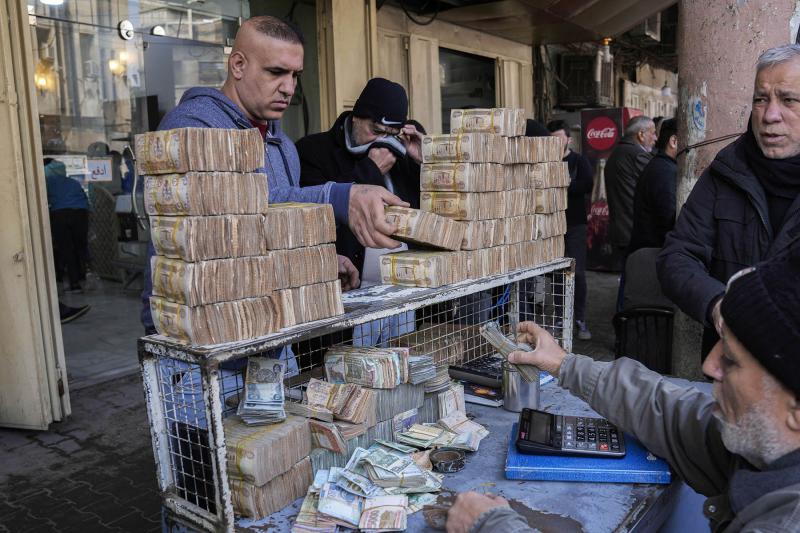
Step inside any high-end café in Cairo, a bustling merchant hub in Amman, or a trendy restaurant in Beirut, and you will witness an identical macroeconomic performance. Patrons may use a mix of cash and electronic payment methods, but cash remains king. Thick, rubber-banded bricks of banknotes, often a mix of volatile local currencies and crisp US dollars. A few blocks away, the imposing glass-and-steel headquarters of the nations’ central banks sit quiet, their foreign reserves depleted and their policy levers rendered entirely useless.
The banks still stand. The money simply found another way to move.
This is the real economy of the modern Middle East’s financially distressed periphery. While international financial institutions track official GDP figures and debate the macro-metrics of sovereign debt, a far more dynamic, unregulated financial architecture has emerged to take its place.
Wracked by the spillover of regional conflict, supply-chain blockades, and institutional decay, the “insolvent periphery” of the Middle East has entered a state of monetary balkanisation. From the Nile to the Euphrates, the formal state financial apparatus is dying. In its place stands a highly efficient, parallel cash-and-carry ecosystem that keeps populations alive today, but dooms them to structural stagnation tomorrow.
The most significant shift is not merely financial but institutional. In healthy economies, trust is concentrated within banks, regulators, and legal frameworks. Across much of the region, that trust has increasingly migrated away from institutions and toward networks. Families trust relatives abroad more than local banks. Merchants trust exchange dealers more than official channels. Businesses rely on personal relationships and informal guarantees rather than contractual certainty. In many cases, reputation has become a more valuable form of collateral than regulation itself.
Nowhere is this transition more striking than in Syria. Following the sweeping political transition that ended decades of the Assad family rule in December 2024, Syria’s legal and economic landscape changed overnight. The United States officially repealed the Caesar Act, the European Union restored its cooperation agreements, and the transitional government explicitly declared a free, competitive market economy. Yet, de jure legal freedom has collided head-on with de facto banking caution.
Despite the lifting of sanctions, major international banks remain reluctant to fully reconnect Syria to the global financial system despite the removal of formal restrictions. Because global banking infrastructure moves at a bureaucratic crawl, Syrian merchants cannot wait.
The Syrian case illustrates a broader reality often overlooked by policymakers. Sanctions can be lifted through political decisions, but financial confidence cannot be restored overnight. Compliance departments inside major international banks continue to assess risk through the lens of years of enforcement actions, penalties, and regulatory scrutiny. Legal permission and practical access are therefore not always the same thing.
To clear trade and fund early reconstruction, the country has simply legalised and scaled up the shadow plumbing it perfected during a decade of isolation. The hawala system, a trust-based, ledger-to-ledger informal cash network, has transformed from an underground evasion tool into the state’s primary financial engine. Millions of dollars in foreign remittances and trade settlements flow through these networks daily, bypassing formal commercial banks entirely.
Furthermore, the deregulation of the Syrian Pound has triggered immense price volatility. With the central bank lacking the institutional depth to manage a free float, hawala dealers have essentially become the country’s real monetary authority, setting the de facto exchange rate on smartphone messaging apps. Paradoxically, as an open Syria aggressively rebuilds its direct regional trade routes, it is beginning to act as a vacuum cleaner for liquid capital, draining economic utility away from neighbouring Lebanon, which for decades served as Syria’s financial lung during years of sanctions and international isolation. Syrian businesses long relied on Lebanese banks and commercial networks to access the global economy. As those links are re-established directly, some of that economic activity is beginning to flow back into Syria.
If the Levant represents a region that has given up on formal banking, Egypt and Jordan represent the rigid anchors desperately trying to play by the global rules. Both nations are walking a fiscal tightrope, heavily managed by International Monetary Fund (IMF) programmes, strict regulatory metrics, and structural reform benchmarks. Yet, their populations are paying a catastrophic price for this compliance.
Nowhere is the friction more visible than in Cairo. Prolonged maritime disruptions in the Red Sea have cost the Egyptian treasury over $10 billion in vital Suez Canal transit fees. For an economy reliant on hard currency to service massive external debt and fund basic commodity imports, this loss is devastating.
To hit its strict IMF targets, the government has aggressively pushed austerity, privatisation, and tax collection. But this formal tightening has starved the domestic banking sector of the liquidity needed to clear import backlogs at local ports.
The result is a bitter divergence: on paper, Egypt meets its macroeconomic benchmarks; on the street, domestic manufacturing stalls due to raw material shortages, and a massive parallel gray market for foreign currency thrives in the shadows. The state’s strict compliance acts as a regressive tax on everyday citizens, pushing more of the population into informal day-labor and un-taxed shadow commerce just to survive the inflationary squeeze.
In the rest of North Africa, the informal economy accounts for up to 40% of the GDP. The cash networks encompass both foreign and local currency transactions. Cash finances cross-border trade between Libya, Tunisia and Algeria making up for rigid inter-state regulations, obsolete banking institutions and the failure to deliver on promises of Maghreb free-trade areas.
Jordan faces a parallel crisis as an institutional darling under siege. As formal regional trade arteries fracture, Amman maintains a highly regulated, transparent banking sector. However, the sheer economic pressure on its borders has sparked a massive surge in informal cross-border smuggling and unregulated gray-market trade. The Jordanian state is caught in an impossible bind: it must enforce rigid formal financial compliance to please international lenders, while turning a blind eye to the border-town shadow economies that keep its fragile social fabric from tearing apart.
Few countries better illustrate the rise of the cash-and-carry economy than Lebanon and Iraq. Though one suffers from financial collapse and the other enjoys vast oil revenues, both reveal how quickly money migrates into parallel channels when formal institutions cease to perform their intended function.
In Lebanon, the gray market has moved beyond a temporary coping mechanism and become fully institutionalised as the status quo. Following the absolute collapse of its formal commercial banking sector, the Lebanese economy reconstructed itself entirely around physical greenbacks. The country is a hyper-dollarised cash haven where trillions of Lebanese pounds and millions of US dollars circulate entirely outside the banking system.
This creates a bizarre financial illusion: while the state is completely bankrupt, the streets are liquid. High-end retail, real estate, and daily commerce thrive on a cash-only basis. But this reliance on physical currency leaves the nation profoundly exposed to global trade shocks. Without a functioning banking system to issue letters of credit or manage trade financing, local businesses face an immediate, punitive “cash tax” on every container of grain, fuel, or consumer goods imported through Levant ports, driving localized inflation to painful heights.
The Lebanese experience demonstrates the difference between liquidity and development. Cash remains abundant in parts of the economy. Restaurants are full, retailers continue trading, and property transactions still occur. Yet liquidity alone cannot finance a modern economy. A nation can circulate millions of dollars in physical cash every day and still remain incapable of funding major infrastructure projects, industrial expansion, or technological modernisation. Cash keeps commerce alive. It does not necessarily create long-term growth.
While Lebanon, Syria, Jordan and Egypt suffer from structural hard-currency shortages, Iraq demonstrates that even a major oil producer is not immune to gray-marketisation when financial institutions fail.
In Iraq, a different version of this cash trap is playing out. Unlike Lebanon, Baghdad generates billions of dollars in formal, audited oil revenues. However, the domestic economy remains profoundly cash-dependent and institutionally fragile. As US authorities and the Federal Reserve imposed tighter scrutiny on Iraqi banks, restricted access to dollar-clearing mechanisms, increased oversight of outward transfers, and tightened controls on the movement of physical US currency into the country, the formal financial system came under mounting pressure.
While the measures were designed to bring greater transparency and compliance to Iraq’s financial system, they also had the unintended consequence of strengthening parallel financial channels.
Vast sums of physical currency now move through exchange houses and informal financial channels, detaching the street price of the dollar from the official government peg. Rather than pulling economic activity into transparent channels, the measures reinforced the role of informal networks that continue to operate beyond the effective reach of regulators.
Exchange houses, informal transfer networks, and cash-based markets became even more central to economic activity, underscoring the resilience of Iraq’s gray-market ecosystem. Vast sums of physical currency now move through exchange houses and informal financial channels, detaching the street price of the dollar from the official government peg. Rather than pulling economic activity into transparent channels, the measures reinforced the role of informal networks that continue to operate beyond the effective reach of regulators.
Iraq proves that even immense oil wealth cannot insulate a state from gray-marketisation if its internal financial infrastructure remains broken and corrupt.
Yet the most striking consequence may be the illusion it creates.
The result is a paradox familiar to both Iraq and Lebanon. In each country, visible consumption often obscures institutional weakness. Luxury vehicles crowd the roads, premium real estate changes hands, high-end restaurants remain busy, and imported goods continue to flow to those with access to dollars. To the casual observer, parts of the economy can appear remarkably resilient.
Yet consumption is not development. Cash can finance a luxury apartment, an imported vehicle, or an expensive dinner, but it cannot easily finance a national electricity grid, modern transport infrastructure, large-scale industrial expansion, or the technological foundations required for long-term growth. Both countries demonstrate how liquidity can coexist with profound structural weakness, creating the illusion of prosperity while the underlying institutions necessary for sustainable development continue to erode.
Yet the survival of these economies raises a fundamental question. If banks are frozen, sanctions remain disruptive, currencies are unstable, and formal financial systems are under strain, how does capital continue to move across the region?
The answer lies in a vast and increasingly sophisticated network of intermediaries that has emerged to fill the vacuum left by weakened institutions. Exchange dealers, hawala operators, traders, brokers, logistics companies, money changers, and regional commercial hubs now perform many of the functions once associated with the formal banking sector. Together, they have created an alternative financial architecture that stretches across the Middle East and beyond.
As formal banking channels weaken, capital does not stop moving. It simply finds new routes. Across the Middle East’s distressed economies, money increasingly travels through a patchwork of exchange houses, hawala networks, trade intermediaries, cash couriers, and regional commercial hubs rather than through traditional banking institutions.
The routes of capital increasingly stretch far beyond the Levant itself, linking Dubai, Istanbul, Africa, Asia, and other commercial hubs into a flexible ecosystem capable of moving goods, money, and value where formal institutions often cannot or will not.
Cities such as Dubai and Istanbul have become important nodes in this evolving financial geography. For merchants in Damascus, traders in Baghdad, or businesses in Beirut, these hubs often provide the connectivity that local financial systems can no longer reliably deliver. Goods may be purchased in one jurisdiction, financed in another, settled through a third, and physically delivered to a fourth. Capital moves through relationships as much as institutions.
The remarkable efficiency of these networks helps explain their resilience. Money can often move faster through exchange dealers, commercial intermediaries, and personal networks than through heavily regulated institutions burdened by compliance requirements, political risk, and bureaucratic delays. Yet the same flexibility that makes these systems attractive also makes them difficult to supervise, regulate, and tax.
The result is the emergence of a parallel financial map of the Middle East, one in which the movement of capital increasingly follows informal routes rather than formal institutions. As these networks expand, states lose visibility into the very economic activity occurring within their own borders, setting the stage for the transparency and governance challenges that follow.
The consequences extend far beyond economic stagnation. As larger portions of commercial activity migrate into cash-based and informal channels, transparency begins to disappear. Transactions leave few records, oversight weakens, and the movement of capital becomes increasingly difficult to trace. In such an environment, corruption ceases to be an exception and becomes a feature of the system itself.
Public funds can be diverted with limited scrutiny, tax collection deteriorates, smuggling networks expand, and politically connected actors gain disproportionate influence over the flow of money. The same shadow infrastructure that helps businesses survive institutional failure can also shield theft, patronage, and illicit enrichment from public view. Over time, opacity becomes an asset, and those who benefit from it acquire a vested interest in preventing reform.
Nor are the beneficiaries of opacity limited to criminal networks or corrupt officials. As informal financial systems expand, a growing number of otherwise legitimate businesses also begin to benefit from operating outside formal channels. Cash transactions can reduce tax exposure, bypass cumbersome regulations, avoid compliance requirements, and accelerate commercial activity that might otherwise be delayed by bureaucracy. Criminal organisations, smugglers, sanctions evaders, politically connected intermediaries, and opportunistic businesses therefore find themselves sharing a common interest: preserving a system with fewer questions, fewer records, and fewer controls.
All across MENA, security risks are huge. Cash can underpin the fraying of the state and finance the activities of extremist groups and regional proxies beyond the reach of authorities.
What begins as a survival mechanism for households and merchants can gradually evolve into an ecosystem in which powerful economic actors profit from opacity and have little incentive to support transparency or reform.
As informal systems expand, governments lose more than tax revenue. They lose visibility, influence, and ultimately control. Monetary policy becomes less effective when transactions occur outside the banking sector. Regulatory decisions carry less weight when businesses rely on parallel channels. Over time, states become increasingly disconnected from the real movement of capital within their own borders, creating a widening gap between official economic policy and economic reality.
The beneficiaries are not merely institutions but individuals. As formal financial systems retreat, a new class of intermediaries emerges to fill the vacuum. Exchange dealers, cash brokers, informal financiers, and politically connected facilitators acquire influence once reserved for banks and regulated financial institutions. In many cases, these actors become indispensable to commerce, accumulating both wealth and leverage from the dysfunction around them. The longer the system persists, the stronger their position becomes and the greater their interest in preserving the status quo.
Perhaps the most lasting consequence is cultural rather than financial. Entire generations are learning to navigate economic life through personal networks, cash transactions, and informal arrangements rather than through institutions. As these habits become entrenched, rebuilding trust becomes far more difficult. The challenge is no longer merely repairing banks or modernising regulations; it is persuading citizens that formal systems are once again worth using. Over time, informality ceases to be an emergency response and becomes the accepted operating system of the economy.
This dynamic is particularly dangerous because it is self-reinforcing. The weaker formal institutions become, the more economic activity migrates into informal channels. The larger those channels become, the harder it becomes for governments to restore accountability, transparency, and public trust. What begins as a survival mechanism gradually evolves into a parallel system with its own incentives, beneficiaries, and political protection.
The ultimate tragedy of the Middle East’s cash-and-carry transformation is that it works too well in the short term. The hawala networks of Damascus, the cash suitcases of Beirut, and the parallel exchange booths of Cairo and Baghdad provide a vital safety valve. They bypass broken institutions, outrun slow global bureaucracies, and ensure that food, fuel, and capital continue to move across borders when formal systems fail. The shadow economy is saving the periphery from immediate, catastrophic starvation.
But this survival mechanism doubles as an economic death sentence for long-term development. The gray market is inherently incapable of generating capital-intensive, structural growth.
No international consortium will finance a nationwide electrical grid, construct a modern deep-water port, or build a high-speed rail network using duffel bags of physical currency or un-audited hawala ledgers. These generational infrastructure projects require deep, institutional, and transparent capital markets rooted in regulatory trust.
The danger is not that gray markets exist. Informal finance has existed throughout history and often serves as a valuable safety valve during periods of crisis. The danger is that these systems become so effective at sustaining daily life that the urgency to rebuild formal institutions gradually disappears. Every successful hawala transfer, every cash-based property transaction, and every shipment financed outside the banking sector reinforces the perception that formal institutions are no longer necessary. Temporary solutions risk becoming permanent features of the economic landscape.
By allowing the formal banking sector to rot while the gray market thrives, the Middle East’s crisis-affected periphery is trading its future for its present. It is adjusting to institutional failure rather than fixing it. The longer these parallel networks run the show, the more permanent they become, permanently detaching the region from the global financial system. The cash café may be full, and the shadow merchants may be thriving, but the foundations for real economic sovereignty are quietly turning to dust.