
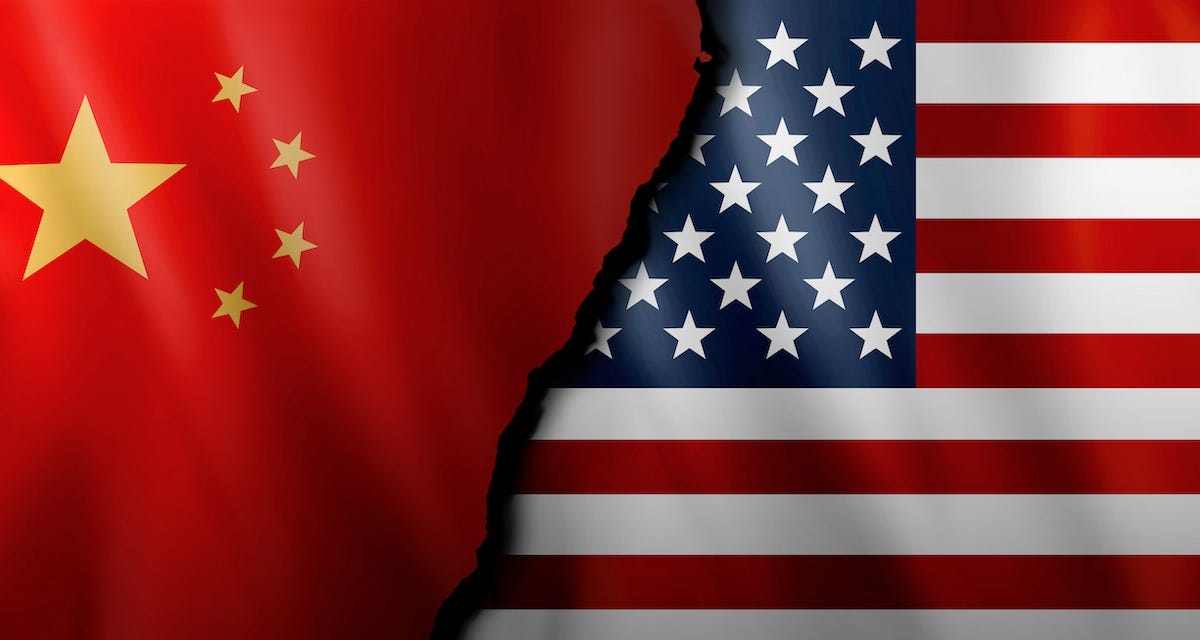
The Trump administration has made deals to take partial government ownership of companies like Intel and U.S. Steel. These measures are part of its broader effort to exert control over private businesses through threats of tariffs or other forms of regulatory coercion. Many commentators describe these efforts as the beginning of “state capitalism” in America.
Greg Ip, chief economics commentator for the Wall Street Journal, defines “state capitalism” as “a hybrid between socialism and capitalism in which the state guides the decisions of nominally private enterprises.” Ip argues that the U.S. is becoming more similar to China by adopting “state capitalism with American characteristics.” Commentators at prominent organizations like The Washington Post, the Council of Foreign Relations and the Cato Institute have made similar statements.,,,
There’s reason to worry that the United States is heading toward a system like China’s where the government exerts more control over businesses. But the term “state capitalism” obscures the real nature of this disturbing trend and muddies our understanding of capitalism. There’s a different concept — one completely antithetical to capitalism — that accurately captures the current trend, and it’s one that opponents of that trend desperately need to understand more deeply.
One reason to be suspicious of the term “state capitalism” is its origin. The term doesn’t come from advocates of free markets, but from Marxist theoreticians.
According to Marx, genuine socialism arises only when the state “withers away” after the revolution of the working class. His collaborator Friedrich Engels claimed that a system in which the state seizes private businesses from their owners and runs them itself is still a form of capitalism, and the Marxist Wilhelm Liebknecht introduced the term “state capitalism” to name the situation Engels described.,
Subsequently, some Marxists have used the term to distance themselves from the Soviet Union. The brutal Soviet dictatorship, they argued, cannot be blamed on socialism, because it is not real socialism — it’s “state capitalism.”
This origin gives opponents of Marxism (like Ip and Cato) every reason to ask whether it carries false Marxist assumptions that distort discussions of political systems.
It does. The term “state capitalism” presupposes the Marxist view that the defining feature of capitalism is that a “class” of people owns the “means of production” and employs others to perform labor (who are thereby, they say, “exploited”). Marxists consequently don’t claim to recognize a fundamental difference between private industry and industries owned and operated by the state. To Marxists, any society in which one “class” of people owns the means of production is some type of capitalism. Under the “real socialism” they imagine, “classes” will disappear along with the state.
The Marxist view, in essence, is that the state becomes a capitalist by owning and operating a business. But this wrongly conflates private businesses with government-owned businesses. By applying “state capitalism” to China and to Trump’s policy of acquiring ownership shares in businesses, Ip and others are buying into a blatantly Marxist distortion.
There are fundamental differences between private ownership and state control that must not be ignored. A private business operating in a free economy can only deal with people by voluntary agreement. Its employees, suppliers, customers and investors are free to decide whether to deal with it or not. And it can only stay in existence by figuring out how to make profits — which it can only do by producing goods and services that people want to buy.
Not so with state-owned businesses like China’s three largest mobile carriers, China Mobile, China Telecom and China Unicom. These three companies almost completely dominate the market because the Chinese government prohibits any new company from entering the field unless it is at least 51% government-owned. This means that anyone who wants to do business in the telecommunications market is forced to deal with one of these three firms.
And although Chinese state-owned enterprises have some nominal autonomy in their operation, they must seek approval on all major decisions from a committee of members of the Chinese Communist Party organized within the enterprise. And the central government body that oversees many of the country’s state-owned enterprises can force them directly to make changes to their operations. For example, all three of these companies were engaged both in operating cellular networks and in constructing cell towers. In 2014, however, the Chinese government forced these companies to give up their tower construction businesses. It took over their assets related to tower construction and created a new state-owned business, China Tower Company.
These state-owned businesses operate in a fundamentally different way from Verizon and AT&T. The owners of private companies are free to decide which industries to enter, what goods and services to produce. They succeed by creating value and offering trades that people willingly agree to. But a government forcibly controls the decisions of executives of state-owned businesses companies. And it runs a business like China Mobile by wielding force to limit competition. Describing this authoritarian control as a kind of “capitalism” obscures the fundamental difference between voluntary trade and coercion.
Marxists, of course, want to obscure that difference, because they want to destroy the system of free enterprise. The coinage “state capitalism” doesn’t just permit them to whitewash Marxism by distancing it from the Soviet nightmare; it also enables them to smear private entrepreneurs by equating their operations with government coercion. Advocates of economic freedom should not walk into their trap.
Think about what it means more broadly to say that both China and a country with completely free, private enterprise are “capitalist” societies simply because someone or other “owns” its businesses.
China, a country with state ownership of businesses, is a brutal dictatorship that heavily restricts speech, surveils its citizens and arrests them for long periods of time without any due process. A country with free markets in which businesses are privately owned could also completely and consistently protect individual rights, including not just property rights but also freedom of expression, personal liberty and due process. On all the most important political issues, such a country would be the opposite of China. Equating them under the label “capitalism” would be absurd. It would serve only to whitewash China and/or smear free countries.
I would argue, following Ayn Rand, that capitalism is best understood as a system “based on the recognition of individual rights, including property rights, in which all property is privately owned.” This definition highlights the stark difference between a country of private enterprise and a country in which the economy is largely controlled by the state, and reserves the term “capitalism” only for the former.
On this conception of capitalism, it doesn’t make sense to think the United States was a fully capitalist country even pre-Trump. The U.S. certainly has much more private ownership and economic freedom than China, and it does a far better job protecting citizens’ rights more generally. But the regulatory state has long infringed in major ways on Americans’ economic freedom. By the 21st century, the American economy was already only partly capitalist, mixed with heavy elements of statism. It would be most apt to describe it as a mixed economy moving further and further away from capitalism.
What is it moving toward? If not “state capitalism,” is there a name for the specific type of statism toward which the U.S. is moving under Trump? Another statement from Rand is illuminating here. In contrast to socialism, which abolishes private property in favor of state ownership of industry, there is a variant of statism in which individuals “retain the semblance or pretense of private property, but the government holds total power over its use and disposal.”
The name for that system is fascism.
Although people today mainly associate fascism with racism and nationalism, Rand’s point is that there is also a characteristically fascist type of control over the economy. In spite of still calling themselves “communist,” the Chinese government exercises this same type of fascist control over many of its officially private businesses. And Trump’s use of tariffs and regulation to control American businesses are an ominous step in America’s journey toward the same destination.
Those of us who oppose the shift of the U.S. political system in the direction of China should name it clearly for what it is. We are not in a transition from one type of capitalism to another, “state capitalism,” but a transition away from capitalism and toward a fascist form of statism. If we are to have a chance at reversing this transition, we must clearly identify it as a fascistic trend, not equate it with its opposite.