
Part-III of a Four-Part Research Series
India’s young are quietly rewiring the watch market. And Tissot’s India numbers suggest that the pivotal moment is not the second or third luxury purchase, but the first serious watch – the upgrade from a budget device or smartwatch to a Swiss mechanical piece that feels permanent.
From notifications to Nivachron: The smartwatch plateau
For most of the past decade, smartwatches were the story. In India, wearable shipments grew rapidly as low-cost devices flooded the market and consumers embraced fitness tracking and notifications on the wrist. That narrative has now shifted.
IDC’s India Monthly Wearable Device Tracker shows that India’s wearable device market recorded its first full-year decline in 2024, with shipments falling 11.3% year-on-year to 119 million units. Smartwatches were the main drag: shipments dropped 34.4% year-on-year to around 35 million units, and their share in the overall wearables mix fell from roughly 39.8% to 29.4% in a single year.
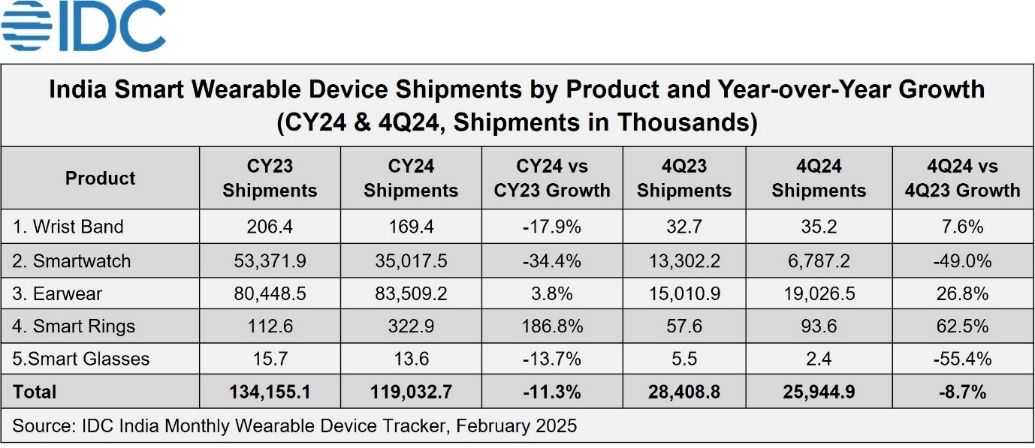
IDC attributes this slump to an influx of low-cost products, inventory overhang, and a “race to the bottom” in average selling prices, which eroded margins and pushed brands into unsustainable discount cycles.
In quarterly data, the picture is even starker. In Q2 2024, smartwatch shipments in India fell about 27-45% year-on-year depending on the source, while overall wearables volumes also softened as price fatigue set in.
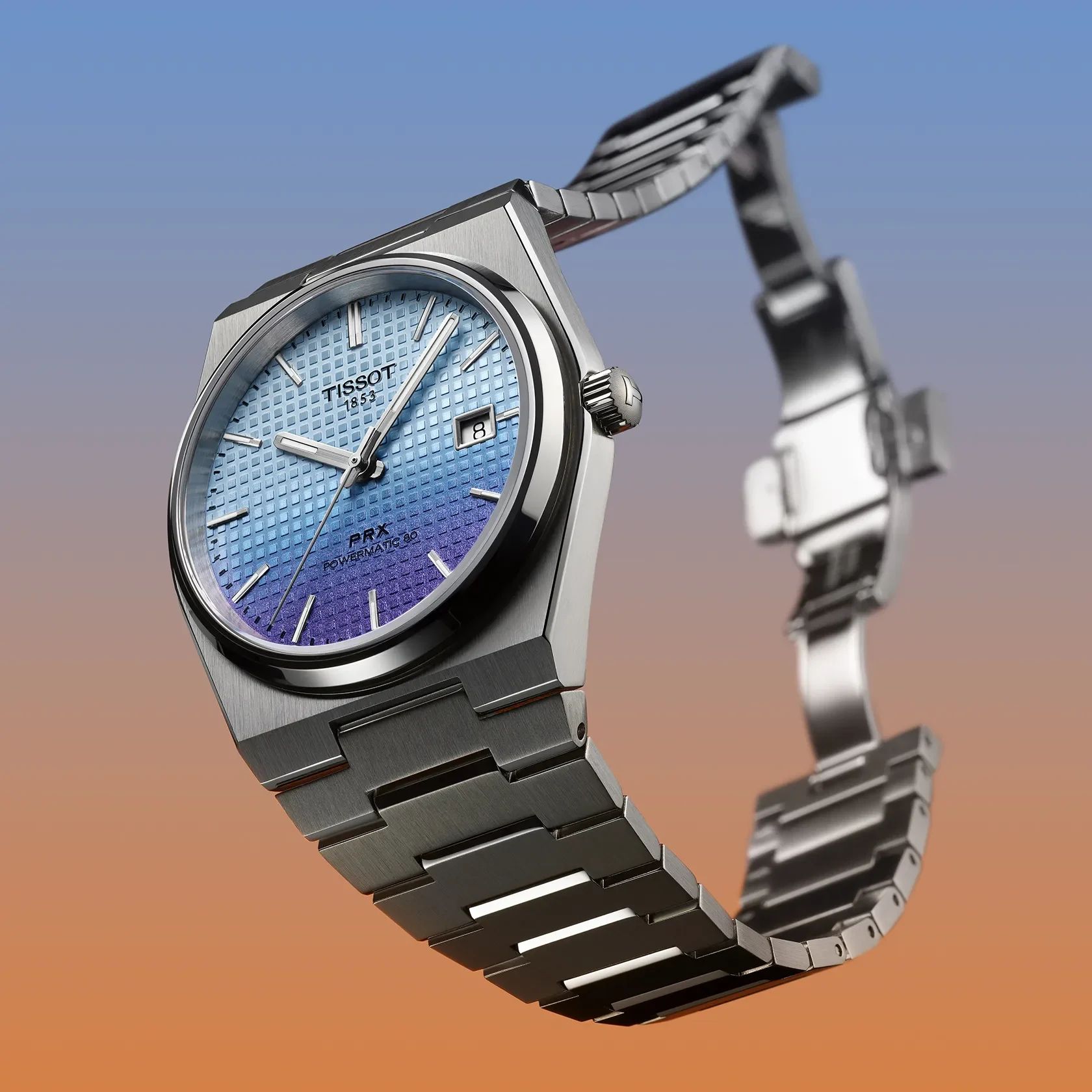
At the same time, according to Tissot’s India numbers, global smartwatch growth decelerated from around 12% in 2022 to under 4% in 2024, and the brand argues that Indian youth are “rediscovering the traditional watch as a style and status statement,” often wearing a Tissot PRX alongside – or instead of – an Apple Watch or budget smart device.
In other words: the utilitarian appeal of notifications on the wrist has not disappeared, but its growth curve has clearly flattened. The upgrade path is no longer from smartwatch A to smartwatch B, but increasingly from smartwatch to Swiss watch.
India wearables – signs of saturation
|
Metric (India wearables 2024) |
Value / change |
|
Total wearable shipments |
119m units, −11.3% YoY |
|
Smartwatch shipments |
35m units, −34.4% YoY |
|
Smartwatch share of wearables |
~29–31% (down from ~39–40%) |
|
ASP trend |
ASP down ~10% in 1H 2024 |
Against that backdrop, the idea of the “first serious watch” takes on a different meaning: it becomes a move away from a saturated, price-compressed category toward one where craft, status and longevity matter more than specs charts.
Tissot as the gateway Swiss brand
Tissot India explicitly positions the brand as “the gateway Swiss brand – aspirational to represent achievement while being attainable” for India’s young professional class. It cites India’s demographic tailwind bluntly: around 600 million people under 25, roughly 65% of the population below 35, and urban youth disposable incomes growing at around 14% annually, based on CRISIL data.
In that context, Tissot is described as the most aspirational Swiss watch brand among Indian urban professionals aged 22-35 in its segment, and as the default first Swiss choice for many.
This is not just positioning language. The pricing and portfolio details show why the “gateway” label fits:
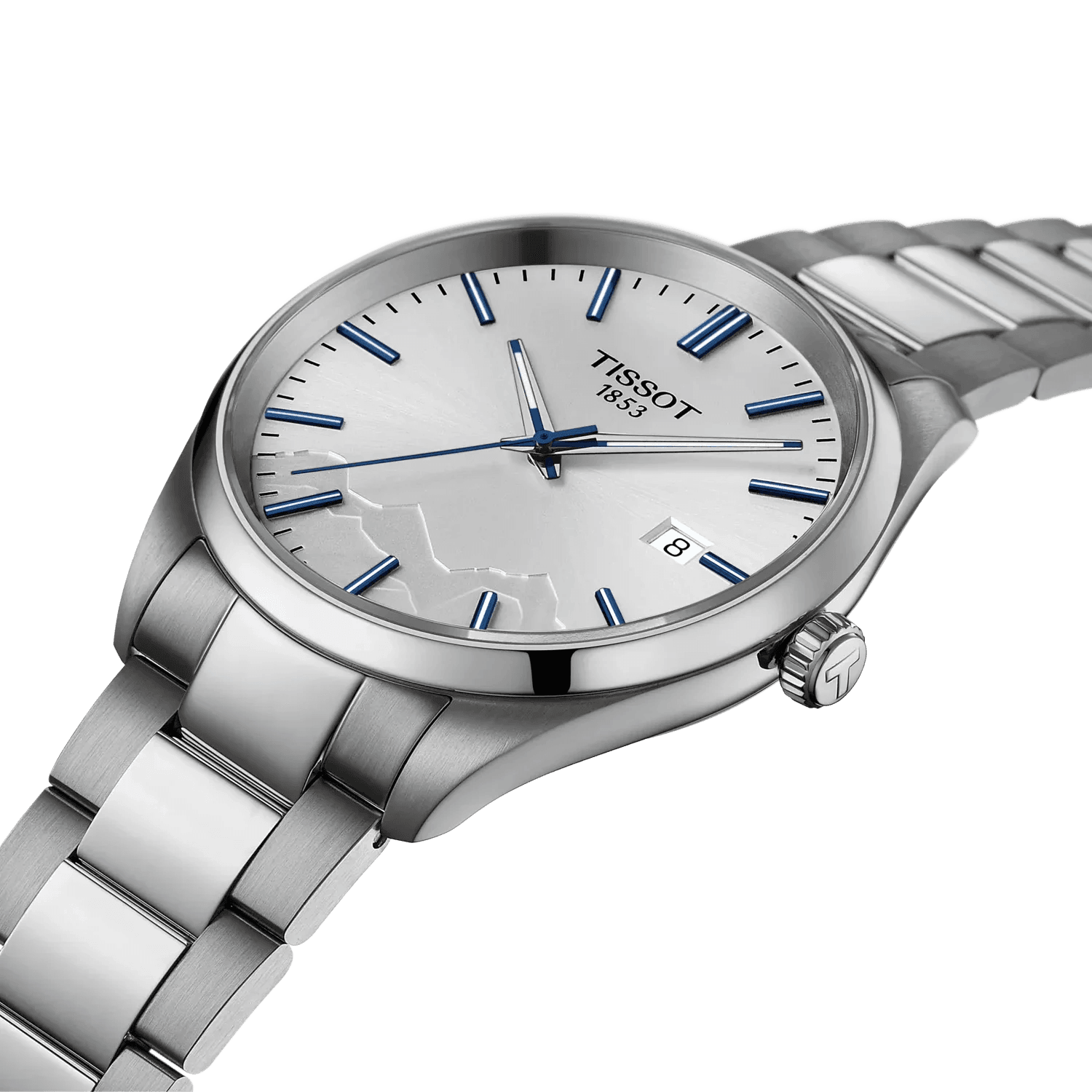
– PR 100 (Tissot’s workhorse collection) offers entry quartz models from about Rs.22,000 to Rs.35,000 and automatics from roughly Rs.40,000 to Rs.55,000 – price points that sit just above high-end smartwatches and well within reach of upwardly mobile urban buyers.
– PRX, the hero collection, starts around Rs.39,500 for quartz references and moves through Rs.44,000, then into Powermatic 80 automatics between roughly Rs.57,000 and Rs.83,500, and finally titanium, chronograph and two-tone 18K gold variants closer to or above Rs.1 lakh.
– Seastar, Gentleman, Le Locle, Ballade and others fill out the range, broadly spanning around Rs.28,000 to Rs.1.10 lakh+, with specific pieces like Seastar Powermatic 80 Silicium cited as “one of the best-specified dive watches in India under Rs.1 lakh.”
Tissot India price ladder
Imagine a horizontal range chart with collections on the vertical axis and rupee values on the horizontal.
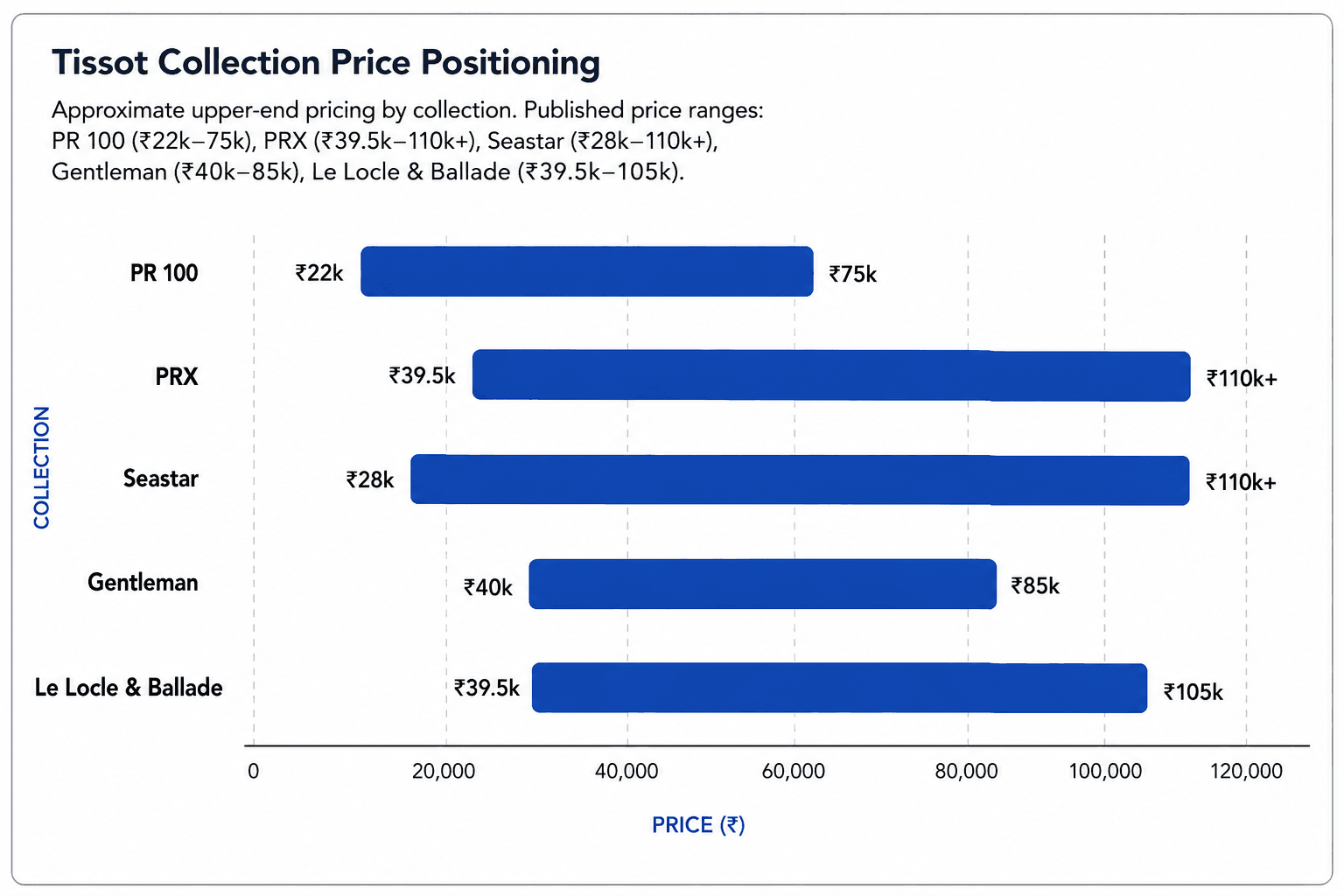
Visually, this ladder shows how a buyer can enter Tissot’s universe just above smartwatch prices and then trade up within the same brand and design language as incomes and aspirations grow.
Crucially, luxury defined only by rarity and price is not Tissot’s vision – instead, it seeks to offer millions the joy of wearing a Swiss watch crafted with quality and beauty that honor its legacy, embodying Swiss precision, innovation and tradition.
In India, that philosophy is expressed through a portfolio that makes Swiss mechanics accessible without trivializing them.
What Deloitte sees in India’s young watch buyer?
Deloitte’s “Swiss Watch Industry Insights 2024: Spotlight on India” reinforces the idea that the first serious watch moment is structurally important.
The report highlights India as a lucrative growth destination for Swiss watchmakers, driven primarily by Gen Z and millennials who prefer discretionary spending on fashion, luxury experiences and products, and who have “developed a passion for timepieces.”
It notes that almost 60% of Indian consumers invest in luxury products each year – including watches, jewelry, fashion and leather goods. It also adds that in luxury watch purchases, about 64% of Indian consumers prioritize brand image as the most important factor, and around 30% of them spend more than INR 120,000 on such watches.
For Tissot, this is a near-perfect profile:
– A young, self-purchasing buyer who wants a watch as both a personal status marker and an object of long-term ownership.
– A strong sensitivity to brand image, which plays directly to “Swiss Made” as a trust and prestige signal.
– A comfort with online research and purchase, which aligns with Tissot’s DTC platform and digital presence.
Mechanical value in a rising luxury market
Zooming out, the broader luxury watch market context supports the idea that mechanical watches are increasingly the “destination” category. Globally, mechanical luxury watches are expected to grow at around 5.2% CAGR between 2026 and 2033, outpacing some electronic segments. In India also, the total watch market, which was at USD 3.2 billion in 2024, is projected to rise to about USD 5.13 billion by 2033, with a CAGR of around 5.28%, as “luxury and branded watches” are gaining share as disposable incomes rise and urban consumers trade up.
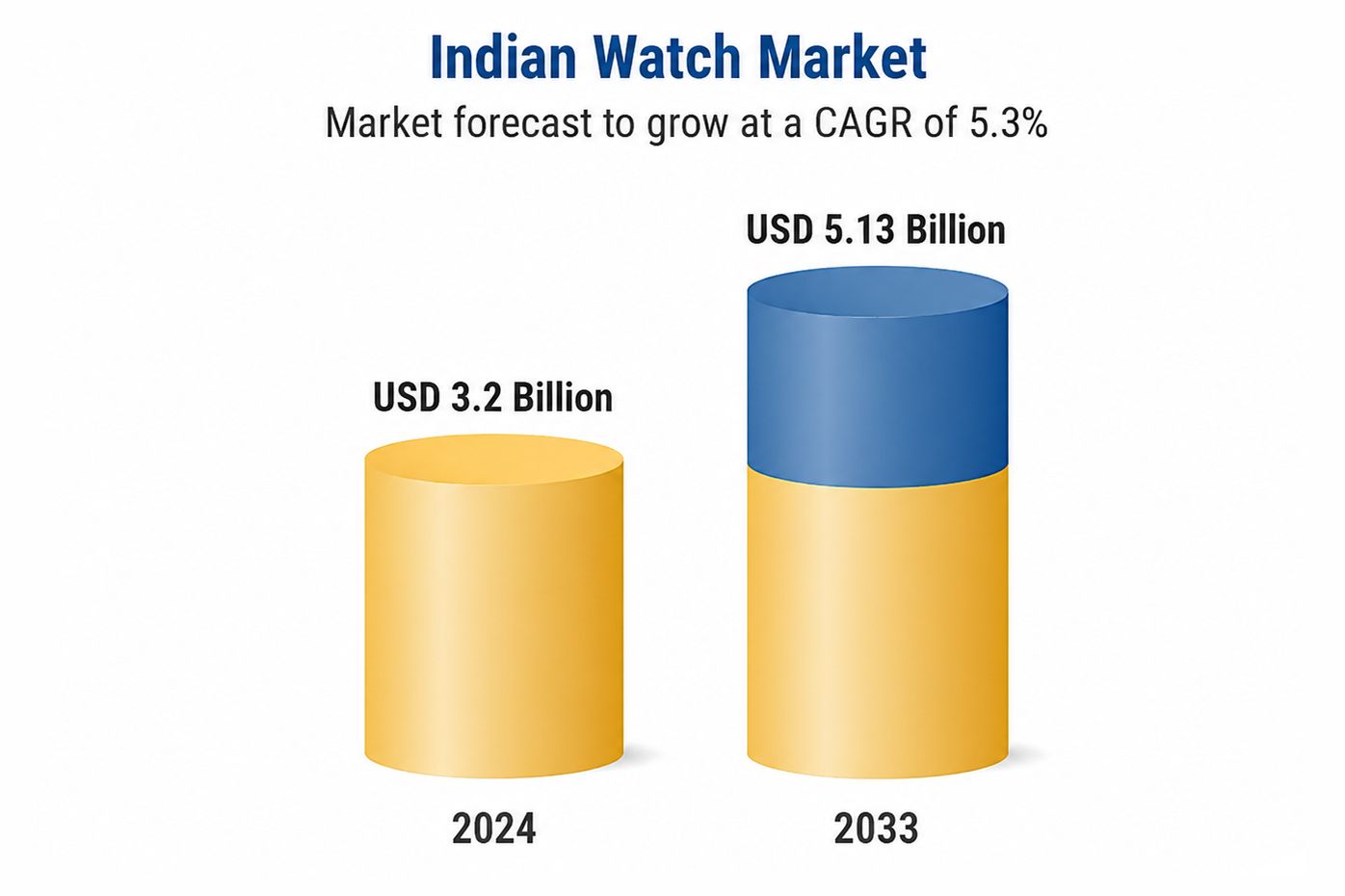
Put simply, the fastest growth in value is happening where craft, movement technology and brand history matter – exactly the space Tissot occupies with Powermatic 80, Nivachron, silicon hairsprings and solar innovations.
Tissot has pioneered the democratization of Swiss watchmaking innovation, making features previously found only in watches at three to five times the price accessible at Tissot’s levels. For an Indian buyer upgrading from a smartwatch or local quartz piece, the appeal is not just the logo. It is a movement that runs all weekend off the wrist, resists everyday magnetism, and feels technically justified at the price.
The sociology of the first serious watch
Numbers alone cannot capture why this moment matters. India’s young consumers increasingly treat watches as part of a wider luxury experience portfolio: they spend discretionary income on travel, fashion, and accessories, and see watches as both style statements and durable possessions. There is a noticeable shift from jewelry to luxury watches as investment objects for some buyers, with many viewing watches as reliable investments.
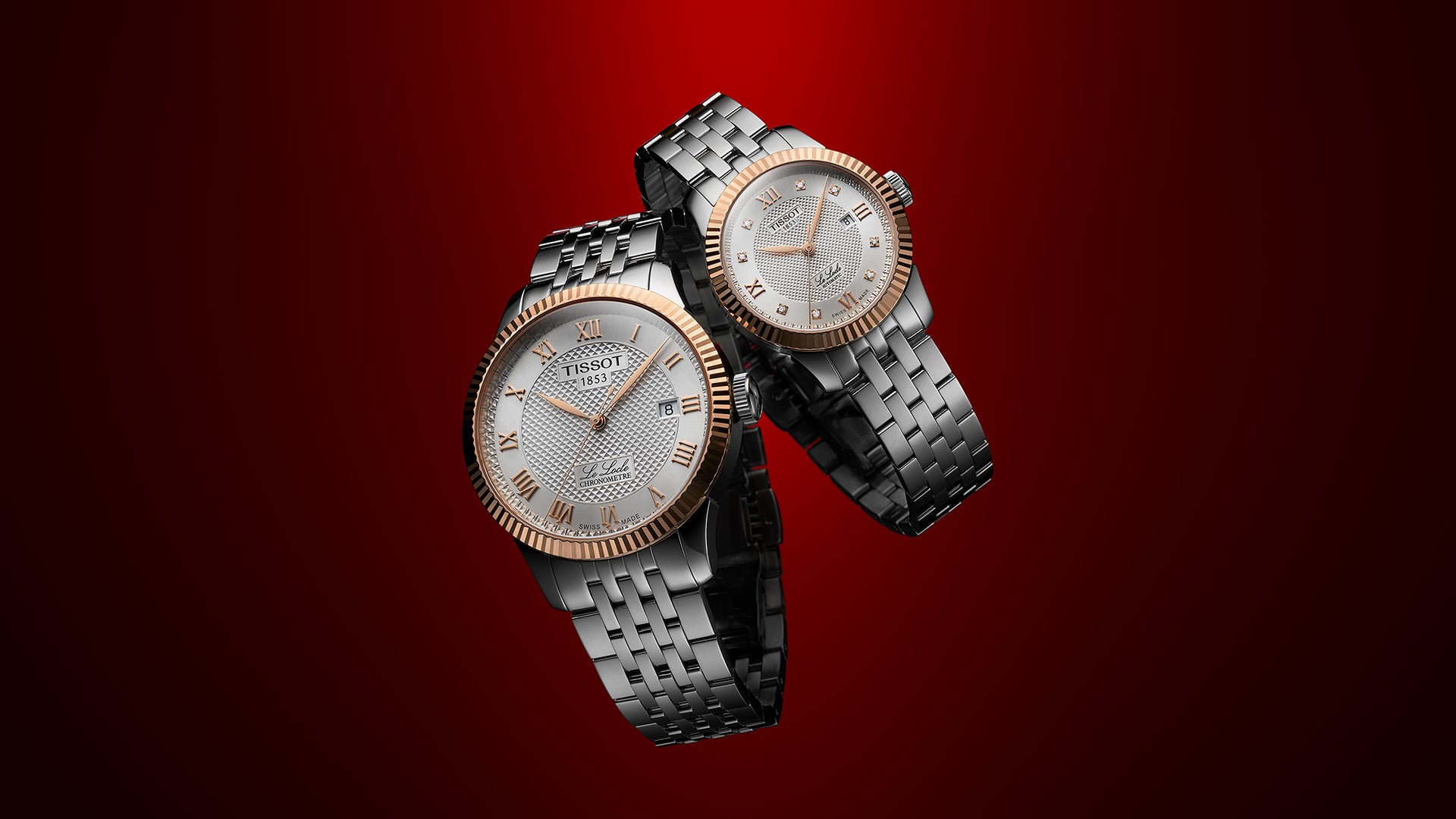
In this context, the first serious Swiss watch – often falling into the Rs.30,000-80,000 band, is not only a consumption decision. It is an identity and portfolio decision:
– Identity, because it signals entry into a certain professional and social stratum.
– Portfolio, because it reallocates spending from purely ephemeral items to something with heirloom potential.
Tissot captures this sociology indirectly. It is the preferred Swiss gift brand in the Rs.25,000+ tier for weddings, corporate awards and family occasions, and the Swiss Made credential is cited as the single most effective trust-builder at point of sale.
The first serious watch – key factors (India)
|
Factor |
Evidence / data point |
Relevance to Tissot |
|
Age and income |
Large youth cohort, 14% annual disposable income growth |
Gateway price points, youth focus |
|
Brand image importance |
64% prioritize brand image in luxury watch purchase |
Swiss Made trust signal |
|
Self‑purchase vs gifting |
78% plan to buy for themselves next year |
First serious self‑purchase |
|
Preferred channels |
~70% buy watches online |
DTC and online community presence |
|
Price band |
Significant share spending >INR 120,000 |
Tissot sits just around this, capturing aspirational step |
What this means for the future of India’s watch market?
If the first article in this series showed India as an outlier in Swiss export growth, and the second article argued that infrastructure is becoming the real moat, the third reveals a demand-side transition that may be just as important: a structural rebalancing of the wrist.
On one side of that rebalance is a saturated smartwatch market, facing price pressure and slowing growth.
On the other side is a rising cohort of young, brand-aware Indian consumers who are treating Swiss mechanical watches as the natural next step in their consumption and identity journey, supported by:
– Demography and income growth.
– Swiss import expansion and duty reductions.
– Digital discovery and online purchase comfort.
– An increasingly visible enthusiast ecosystem pointing them toward specific “gateway” brands and models.
Tissot’s India strategy – its price ladder, movement technology, network architecture and brand philosophy – positions it squarely at the intersection of those forces. It is not trying to replace the smartwatch – it is trying to define what comes after it for a large segment of Indian buyers.
For the wider market, the implication is clear:
The next decade of growth will be driven not just by selling more devices, but by winning the first serious watch decision. Brands that can credibly offer Swiss values at attainable price points, and back them with infrastructure and storytelling, will be the ones that turn that decision into compounding demand.
The numbers and data suggest that this pivot is already underway. The notifications will still buzz, but increasingly, the signal that matters most will be the one sent by the watch that doesn’t need a software update to stay relevant.