
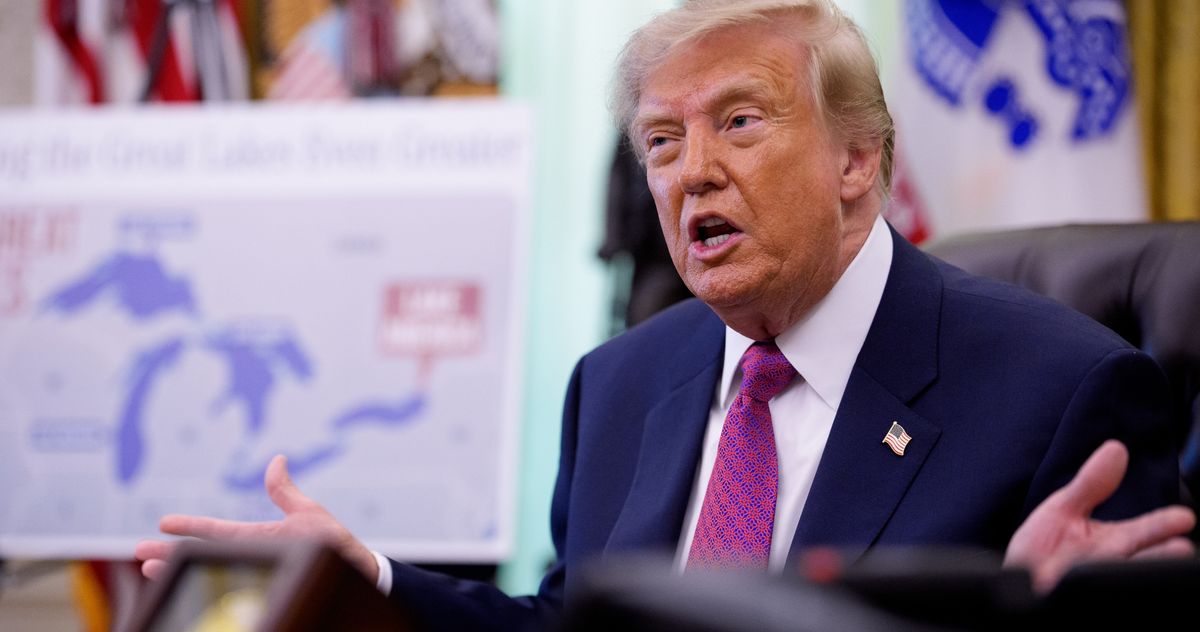

The poster child for poorly conceived war plans (and name changes).
Photo: Andrew Harnik/Getty Images
In terms of their relations with the U.S., Canada, and Iran have very little in common. One is America’s closest neighbor and second-largest trade partner, sharing the world’s longest international border, extensive economic and cultural ties, and a long history of friendly cooperation. The other has been a U.S. adversary for nearly five decades, including a new war that has now lasted more than six months. What Canada and Iran do have in common is an enemy: they’re both targets of new economic offensives by President Trump — and they’re both equally unlikely to capitulate to them.
Over the past week and a half, the Trump administration has escalated the president’s trade war with Canada by blowing up trade negotiations and imposing 50 percent tariffs on $20 billion worth of Canadian exports, leading Canadian Prime Minister Mark Carney to slap retaliatory tariffs on a wide range of American products. Meanwhile, Trump has also escalated his economic war with Iran in the apparent hope that it will succeed where U.S. air strikes have failed. On Monday, Treasury Secretary Scott Bessent announced Operation Economic Outcast, a new pressure campaign he likened to “economic D-Day” that would impose sanctions not only on Iran but on other countries and institutions that do business with it.
These are two very different conflicts with very different countries, but both escalations are likely to fail in similar ways, for similar reasons.
Trump lacks the public support and political capital he needs to sustain the fights he has picked, especially as Americans don’t see how or why we got into these conflicts in the first place. Other countries aren’t willing to back the U.S. in either instance, and Trump is rightly afraid to pull the biggest levers he has available, because the potential blowback on the U.S. economy would be too severe. Iran and Canada alike are more prepared to endure significant economic hardship to resist what they see as threats to their national sovereignty by a belligerent U.S. government — and probably far more than Americans are prepared to endure to sustain these threats.
Trump’s tariffs and Carney’s counter-tariffs are both going to cause some pain in Canada, but the prime minister has public support for fighting back rather than giving in. Canadians are shocked and outraged at Trump’s betrayal of the longstanding friendship between their country and ours. With his trade wars, childish insults, overt threats to annex Canada, and antics like trying to rename Lake Ontario “Lake America,” Trump has presided over a historic downturn in Canadians’ opinions and trust of their southern neighbors. Americans, however, still hold Canada in high regard, and there’s not much of a constituency for a trade war that is bound to cost American jobs and raise prices, even if its marginal impact on Canada is more severe.
The U.S. economy is more dependent on Canadian imports (especially lumber, oil, electricity, and auto parts) than Trump cares to acknowledge. Tellingly, his tariffs exclude oil, natural gas, potash, and other minerals, perhaps because Trump fears the consequences of raising the prices of these essential commodities (and his 50 percent tariffs on cars, trucks, auto parts, and steel come into effect in January, delaying the resulting price shocks until after the midterms). Trump might be happy to see New Yorkers or Minnesotans suffer for his trade war, but it stands to hurt him and the GOP politically in border states like Maine, Michigan, and Alaska, as well as other reddish-purple Midwestern states whose economies depend on trade with Canada.
Canada has its own escalation levers it can pull, too. Ontario premier Doug Ford is egging on Carney and his fellow provincial leaders to tighten the screws on the U.S. by taxing or cutting off energy and mineral exports. Meanwhile, the prime minister has spent the past year and a half (since Trump imposed his first round of sweeping tariffs) cutting new deals with other countries to reduce Canada’s reliance on trade with the U.S., putting the country in a better position to hold out against Trump’s demands until he either backs down or leaves office. Canadians will feel some economic pain, but so far, it looks like a price they are willing to pay to stand up to American bullying. How Americans respond to surging toilet paper prices remains to be seen.
With Iran, the balance of U.S. public opinion is not in Trump’s favor, either. The war is deeply unpopular, even among Trump’s base, who backed him in part for his promise not to entangle the U.S. in more pointless and costly wars in the Middle East. Iran’s closure of the Strait of Hormuz (which Trump was clearly not expecting, despite ample warning) has wrought havoc on the global economy and driven up fuel prices, and the longer that disruption goes on, the more Americans will feel the impact.
Iran’s economy was already shambolic before the war, and the combination of U.S. and Israeli air strikes, a naval blockade on Iranian oil shipments, and sanctions has only made things worse, yet Iran remains stubbornly resilient.
Iranian public opinion is notoriously difficult to measure accurately, especially from abroad, so it is harder to determine what Iranians think about the war and its impact. One recent survey of Iranians found that opposition to Iran’s increasingly hard-line government remains widespread, as is anxiety over inflation and economic pressures, yet respondents were slightly more likely to describe the U.S. war as an act of military aggression than a humanitarian intervention. The regime may not be popular, but nobody likes getting bombed, and any Iranians who had hoped the war would dislodge the Islamic Republic and usher in a new, more representative form of government have had those hopes dashed.
Even without a “rallying round the flag” effect, the war has created an opportunity for the regime to crack down on domestic opposition, making it even more resilient to popular pressure than before the war. Iranians might not want to endure further hardship under tighter U.S. sanctions, and they might even prefer that their leaders make concessions to end the war, but they probably won’t have much choice in the matter. If history is any guide, new sanctions will create a lot more pain and suffering for Iranians without doing much to influence Tehran’s decisions.
Here again, there are good reasons to doubt Trump’s willingness or ability to make good on his most provocative threats. Even as Bessent was announcing Operation Economic Outcast on Monday, the Treasury secretary was already being cagey about how serious the proposed secondary sanctions would be, who would be targeted, and when — saying the administration would first engage in private talks to persuade other countries to stop doing business with Iran. “Why would I want to blow up the global financial system?” Bessent said, inadvertently making the key argument for why the threatened sanctions might never be fully implemented.
Major Chinese banks were notably absent from the list of targeted institutions, which takes much of the bite out of this threat considering that China buys the vast majority of Iran’s oil exports, and these banks facilitate those transactions. China denounced the sanctions, which do target some smaller Chinese companies, describing them as illegal and saying it would “take all necessary measures to firmly safeguard its own rights and interests.” If China isn’t cooperating with Trump’s economic war on Iran, it’s hard to see it having much impact. Iran, for its part, responded by threatening to target neighboring countries who join the U.S. pressure campaign and further block their oil exports — a reminder of how much leverage Iran still has to disrupt the global economy in this war, even as its own economy collapses.
With the military situation in a stalemate and peace negotiations stalled — Trump said Wednesday, yet again, that the U.S. was “winning very big” in Iran and that he was in no hurry to resume talks — the new sanctions effort is theoretically meant to force Iran back to the negotiating table. However, the Atlantic’s Jonathan Lemire and Nancy Youssef report that the strategy here is not so much to secure a victory but to create the perception of forward motion and push Iran out of the headlines until after the fall elections. They quote one Trump adviser’s acknowledgement that “We’re just trying to hang on until the midterms.”
And therein lies the trouble for Trump’s misadventures: In both the trade war and the real war, his adversaries are prepared to hang on for far longer.