
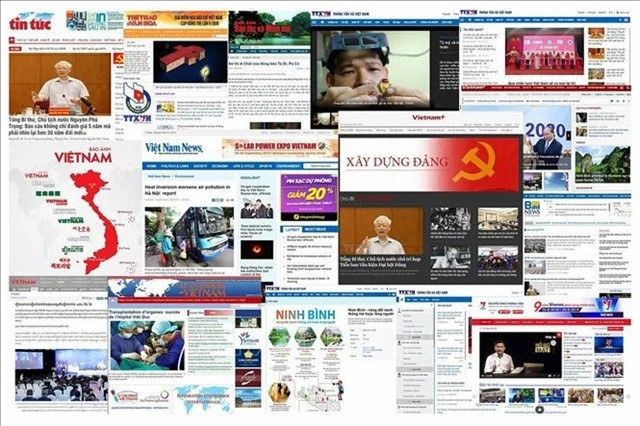
For decades, the country’s press sector relied largely on two traditional sources of revenue: print circulation and advertising. However, the rise of social media and cross-border digital platforms has fundamentally altered that equation, forcing newsrooms to rethink how they operate and generate income.
According to experts, the economics of journalism have become one of the biggest challenges facing media organisations in the digital era.
Advertising revenues have shifted rapidly to global platforms such as Google, Facebook and TikTok, while the decline of print circulation has further eroded traditional income streams.
At the same time, news organisations are under mounting pressure to invest in technology infrastructure, multimedia production and digital talent. The widening gap between revenues and costs has left many outlets struggling financially, with some reducing their scale of operations or relying more heavily on state support.
Experts noted that many Vietnamese media organisations are still in a stage of partial transformation, having moved content onto digital platforms without establishing comprehensive digital business models.
Limited access to user data, technology and long-term development strategies has made it difficult for many newsrooms to create economic value from content.
As a result, the economics of journalism have become an integral part of Vietnam’s broader press digital transformation strategy, alongside content and technology.
Specialists argue that digital transformation is not simply about adopting new technologies but also about changing economic thinking.
To adapt to changing reader habits, content must be organised, packaged and distributed in ways that align with digital consumption patterns. Without solving the economic challenge, experts warn, journalism may struggle to maintain content quality and fulfil its role of guiding public opinion in an era increasingly affected by misinformation.
Many news organisations have begun experimenting with new business models. Diversifying revenue sources has emerged as one of the most frequently discussed solutions.
In addition to traditional advertising, some outlets are expanding into data-driven digital advertising, branded content, event organisation, thematic forums, commissioned content production and integrated communication services.
Subscription-based models, though still uncommon in Vietnam, are also viewed as a long-term trend. Experts believed that premium, exclusive and specialised content will be essential if news organisations are to successfully introduce paywalls in the future.
Technology is increasingly seen as a key driver of media economics. Applications of artificial intelligence and big data allow newsrooms to better understand audience behaviour, optimise content distribution, personalise user experiences and improve advertising effectiveness. Mastering data, experts say, could provide media organisations with an economic advantage over social media platforms.
However, successful transformation depends not only on technology but also on people.
Newsrooms need multidisciplinary workforces capable of combining journalistic expertise with knowledge of digital technology, marketing and content business development.
Alongside changes within newsrooms, policymakers are seeking to create a more supportive legal framework.
According to Nguyen Van Hieu, Deputy Director of the Press Department under the Ministry of Culture, Sports and Tourism, the revised Press Law 2025 is designed to ensure state management while expanding space for innovation and the development of media economics and adapting to the rapid development of modern communications technology.
One notable provision in the draft law is the official recognition of digital content channels operated by media organisations as formal journalistic products.
“Recognising journalistic products in cyberspace is an important step to help journalism keep pace with modern communication trends and digital transformation,” Hieu said at a recent conference in Hanoi.
According to Hieu, the revised law aims to increase the autonomy of media organisations while expanding opportunities to mobilise social resources. Mechanisms for content cooperation are expected to be broadened, except in areas related to politics, national defence, security and foreign affairs.
The draft legislation also proposes additional legal revenue sources, including copyright exploitation, public service activities, assigned programs and projects, and other lawful operations.
These adjustments are an important basis for enhancing the financial autonomy of the press amid increasingly intense competition.
Other experts also called for stronger copyright protection, suggesting that organisations and businesses using journalistic content should be required to negotiate with news organisations rather than benefiting from content produced at considerable cost without compensation.
Despite the push toward greater self-reliance, participants emphasised that journalism would remain a special sector requiring state support. Continued investment in public-interest journalism, media outlets serving remote areas and ethnic minority communities, as well as policies supporting digital transformation and workforce training, were identified as essential to sustainable development.
As Vietnam’s media industry continues its digital transition, many experts agree that media economics is no longer merely a question of increasing revenue. Instead, it has become a prerequisite for maintaining professional journalism, preserving editorial independence and ensuring the long-term sustainability of the country’s press system./. VNA