
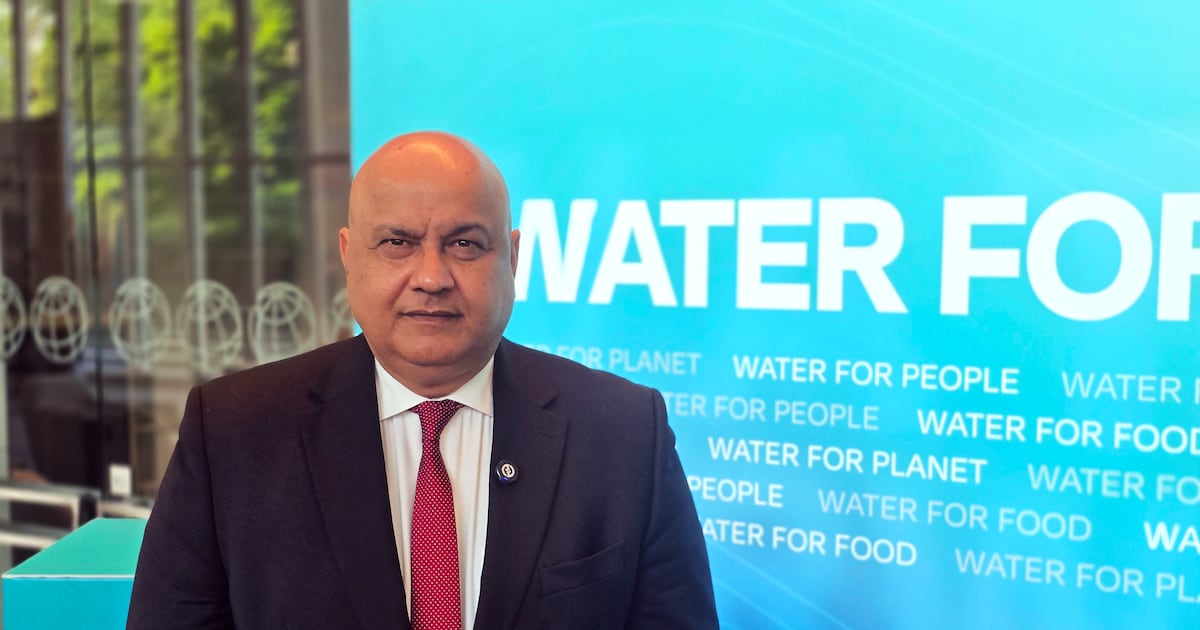
Water scarcity is no longer just an environmental or development issue. It directly constrains economic growth, according to the World Bank’s global water director, as a widening gap between supply and demand threatens productivity, jobs and stability.
“If you don’t manage water well and ensure water security … there’s an economic contraction,” Saroj Kumar Jha told The National.
He warned that the global economy is entering a period where water is shifting to a binding constraint on output, rather than a background resource.
Water demand is projected to outstrip supply by at least 30 per cent by 2030, he said – a gap that could ripple through key sectors including agriculture, energy and industry, especially as the race to build data centres gathers momentum. A large centre can use up to 5 million gallons of water a day, the same as a small town, according to the World Resources Institute.
The WRI projects even more worrying water gap numbers, with demand for water in 2030 expected to exceed availability by 56 per cent.
The data centres are not just energy hungry, they’re also thirsty
Saroj Kumar Jha,
World Bank’s global water director
The World Bank Group is taking heed of these warnings and is co-operating with a coalition of development banks, governments and investors to launch Water Forward, a global initiative aimed at improving water security for up to a billion people by 2030.
“Water is foundational to how economies function. When water systems work, farmers produce, businesses operate, and cities attract investment,” World Bank President Ajay Banga said last week, announcing the initiative.
But despite underpinning an estimated 1.7 billion jobs globally, the sector remains chronically underfunded and structurally mispriced.
This water crisis is projected to yield average losses of 8 per cent of GDP in countries around the world by 2050, and up to 15 per cent in the lowest-income countries, according to a 2024 report by the Global Commission on the Economics of Water.
The World Bank estimates that more than “$1 trillion per year [is] needed to meet clients’ water security needs”, demonstrating the scale of investment required to sustain water systems as demand rises.
A hidden economic risk
To address this emerging concern and bridge the gap, the World Bank is seeking to change how water is managed and financed – essentially building a global water industry.
“The most challenging context for water is the lack of a clear, comprehensive, predictable regulatory environment in the sector,” Mr Jha said. “No investor will come when they really don’t know how the sector is regulated.”
He added that this mismanagement of water also masks its true cost and value for investors.
“There is a very large amount of subsidies in the water sector, which means that the money spent on producing water for irrigation, or for drinking – you don’t recover the cost of producing that water or providing the service,” Mr Jha said. “So somebody is paying for it.
“The people who consume more water – wealthy people – get more subsidies because they consume more water,” he added.
That dynamic has helped keep private investment low and water scarcity high in the regions that need it most. While sectors such as energy and transport attract significant capital, water remains overwhelmingly state-funded, limiting its ability to scale.
The broader macroeconomic context reinforces the risk. The International Monetary Fund warned this week that global growth expected to slow to about 3.1 per cent this year, with downside risks from supply shocks and rising commodity prices.
From public service to investable sector
The World Bank’s push reflects a broader shift to position water as an investable sector. Closing the funding gap would require an additional $131 billion to $140 billion annually, almost tripling current spending, the lender estimates.
Mr Jha said unlocking that capital depends on reframing water from a public good into an asset class assessed on risk and return. “The answer [to whether the water economy can yield profits] is yes, but not in every single water project.”
Projects such as desalination and bulk supply can generate stable revenue, while others require public support to be viable. “You bring in some public financing, and you blend that with the private investment to make it more bankable,” he added.
That includes guarantees and credit enhancements to reduce risk, tools widely used in sectors such as energy and transport. The approach mirrors the evolution of energy markets, where regulatory reform and pricing unlocked private capital. Water, however, remains politically sensitive, particularly around tariffs.
The shift is also reshaping how investors view the sector. Parts of the water economy are approaching a trillion-dollar scale, with the global water and wastewater market expected to reach $1 trillion by the end of the decade, according to estimates from Frost & Sullivan and The Business Research Company. But water is less a stand-alone industry than a system that underpins the wider economy.
The World Economic Forum estimates that about $58 trillion of global GDP, about 60 per cent of output, depends on water and freshwater ecosystems, making it larger than any single industry and reinforcing its role as a critical economic foundation.
Foundation of the modern economy
The economic case rests on water’s role as a foundational input across industries.
Agriculture, which accounts for about 70 per cent of freshwater use globally, according to the Food and Agriculture Organisation, depends on reliable irrigation systems. Energy systems rely on water for hydropower and cooling.
Manufacturing requires water for processing and reuse. Even digital infrastructure, including AI-driven data centres, is increasingly water-intensive.

“Strong water systems are foundational to healthy economies that can attract private investment and create jobs,” the World Bank said.
Mr Jha said emerging sources of demand are adding new pressure to already strained systems.
“The data centres are not just energy hungry; they are also thirsty,” he said, calling on countries to ensure that such projects do not draw from already stressed water basins without adequate recycling and reuse plans.
Challenges ahead
Despite growing recognition of water’s economic role, significant barriers remain.
Tim Wainwright, chief executive of WaterAid UK, which is part of the Water Forward initiative, said water had long been overlooked despite its central role across economies and societies.
“Everything starts with water: health, education, gender equity, business and agriculture all depend on it. Despite its fundamental importance, water has long been mismanaged, underfunded and overlooked politically over the years.”
The World Bank is promoting “country water compacts”, government-led programmes that combine policy reform, investment planning and financing tools to make projects more attractive to investors.
Fourteen countries have already launched such compacts, Mr Jha said, with more expected to follow.
The success of the initiative will depend on whether governments can balance affordability with financial viability, a challenge that has long constrained the sector.
For Mr Jha, the stakes are increasingly clear.
If water continues to be underpriced and underinvested, the consequences will extend far beyond shortages.
The risk is that water becomes a defining constraint on economic growth, much like energy shocks have shaped global markets in the past.
The difference, he said, is that this time, the warning signs are already visible.