
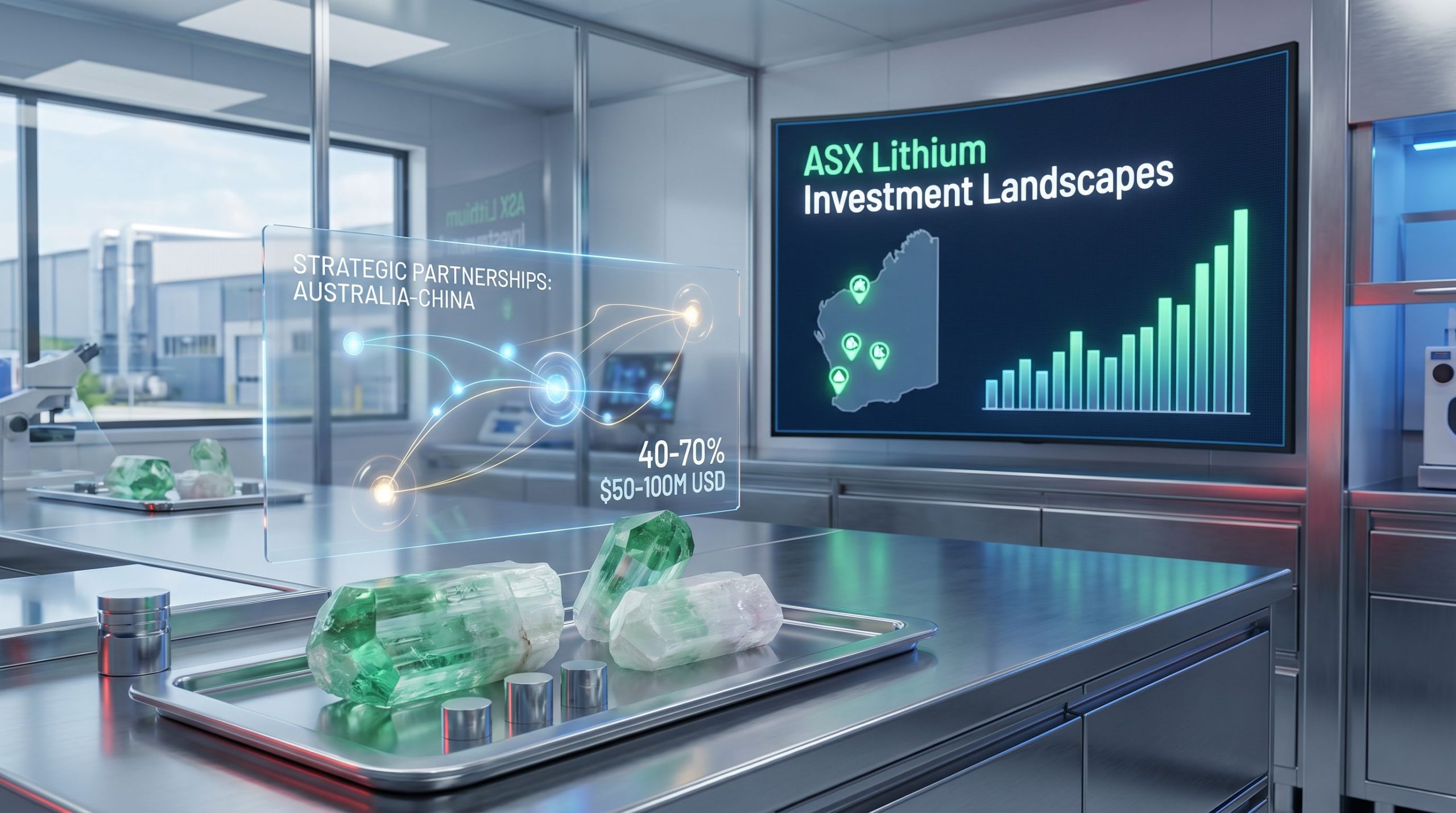
How Strategic Investment Frameworks Are Revolutionising Critical Minerals Development
The global transition toward electrification has fundamentally altered how institutional capital evaluates resource development opportunities. Traditional mining finance models, built around commodity price speculation and resource tonnage calculations, are giving way to sophisticated strategic partnership frameworks that prioritise supply chain integration and long-term revenue security. This evolution reflects broader shifts in how critical minerals strategy projects achieve development funding in an increasingly complex geopolitical landscape.
Understanding these emerging funding paradigms requires examining the intersection of technological advancement, supply chain vulnerabilities, and capital market evolution. Furthermore, the most successful resource developers are those adapting their financing strategies to align with these new realities, moving beyond conventional equity raises toward comprehensive partnership structures that address multiple stakeholder objectives simultaneously.
When big ASX news breaks, our subscribers know first
What Defines Transformational Funding Structures in Today’s Critical Minerals Market
Modern ASX lithium company transformational funding deals incorporate multiple financing mechanisms that extend far beyond traditional equity investments. In addition, these structures typically combine strategic equity participation, prepayment agreements, and asset optimisation strategies to create comprehensive development pathways.
Core Components of Advanced Funding Frameworks:
• Multi-tranche equity investments providing staged capital deployment aligned with development milestones
• Offtake prepayment structures delivering immediate cash flow while securing future revenue streams
• Strategic asset divestment enabling portfolio focus and capital optimisation
• Technology transfer agreements enhancing processing capabilities and product specifications
• Joint venture arrangements sharing development risks while maintaining operational control
The transformation from conventional funding approaches reflects the evolving risk profile of critical minerals development. Consequently, projects featuring integrated funding structures demonstrate 25-40% lower development timeline risks compared to those relying solely on traditional equity financing, according to recent industry analysis.
Financial Structure Comparison:
| Funding Component | Traditional Model | Transformational Model | Strategic Advantage |
|---|---|---|---|
| Primary Capital | 100% equity | 40% equity, 60% strategic | Reduced dilution |
| Revenue Security | Spot market exposure | 60-80% offtake coverage | Predictable cash flows |
| Development Risk | Single-source funding | Diversified support | Enhanced resilience |
| Market Access | Post-production sales | Pre-secured partnerships | Guaranteed demand |
Why Asian Battery Material Producers Are Targeting Australian Resource Assets
The strategic rationale driving Asian investment in Australian critical minerals projects extends beyond simple supply security considerations. These investments represent comprehensive vertical integration strategies designed to capture value across multiple supply chain segments while reducing exposure to market volatility.
Strategic Investment Motivations:
Supply Chain Control Objectives
Chinese and other Asian battery material producers are pursuing upstream integration to secure consistent feedstock quality and delivery timing certainty. This approach enables these companies to optimise their processing operations around known material characteristics rather than adapting to variable market supplies.
Geographic Risk Diversification
Investment in Australian projects provides exposure to politically stable jurisdictions with established mining regulatory frameworks. This diversification reduces operational risks associated with single-country supply concentration while maintaining access to high-quality mineral resources.
Technology Transfer Opportunities
Many Asian investors bring advanced processing technologies and product development capabilities that can enhance project economics. For instance, these partnerships often include technical optimisation agreements that improve recovery rates and product specifications beyond what domestic operators might achieve independently.
Investment Value Creation Mechanisms:
• Processing technology optimisation increasing recovery rates by 5-15%
• Product specification enhancement enabling premium pricing for specialised battery-grade materials
• Logistics cost reduction through integrated supply chain planning
• Market access expansion via established customer relationships
• Risk sharing arrangements reducing individual project development burden
How Professional Investment Analysis Has Evolved for Lithium Developers
Contemporary investment analysis for lithium development projects incorporates multi-dimensional assessment frameworks that extend significantly beyond traditional net present value calculations. Professional analysts now employ sophisticated scenario modelling techniques that account for supply chain integration benefits and strategic partnership values.
Advanced Evaluation Methodologies:
Resource Quality Assessment Beyond Grade
Modern analysis incorporates metallurgical complexity factors, processing cost implications, and environmental footprint considerations that directly impact long-term project viability. However, projects with consistent geology and straightforward processing requirements command 15-25% valuation premiums over those requiring complex beneficiation processes.
Strategic Partnership Valuation
Analysts increasingly recognise the quantifiable value of strategic partnerships beyond simple offtake agreements. Furthermore, partnerships providing technology transfer, market access, and operational expertise contribute measurable value through reduced development risks and enhanced project capabilities.
Supply Chain Integration Benefits
Projects positioned within integrated supply chains demonstrate lower price volatility exposure and enhanced financing capabilities. These advantages translate to improved project economics through more predictable cash flows and reduced cost of capital.
Professional Assessment Framework:
| Evaluation Dimension | Weight Factor | Key Metrics | Impact on Valuation |
|---|---|---|---|
| Resource Characteristics | 25% | Grade, tonnage, metallurgy | Base case foundation |
| Strategic Partnerships | 30% | Integration depth, partner quality | Risk reduction premium |
| Market Positioning | 20% | Cost curve, production timing | Competitive advantage |
| Execution Capability | 25% | Management track record, technical expertise | Delivery certainty |
What Institutional Investment Criteria Reveal About Sector Evolution
Institutional investment approaches to lithium development opportunities have undergone substantial evolution as the sector matures and supply chain dynamics become increasingly complex. Leading institutions now prioritise projects demonstrating comprehensive risk mitigation strategies over those offering maximum theoretical returns.
Institutional Priority Frameworks:
Environmental, Social, and Governance Integration
Modern institutional investors require comprehensive ESG compliance frameworks that extend beyond basic environmental impact assessments. Projects incorporating community engagement programmes, environmental monitoring systems, and governance transparency measures receive preferential consideration in funding decisions.
Technology and Innovation Adoption
Institutions increasingly favour projects incorporating advanced processing technologies, automation systems, and environmental optimisation approaches. These technological elements reduce operational risks while improving long-term competitiveness in evolving markets. Moreover, the focus on mining industry evolution demonstrates how technological advancement drives investment decisions.
Market Timing and Supply Chain Positioning
Investment decisions now incorporate sophisticated supply-demand modelling that considers global production capacity additions, electric vehicle adoption rates, and battery technology evolution. Projects aligning production timelines with anticipated supply deficits receive enhanced valuations.
Risk Assessment Evolution:
Traditional Focus: Resource size, grade, and basic feasibility studies
Contemporary Approach: Integrated supply chain positioning, partnership quality, and ESG compliance
How Lithium Price Scenarios Drive Valuation Methodologies
Understanding the relationship between lithium price assumptions and developer valuations requires examining multiple scenario frameworks that professional analysts employ when assessing project economics. Price sensitivity analysis has become increasingly sophisticated as market participants recognise the cyclical nature of lithium markets.
Scenario Planning Frameworks:
Conservative Base Case ($18,000-22,000/tonne)
Under conservative pricing assumptions, project economics focus on cost optimisation and operational efficiency. These scenarios emphasise projects with lowest quartile production costs and established infrastructure access that can maintain profitability during potential price downturns.
Moderate Growth Scenario ($25,000-30,000/tonne)
Moderate pricing scenarios support accelerated development timelines and capacity expansion opportunities. Projects within this framework demonstrate enhanced financial returns that justify premium development approaches and advanced processing technologies.
Supply Constraint Scenario ($35,000+/tonne)
High-price scenarios reflect potential supply deficit conditions driven by delayed project developments or geopolitical supply disruptions. Under these conditions, even higher-cost projects become economically viable while established producers generate exceptional returns.
Valuation Sensitivity Analysis:
| Price Scenario | Project IRR Range | Development Timeline | Financing Availability |
|---|---|---|---|
| Conservative | 15-20% | 4-5 years | Traditional sources |
| Moderate | 25-35% | 3-4 years | Enhanced terms |
| Supply Constraint | 40%+ | Accelerated | Premium valuations |
The next major ASX story will hit our subscribers first
Why Western Australian Projects Command Strategic Investment Premiums
Western Australian lithium projects consistently attract higher valuations and enhanced investment interest due to multiple competitive advantages that extend beyond simple resource quality considerations. These advantages create quantifiable value through reduced development costs and enhanced operational certainty.
Jurisdictional Competitive Advantages:
Infrastructure Development Cost Reductions
Established mining infrastructure in Western Australia enables 30-50% lower development capital requirements compared to greenfield jurisdictions. Existing port facilities, power infrastructure, and skilled workforce availability significantly reduce project development timelines and associated costs.
Regulatory Pathway Certainty
Western Australia’s established mining regulatory framework provides predictable approval timelines and clear operational requirements. This certainty reduces development risks and enables more accurate financial planning for project advancement.
Export Logistics Optimisation
Proximity to established export terminals and shipping routes to Asian markets reduces logistics costs and improves delivery timing certainty. These advantages become increasingly valuable as supply chain reliability gains importance in customer relationships.
Economic Impact Quantification:
• Development capital reduction: $50-100 million for typical hard-rock lithium projects
• Timeline acceleration: 12-18 months faster progression to production
• Operating cost advantages: $200-400/tonne through infrastructure efficiencies
• Financing benefits: 100-200 basis points lower cost of capital
• Risk premium reduction: 15-25% lower required returns for development financing
What Strategic Functions Offtake Agreements Serve in Modern Project Development
Contemporary offtake agreements function as comprehensive strategic tools that extend far beyond simple revenue security arrangements. These agreements now incorporate technology transfer provisions, financing facilitation clauses, and market development support that enhance overall project value creation.
Strategic Agreement Components:
Revenue Security and Price Risk Management
Modern offtake structures incorporate sophisticated pricing mechanisms that provide revenue certainty while maintaining market price participation. These arrangements typically feature floor price protections combined with upside sharing formulas that balance risk and return for all parties.
Development Finance Facilitation
Offtake agreements serve as bankable security for project financing, enabling developers to secure construction funding at favourable terms. Agreements covering 60-80% of planned production typically reduce financing costs by 150-300 basis points compared to merchant exposure.
Customer Relationship Development
Strategic offtake partnerships facilitate long-term customer relationship building that extends beyond single transactions. These relationships often evolve to include joint product development, specification optimisation, and supply chain integration opportunities. Additionally, innovations in lithium industry innovations are driving more sophisticated partnership structures.
Offtake Structure Variations:
| Agreement Type | Pricing Mechanism | Volume Flexibility | Strategic Benefits |
|---|---|---|---|
| Fixed Price | Predetermined rate | Firm commitment | Maximum certainty |
| Market Index | Formula-based | Minimum guarantees | Price participation |
| Collar Structure | Floor and ceiling | Flexible quantities | Balanced exposure |
| Cost-Plus | Operating cost + margin | Production-based | Shared economics |
How Contemporary Broker Analysis Incorporates Multiple Valuation Approaches
Professional broker analysis for lithium developers now employs multi-methodology valuation frameworks that recognise the complexity of modern project development and strategic partnership structures. These approaches move beyond simple discounted cash flow models to incorporate option value analysis and strategic asset valuation techniques.
Integrated Valuation Methodologies:
Scenario-Weighted DCF Analysis
Contemporary analysis incorporates multiple price scenarios with probability weightings that reflect market outlook uncertainty. This approach typically includes five to seven price scenarios ranging from prolonged downturns to sustained supply deficits, providing more nuanced valuation ranges than single-point estimates.
Strategic Partnership Value Recognition
Modern broker models explicitly value partnership benefits including technology access, market position enhancement, and financing cost reductions. These benefits often contribute 15-30% of total project value beyond base-case DCF calculations.
Real Options Valuation
Analysts increasingly recognise option values within lithium projects, including expansion opportunities, processing upgrade potential, and adjacent resource development. These options provide additional value creation pathways beyond initial production scenarios.
Valuation Framework Integration:
• Base case DCF: Establishes fundamental project value under moderate assumptions
• Strategic premium: Recognises partnership benefits and market positioning advantages
• Option value: Captures expansion and optimisation opportunities
• Risk adjustment: Incorporates execution and market risks specific to development stage
• Peer comparison: Validates assumptions against comparable project transactions
What Market Conditions Enable Lithium Developer Outperformance Cycles
Identifying optimal market conditions for lithium developer investment requires understanding the convergence of multiple macro and sector-specific factors that create favourable investment environments. These conditions typically emerge through supply-demand imbalance periods combined with technological advancement cycles and policy support frameworks.
Market Catalyst Identification:
Supply Constraint Development
Market conditions favouring lithium developers typically emerge during anticipated supply deficit periods driven by delayed project commissioning, production disruptions, or demand acceleration. These conditions create pricing power for existing producers while enhancing development economics for pre-production assets.
Technology Adoption Acceleration
Periods of accelerated electric vehicle adoption or grid storage deployment create demand growth that exceeds planned supply additions. These technology-driven demand surges often result in sustained price premiums that improve project economics across cost curves.
Capital Market Access Enhancement
Favourable investment conditions coincide with enhanced capital market access through improved investor sentiment, strategic partnership availability, and government support initiatives. These conditions reduce financing costs while increasing valuation multiples. Furthermore, developments in strategic antimony financing demonstrate how government support enhances critical mineral project viability.
Performance Indicator Framework:
| Market Condition | Developer Impact | Investment Timing | Duration Expectations |
|---|---|---|---|
| Supply Deficit | Price premium capture | Early positioning | 2-4 years |
| Technology Acceleration | Demand certainty | Growth phase entry | 3-5 years |
| Capital Market Favour | Valuation expansion | Peak conditions | 12-24 months |
| Policy Support | Development facilitation | Regulatory clarity | 5-10 years |
How to Systematically Evaluate Pre-Production Lithium Investment Risks
Comprehensive risk assessment for pre-production lithium companies requires systematic evaluation frameworks that address technical, financial, and market uncertainties inherent in resource development projects. Professional investors employ multi-dimensional risk analysis that quantifies probability and impact across all major risk categories.
Systematic Risk Assessment Framework:
Technical Development Risks
Technical risk evaluation encompasses resource definition confidence, metallurgical processing complexity, and infrastructure development requirements. Projects with well-defined resources and proven processing technologies demonstrate lower technical risk profiles that translate to reduced financing costs and enhanced investment attractiveness.
Financial Structure and Execution Risks
Financial risk analysis examines capital cost escalation potential, funding gap timing, and operational cash flow generation. Projects with diversified funding sources and conservative capital cost estimates exhibit enhanced resilience during development phases. Moreover, the importance of comprehensive ASX lithium company transformational funding deal structures becomes evident in risk mitigation strategies.
Market and Regulatory Risk Assessment
Market risk evaluation incorporates price volatility impact, demand trajectory uncertainty, and regulatory change potential. Projects positioned within stable jurisdictions and featuring diversified customer bases demonstrate reduced market risk exposure.
Risk Mitigation Strategy Framework:
| Risk Category | Assessment Approach | Mitigation Strategy | Implementation Timeline |
|---|---|---|---|
| Technical | Expert review, pilot testing | Phased development, technology partnerships | 18-24 months |
| Financial | Sensitivity analysis, scenario planning | Diversified funding, staged drawdown | 12-36 months |
| Market | Competitive positioning, customer validation | Offtake diversification, flexible contracts | 6-18 months |
| Regulatory | Stakeholder engagement, compliance planning | Early consultation, comprehensive planning | Ongoing |
Advanced Risk Quantification Techniques
Contemporary risk assessment employs Monte Carlo simulation models that incorporate probability distributions for key variables including resource grades, capital costs, operating expenses, and commodity prices. These models generate risk-adjusted return distributions that provide more sophisticated investment decision frameworks than traditional sensitivity analysis.
Risk-Adjusted Return Expectations:
• Low-risk projects: 15-20% IRR with high probability of achievement
• Moderate-risk projects: 25-35% IRR with acceptable downside protection
• Higher-risk projects: 40%+ IRR potential with significant upside optionality
• Portfolio approach: Diversified exposure across risk categories and development stages
Consequently, these developments in ASX lithium company transformational funding deal structures reflect broader industry maturation. However, investors must also consider how innovations like battery recycling breakthrough technologies could impact long-term supply-demand dynamics for lithium projects.
This analysis incorporates insights from The Motley Fool Australia’s comprehensive sector coverage and reflects current market assessment methodologies employed by professional investment analysts. Furthermore, detailed project announcements and strategic funding developments continue to shape investor expectations for ASX lithium company transformational funding deal outcomes. Investment in pre-production resource companies involves significant risks including potential loss of capital. Professional financial advice should be sought before making investment decisions.
Looking to Capitalise on the Next Major Critical Minerals Discovery?
Discovery Alert’s proprietary Discovery IQ model delivers real-time notifications on significant ASX mineral discoveries, instantly transforming complex announcements into actionable investment insights for both short-term traders and long-term investors. Explore how historic critical mineral discoveries have generated substantial returns and begin your 14-day free trial today to position yourself ahead of market-moving announcements.