
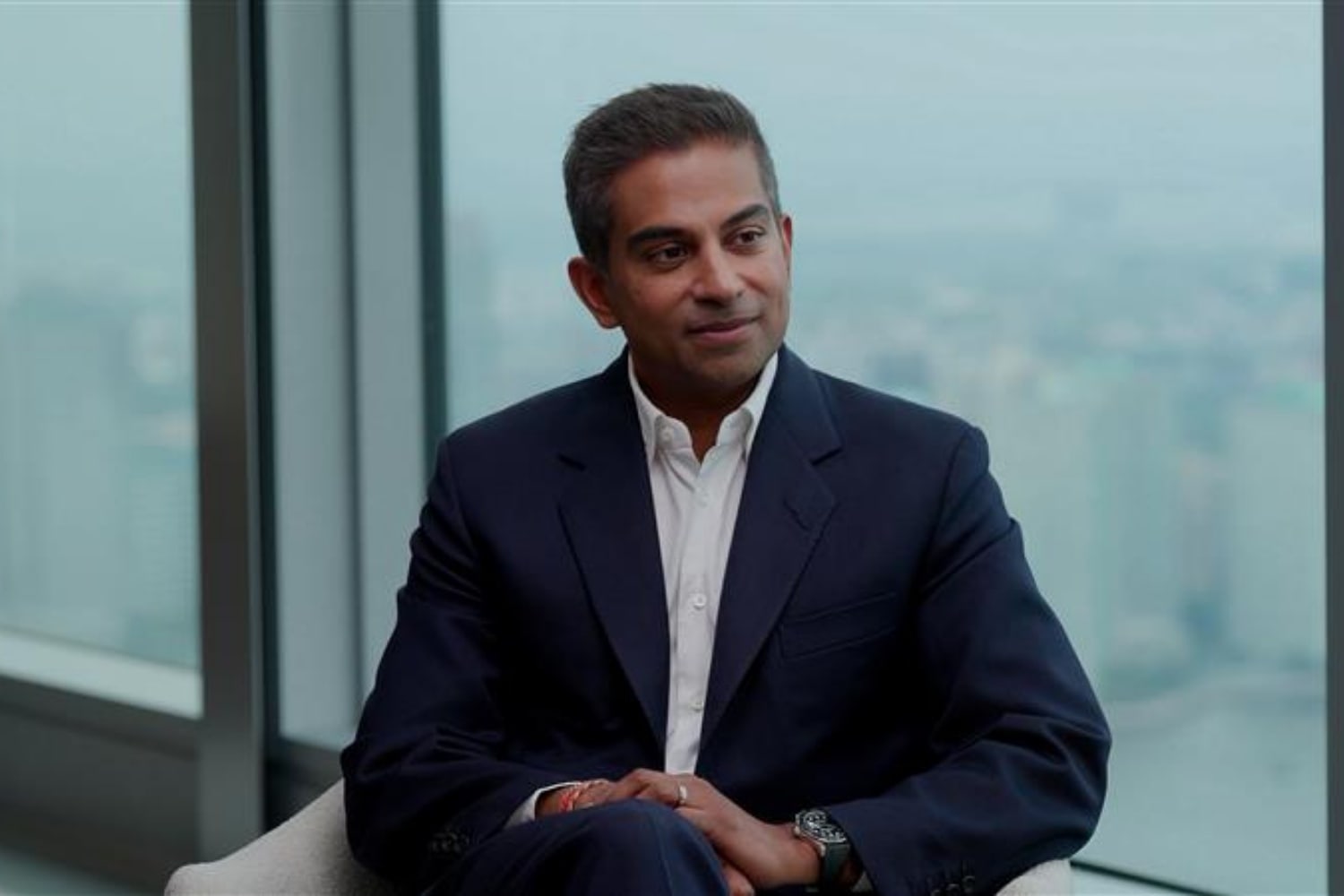
Dipan Patel: Good things happen to good companies, and bad things happen to bad companies. I think what AI is doing is just accelerating those things. So if you’re a business that aggregates commodity data, sells it through a commodity channel with a commodity UX, you are probably already on a decline curve and if you’re a company with proprietary data and with network effects, an incredibly strong brand, and you’ve built a user experience which is built for the idiosyncrasies of a vertical probably you’re going to be on the right side of AI”.
Alison Mass: Welcome to Goldman Sachs Exchanges: Great Investors. I’m Alison Mass. I’m about to sit down with Dipan Patel, Co-Managing Partner and Co-CEO of Permira, a global investment firm spanning private equity and credit, with approximately $100 billion in assets under management.
So welcome to Great Investors. It’s so great to have you here.
Dipan Patel: Thank you for having me.
Alison Mass: So, everyone remembers their first job, but yours must have been especially memorable. You worked at Arthur Andersen in 2002, and then after university you went to Lehman Brothers.
Those must have been fascinating experiences. So, tell us a little bit about them.
Dipan Patel: Yeah, that’s right. I worked at Arthur Andersen in 2002 during the Enron scandal, and then Lehman Brothers in 2008, obviously during the global financial crisis.
Formative to see two iconic companies struggle and eventually fall before I was 30. Once you see it, it’s hard to unsee it.
Alison Mass: Yeah.
Dipan Patel: It leaves lasting memories and a lot of learnings.
Alison Mass: Tell us about Permira today. For those who aren’t familiar, what makes Permira unique? And maybe tie in some of the lessons that you learned from earlier in your career that have helped you lead Permira today.
Dipan Patel: So, Permira started in 1985 as four people and $48 million from Schroders Bank. Over the last 41 years, if you wind the clock forward, the business has raised more than $100 billion of capital.
We have about 500 people, 250 investors, and 16 offices globally. We invest in private equity and in credit. Our private equity business invests really across four sectors: consumer, healthcare, services, and technology. It does this primarily across the mid-market, so think businesses in the kind of $200 million EV to $2 billion EV range.
And everything we do is really significant minority so governance with teeth, all the way through to full control. We are very active owners. Then our credit business invests across private credit through to liquid credit and right through the risk-return spectrum. You asked a question around what makes us unique and what’s our edge.
I’d say it is a few different things. The first thing is Permira raised the first Pan-European fund in late 1990s and as a result, we built boots on the ground right across Europe and just dense networks, relationships, footprints, and that’s served us really well.
That’s 50% of our investing today. At the same time, we’re probably one of the very few firms that have an equal weight to the US and European business. About 50% of our people sit in the US, 50% are in Europe, 50% of our capital deployed and capital return have come from both regions.
So that’s one. We have what we call digital core multi-sector, so we’re very deep in digital. But the most interesting aspect of our investing has always been at the intersection of digital and our real economy sectors, so consumer healthcare and services.
And that’s where we have a particular edge. Like a real economy business where there is a significant value creation underwrite in the realm of digital is power alley for Permira. We have a very strong growth DNA, so we’ve probably got one of the fastest-growing portfolios in the larger cap end of PE.
Our portfolio consistently grows organically low teens top line and significantly higher at the bottom line that’s by design. We over-index to growthier businesses. The typical Permira business will be under-levered, under-margined and over-growthed, and we really like that formula.
In the end, when you’re selling businesses, particularly selling businesses to strategics, you are trying to convince someone that there is a long growth runway, and you don’t get there by under-investing in a business and milking a business over your investment period. So, we tend to invest really deeply in new products, new channels, new geographies.
We often do business model transitions, but growth underwrites are central to anything that comes through our investment committee. And then the last thing is, we are a private company. It’s not unique there are a bunch of scaled private equity funds, but it’s increasingly becoming important over time.
And we’re a private partnership since inception, that’s not changed. We’re owned by our partners, and that goes ultimately to outcomes and performance and incentives and alignment.
Alison Mass: In what ways does being private and remaining private help with your investment culture and with retaining talent and recruiting talent?
Dipan Patel: So Permira is built by investors for investors, and so we want and attract people who are craftspeople, right? So, I think the industry is bifurcating between more, like, factory models and artisanal models.
Alison Mass: Right, and you’re an artisanal model.
Dipan Patel: Yeah, there’s no right or wrong in these models and both these models will work, but they are definitely different, and they attract different types of people. And if you’re someone who likes to craft an investment thesis, think differently, work a deal, is comfortable with really long gestation periods, wants to be an absolute expert in their space; is frankly comfortable not doing deals and being in the cadence of just allocating assets, Permira’s going to be the place for you. And if you want to build new products and new channels and new business lines. There will be other firms that are better homes for those people. But Permira’s a craftsman’s place of work.
Alison Mass: Yeah. That’s a great way to describe it. So thank you for that. So you’ve been at Permira since 2009.
Was there any particular deal from early in your career that you’re especially proud of?
Dipan Patel: We did a deal taking a company called Renaissance Learning private in the US.
It was an ed-tech company. It was sold into 70,000 schools. And ended up selling it in two and a half years. We made more than four times the money. Did a range of things with that company, and I was fortunate to be involved in it.
The reason why it’s special for me was. And I think actually says a lot about our firm when I joined, and I think we do this a lot with our junior talent, we really encourage thematic thesis-driven work from right at the beginning of people’s career journeys in the firm.
And I went off and I started working on a thematic piece in ed-tech. I remember coming up with something called the global top 10 these companies that I thought would be interesting.
Alison Mass: And Renaissance was on that top 10?
Dipan Patel: Renaissance Learning was on that top 10. And, you know, I was relatively new to the industry and I went to my principal at that time, who now actually is a partner in the firm, and said, “Look, I’ve been doing this work, and what do you think?”
And actually, funny thing I’d reached out to a guy called Barry O’Brien-
Alison Mass: Right.
Dipan Patel: Who was I think then probably a VP at Goldman Sachs.
Alison Mass: Yes, who now runs our TMT business globally.
Dipan Patel: And he put me in touch with Terry and Judi Paul, who owned the company. And I said to the guys there, “Well, should I just go?” And they said, “Sure, just go.” And I was an associate in the firm, and they said, “Just call this guy on the West Coast” cause it’s a US thing.
And so I called a guy called Brian Ruder, and we went along to the meeting. It was in Denver. And one thing led to another, and we ended up prosecuting that deal and taking that company private. And the great thing about it for me was, and I think about it a lot with the junior talent we have in the organization, is that idea came from a junior person.
It also came because that junior person was encouraged to go take that thread as far as they possibly could. It was fascinating for me because the things we did with that business, we shut down a hardware division, we transitioned the whole business model to SaaS, we entered a new country, we invested in this whole new math product.
We did that all in the course of about three years and got rewarded for all of it so it was a vignette of good stuff. I got spoiled because I probably ended that and thought-
Alison Mass: You said, like, “This is easy.”
Dipan Patel: “This is how private equity works.” Right? And so yeah, special place in my heart that investment.
And thank you to Barry.
Alison Mass: Yeah. I love the story, how it originates with a call to Goldman Sachs.
Dipan Patel: Yeah.
Alison Mass: I’m going to have to tell Barry that and Brian, the first deal with Brian. So now you share the top job at Permira with Brian. How did that come about, and how do you split up responsibilities or look at being co-managing partners?
Dipan Patel: Yeah, so Brian and I have worked together for a long time. So actually, after we did Renaissance Learning together Brian called me some point and said, “Take a look at this business called Ancestry.com.”
And long story short, we took that company private, made nearly four times the money on that investment, and in the middle of that he said, “Why don’t you come out to the West Coast?”, so I moved out to the West Coast, and I worked in-
Alison Mass: What year was that?
Dipan Patel: That was in 2012.
Alison Mass: Okay.
Dipan Patel: And I was in our Menlo Park office which is now 40 people and that…
But at that time it was four or five of us. And so I got to know Brian there, and we worked together on lots and lots of deals you know, Ancestry and then many other deals together after that. So we had a long, very long working relationship. Permira’s done five leadership transitions in its 41-year history, the common themes have always been the two co-managing partners or the new co-managing partner has been an internal promote and the existing leadership or leader has stayed in the organization for a handful of years and been very active. So that’s been very consistent in terms of the way that this leadership transition has worked.
Brian and I, as I said, we’ve worked together for a long time he’s based in the US, I’m based in Europe, and we both grew up in tech, but he co-ran tech I went on to co-run the consumer team, so that’s two of our biggest sectors and we tend to have a co-leadership model we like that model. I think Goldman Sachs has a-
Alison Mass: We do.
Dipan Patel: Fair amount of co-leadership in your sectors and geographies too. It was a natural evolution a couple of years ago when Kurt moved up to Executive Chairman, and Tom had left the business. I would say the most important thing, and of course Brian and I, we have our splits and obviously across geography and sectors and things like that. The most important thing is we make eight to ten really important investing decisions every year.
We make about eight to ten really important exit decisions every year. And less important is how we split the this and the that of the organization, and more important is how we come together, and the investment committee comes together to make just as many world-class decisions as we possibly can.
As I said earlier, we’re a private company, and most of our economics are tied up in the outcomes that we drive, and those decisions are the most important things we do every single year. And if we get them right, we can get a lot of other things wrong. And if we get them wrong, there’s any number of things we can get right, and it won’t make up for it.
Alison Mass: Sounds like a great partnership, and a long-standing-
Dipan Patel: Yeah, that’s right.
Alison Mass: Partnership. So as you mentioned, Permira has built dedicated sector teams in tech, in consumer, services, and healthcare, long before that was standard practice in private equity. So how does AI affect that calculus? There is a perception that a lot of private equity-backed companies stand to be disrupted by AI. So how do you take that into account in your investment committee processes?
Dipan Patel: So, good things happen to good companies, and bad things happen to bad companies. And we think of good companies as companies with strong moats.
And bad companies as companies that lack moats, and obviously that’s a spectrum. I think what AI is doing is just accelerating those things. So, if you’re a business that aggregates commodity data, sells it through a commodity channel with a commodity UX, you are probably already on a decline curve, and AI is going to accelerate that.
And if you’re a company with proprietary data and with network effects, an incredibly strong brand, and you’ve built a user experience which is built for the idiosyncrasies of a vertical probably you’re going to be on the right side of AI, and you are probably succeeding anyway, and AI is going to allow you to add an intelligence layer on top of what you already have and then monetize that.
The private equity industry probably has got a mixture of good and bad companies. And I think the metric that we think about in our firm is how much of our NAV is … Or, or do we feel happy about when Dario opens his mouth. Or when Anthropic drops a model? And honestly, that number was, we were figuring that out probably two, three years ago and were probably on the defense. Today we’re definitely on the offense on that, and that metric is only going up and to the right. But if I look out across the entire private equity industry, and I don’t know the stats, but the reality is there is a mixture.
And for sure 100% of the NAV sitting in the private equity industry is not on the right side of AI and is not benefiting every time a new model is released.
Alison Mass: So are there specific sectors or sub-sectors where you’re looking to deploy capital now?
Dipan Patel: Yup. So first of all, just zooming back it’s a fascinating time to be alive it’s also very stressful and sometimes confusing time to be alive. And I always like the McKinsey analogy of you know, you’ve got the microscope in one hand, and you’ve got the telescope in the other. And when you look down the microscope, the list of problems or the wall of worry is endless, right?
You have government indebtedness, you have potential rate hikes, you have more armed conflicts in the world today than any time since Second World War, you have the threat of unemployment from AI, and I could go on and on and on. At the same time, you’ve got a major platform shift which is super early innings, and it’s going to reshape industries and reshape profit pools.
You have energy transition where power demand is going to double over some period of time, and at the same time, half of the grid capacity is going to need to be retired, you have major advances in the medical field, you have a country in India which is going to come online and drive very significant growth over the next 20 years.
So you’ve got these kind of two things in your hand at the same time, and I think as a leader you’ve got to take a distanced view of the stuff that’s close up and a close view of the stuff that’s far away. And that’s what we try and do in the organization and just think really long term and think about our exit environment and try and skate to where the puck’s going rather than where the puck is.
All of those things and those big, let’s call it telescope things, they’ll be expressed through our sectors I think in different ways. I think within software, it’s going to be about adding an intelligence layer and monetizing that over time. I think within services there will be fascinating things to do in engineering services, in blue-collar services.
In consumer, I think AI’s going to radically transform personalization that will completely change and change the way that companies speak to consumers and how they get into consumers’ wallets. Healthcare — there’s something like 10,000 known diseases and only 600-ish target medicines target drugs for those.
There will be major advances in those fields over time. So we like our bets. We like where we invest, and we will express these big telescope-type things through our sectors in different ways. But we’ve always found the key thing is you have to be on the right side of these big structural trends even if it means paying up and paying more and feeling uncomfortable when you pay up.
Like, over the long term, back to what I said around good things happen to good companies, you just tend to expose yourself to good luck when you’re on the right side of these structural trends, and you tend to be inundated with bad luck when you fight those things.
Alison Mass: Yep. That was a thoughtful way to analyze it. So, you mentioned that you and Brian spend most of your time focusing on the most important investment decisions that you’re going to make each year, and the divestitures, the monetization. So can… What about the much-talked-about issue of liquidity in private equity and the exit backlog that we all talk about. How do you see it, and how are you managing Permira through that?
Dipan Patel: So look, the industry and the model, it only really works if there’s about 20% to 25% DPI per ann. And the industry’s not been delivering that, and it’s not been delivering that for coming up to a handful of years now, right? I think that stat’s probably 10-ish percent.
And that can’t continue if the business model is to work and flourish. So first of all, yes, I think it’s problematic. We each take our data points in the last 12 months, our stat is 22% so we’ve realized 22% of our NAV over the last 12 months, and we’ve done that through a variety of different exit routes.
It’s not easy but it requires you and your organization to have the mindset that DPI is an operating rhythm. It’s not an event. And frankly, and it’s uncomfortable for people, but the truth is, it’s ancient history the second you send the money back.
Alison Mass: Right.
Dipan Patel: Right? And you need to be focused on the next set of things that you’re going to be monetizing and bringing to market.
We have a centralized target-setting system. We have an exit committee we drive really big accountability down the organization. We set incentives that are linked to achieving those things but the single most important thing really is just having good companies.
It’s cliché, and it’s easy to say, but good companies sell themselves, and bad companies just get stuck. And the single biggest reason why we’ve got excess liquidity over the last 12 months, the last 24 months actually if you go back, is actually not our processes and our incentives and our systems.
It’s actually that we’ve got businesses that are desirable. They are businesses that people want to own, and the reason that they want to own them is they have very long growth runways at exit. They’re not over-optimized businesses.
Alison Mass: For our viewers, can you discuss what DPI is? What does it stand for?
Dipan Patel: So, you know, DPI is really just money being sent back to investors. I think that’s the easiest way to describe it. When we talk about percentage of NAV that’s the percentage of your unrealized net asset value and the way that we tend to look at it, and I think the industry tends to look at it, is how much money are you sending back as a percentage of your unrealized net asset value that you’re sitting on? And that metric ought to be at 20 to 25%.
Alison Mass: Got it. Thank you for clarifying. So every investment firm talks about culture. But culture is often forged and built during periods of stress.
Dipan Patel: Yeah.
Alison Mass: So how has Permira’s culture evolved over past market cycles, and how does it guide your decision-making today?
Dipan Patel: So, Lehman Brothers and Arthur Andersen two different companies, two different times two different factors, two different faces at the top of those organizations.
The common theme in those organizations was, in my view, was the same thing that led to extraordinary success for each of them led to extraordinary downfall. So the case of Arthur Andersen, they had built a really strong business cross-selling consulting services into audit clients, and then that caught them out with Enron when they pushed that too far.
Lehman, you know, Lehman wasn’t a bank, it was a broker-dealer. It was borrowing short, and it was investing that very aggressively on the other side. And that led to huge success over a couple of decades until it didn’t.
Alison Mass: Right.
Dipan Patel: And then the question you ask yourself is sort of why and why was that allowed to, to happen? And at least in my view, it was… they’re both examples of just, like, culture failing at scale. And I think if you walked around both of those companies, and I was a very junior person in both of those companies at the time, so I was nowhere near the top table.
But there’s a feeling you get being in organizations. Doesn’t matter what level you are. And I think the common themes in those organizations was probably you had charismatic leadership, you had really big growth ambitions, you had a ton of confidence, you probably also had a culture of risk-taking that had gone too far.
Sort of risky practices that were, like, normalized. You had probably people that couldn’t speak truth to power, you had incentives in the wrong place, and that would’ve been common between both of those companies.
Alison Mass: Yeah. Those are dangerous things to have.
Dipan Patel: Right. And you know, because you’ve built an amazing business in Goldman Sachs, there would’ve been a set of things that would’ve led to that success and continue to propel the company forward today.
But if the culture isn’t one that welcomes diversity of thought, the speaking of truth to power, structures that actually risk manage, any company, including Goldman Sachs, will run into the same problem over time. So that kind of, like, cultural underpinning and bounded entrepreneurialism is really important.
So, I think that now coming back to your question around Permira and culture, I think that, you know, you sort of you live your life forward, you understand it backwards. And I certainly wasn’t taking notes during Arthur Andersen or Lehman Brothers. But by osmosis, I think those things would’ve, you know, impacted the way I think about culture.
Permira is an organization and the number one thing I love about the organization is it gets better out of stress so I’ve always loved the book Antifragility, the Nassim Taleb book. And it’s kind of a complicated book, but the core idea I think is quite simple, and it’s that there are robust systems, and they tend to endure crisis and stress, and then there are anti-fragile systems that get better out of crisis and stress.
And Permira without question, has got better and much better, much faster out of peak stress moments. And I could go through a list of those moments over, you know, 40-plus years. I think the one that was most probably visible to me, and I lived through and is a huge part of our history, was obviously the global financial crisis.
We had a fund at that time which was full of businesses, actually pretty good businesses, but cyclical. Too, too much cyclicality, too much leverage at the wrong time in the cycle we had invested too quickly and when the cycle turned, you know, we… When I joined Permira I remember sitting in …
Actually, it was Tom had put up a slide and he put the fund mark up and I thought it was a typo.
The organization you know, we didn’t lose anyone. The investors, the partners dug deep into their own pockets as we, we sort of had a down round in terms of the next fund cycle.
We held the keys to our businesses, we monetized at the right time, we did some great investing in the rest of that fund. Actually, things like Renaissance Learning and Ancestry were part of that part of that fund too. That fund ended up emerging as a top quartile fund.
Alison Mass: Wow. That’s spectacular. That’s great.
Dipan Patel: And we got better out of that. We also, you know, pivoted our strategy at that time to much higher quality businesses, resilience, growth, structural growth. And that’s the core of our strategy today that we prosecute through our sectors.
And so, yeah, I mean, culture for me, and that’s the thing that I’m most focused on, probably those two things. One is not running into that Lehman, Arthur Andersen problem, right? So having the confidence to know what you do and do well and drive deeper and deeper into that.
And always reevaluating first principles, whether what you’re in and doing is the right thing on, on the one hand, and then making sure we’ve got an organization that is able to not just endure but come out of stressful situations in a better place.
Alison Mass: Yeah. So, it’s like confidence with humility.
Dipan Patel: Exactly.
Alison Mass: So that culture also expresses itself beyond your portfolio, and Permira has made a significant commitment to philanthropy through its foundation. How did that initiative begin, and what makes it important to the firm today?
Dipan Patel: We set up the Permira Foundation 10 years ago. We back today about 35 organizations, 80% of the professionals in our organization have donated significant time and are donating significant time pro bono to these organizations. So it’s really important culturally for us. We just took the decision this year to make the foundation a permanent carry holder in our funds.
Alison Mass: That’s interesting.
Dipan Patel: So we think we’re one of the very few firms maybe the only firm that at least I know of that has done that. And that’s, it’s quite a big ask to go to our partners and say, you know, permanently we want this foundation to be aligned with the outcomes that we drive.
So yeah, it’s you know, important thing. Thank you for asking about it because we never really get to talk about it, but it is important inside our organization. We do talk about it, and most often we only talk about it inside our, inside our business.
Alison Mass: Yeah. Well, it’s, you’re showing a lot of leadership in the industry. I have not heard of anyone putting carry in their foundation. That’s fantastic. So, you and Brian are part of a new generation of private equity leaders.
Dipan Patel: Yeah.
Alison Mass: And looking across the industry more broadly, where do you think your generation of leaders will take private equity over the next decade?
Dipan Patel: It’s a great question. I mean, look, the industry is bifurcating, right? That’s no secret, and you have two very distinct business models emerging, and you have people that are generally private, generally very narrow, and deep in what they do, and they live or die on whether they perform or not.
And there are pluses and minuses to that model. And then there are firms that are building their businesses through newer and newer business lines scaling their products, and breadth is really important to those firms. The retail channel is really important to those firms, but it’s like a different set of considerations.
I can’t speak to both. I can only really speak to what we’re doing, and probably what the set of people new, leadership in this part of the world are thinking about. I’m just really excited about a really simple thing, which is building an organization with a really distinct investing culture.
It becomes the talent magnet for people that want to be craftspeople and just generating superior outcomes over the long term and doing that consistently. And that is no mean feat. That’s really hard to do. It requires just a persistent level of dissatisfaction with every single part of your business, and just constantly turning stones up and asking why we can’t be better, and pushing, and investing and thinking long term.
Being willing to skate to where the puck is going, not where it is today. Those things are easy to say. They’re really hard to do and force yourself to do every day. But I’ve been with the firm 17years. I’d love to be with the firm another 17 years. And Brian, I know feels the same way, and I think that’s what we’re most excited about doing.
Alison Mass: That’s great.
So, on a personal level, you grew up in an immigrant family and watched your father scale a business from the ground up.
Dipan Patel: Yeah.
Alison Mass: How did that first-hand look at entrepreneurship shape your worldview and your approach to backing founders today?
Dipan Patel: My dad, he came into the country in his probably mid-20s. Had a single store long story short, scaled that to about 60 stores. In really, like, prime locations across London. These are grocery stores.
Did a very small P2P, public to private, in the middle of that sold that business to Tesco in 2000, he found another business scaled that over about 20 years sold that to Apax France a roll-up they were doing there.
And, you know, he’s 75 now, and he’s looking for the next thing to do. I think I was relatively kind of street smart probably from an early age just from seeing that kind of stuff ground up I also just developed an empathy for founders.
I’m not a founder and actually my dad always tells me that. I won’t ever understand what that really means to go to bed at night and have on your shoulders an organization in that way. I think that’s just a completely different thing.
But the grit, just the sheer work ethic, of just watching that was huge. The sort of the risk-taking and the calibration of that risk-taking and the confidence and paranoia that that takes you know, it stuck with me.
Alison Mass: Makes total sense. Really an impressive entrepreneurial background.
Dipan Patel: Yeah.
Alison Mass: It’s fabulous. So I like to end these conversations with a lightning round.
Dipan Patel: Yep.
Alison Mass: Just ask you some short-answer questions. So what do you think your personal greatest strength is as an investor?
Dipan Patel: I’d say knowing what I don’t know and knowing where to get it.
Alison Mass: Okay. What was the very first investment you ever made?
Dipan Patel: That was actually before Renaissance Learning. In another private equity firm that I started with, there was a company called Sagem. It was a carve-out from Siemens
Alison Mass: What’s the best piece of advice you’ve ever received?
Dipan Patel: I think in the investing sphere probably I always think about the Howard, I think it was Howard Marks’ phrase “The four most dangerous words in investing are ‘this time is different.'”
Alison Mass: We talked about that earlier with your investment committee. How do you spend your time out of the office?
Dipan Patel: I’ve got three kids, 9, 11, 13, and you know, I mean, this job is, it’s seven days a week, and it’s very intense. And so virtually all my time I try and spend with my wife and my kids.
That’s the first priority. If I’m not doing that, I love sport. I love live sport. I’m a season ticket holder at Liverpool. I’ve traveled the length and breadth of the country and countries to follow the team, and that’s the most likely place you’ll find me is Anfield if I’m not with my family.
Alison Mass: Which investor do you admire most?
Dipan Patel: I think Chris Hohn probably for the way he thinks. Buffett for his temperament. Probably Munger in the same breath, and Howard Marks for sort of like risk management. So yeah, the standard greats I would say.
Alison Mass: Yeah. Well, very impressive investors. And finally, what are you most excited about in the world right now?
Dipan Patel: The whole thing. Everything we talked about. It’s a great time to be alive.
Alison Mass: Yeah. Anyway, Dipan, thank you so much for joining me. Thank you. This was a great conversation.
Dipan Patel: Thank you. Really enjoyed it.
Alison Mass: Thank you all for listening to this episode of Goldman Sachs Exchange’s Great Investors, which was recorded on July 28th, 2026. I’m Alison Mass. If you enjoyed this show, we hope you’ll follow us on Apple Podcasts, Spotify, or YouTube, or wherever you listen to your podcasts, and leave us a rating and a comment.