
What happened?
Growth stocks can be appealing to some investors.
They allow investors to participate in companies that may grow faster than the broader market over time, whether through new technology, earnings recovery, expansion into larger markets, or long-term growth themes such as artificial intelligence, semiconductors, data centres, healthcare and digitalisation.
However, growth investing can also be tricky, as a company may have a strong story but weak profits, expensive valuations or too much debt.
That is why I think investors need more than just a good story when looking for growth stocks.
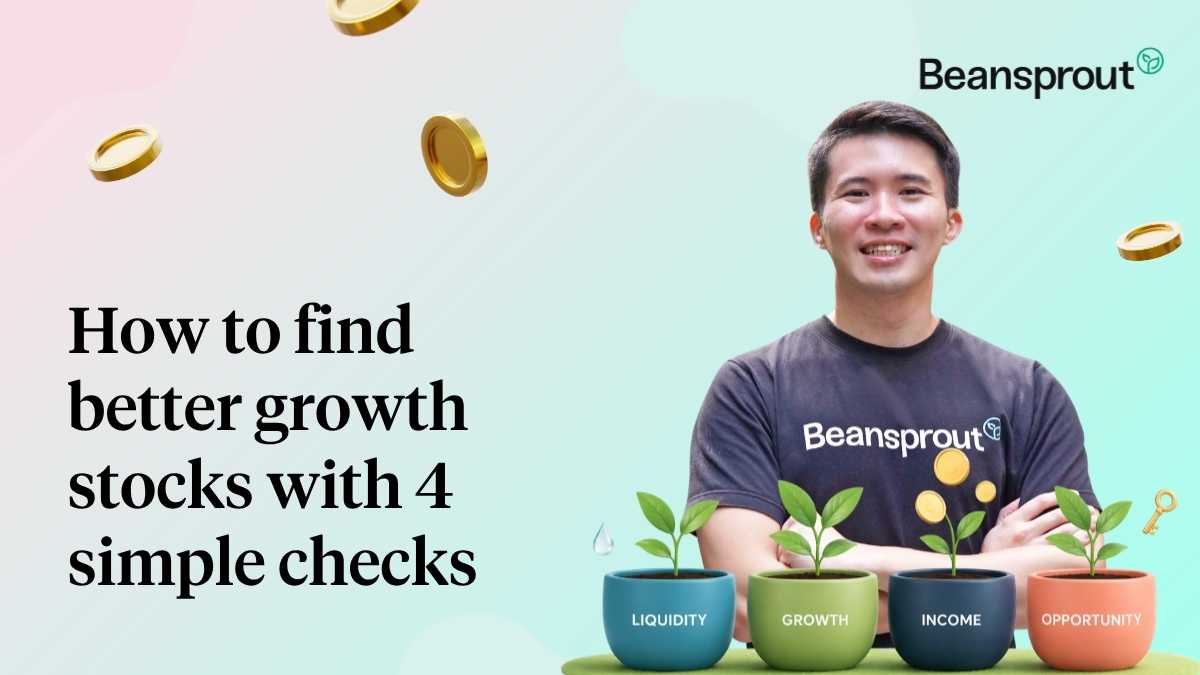
Within Beansprout’s four pots of wealth framework, higher-growth ideas would usually sit within the Opportunity Pot., where we look for companies that can potentially grow meaningfully over the next one to three years after applying a disciplined process.
In this article, we focus on one important part of that process: four simple screening factors that help us decide whether a growth stock deserves deeper research.
Why screening matters when picking growth stocks
Many growth stocks sound attractive at first.
The company may be in a fast-growing industry. It may have reported strong revenue growth, expanded into new markets, or appeared frequently in analyst reports and investor discussions.
But a good story does not always make a good investment.
For example, a company may be growing revenue quickly, but still fail to generate profits. Another company may be profitable, but carry too much debt.
A smaller company may look promising, but its shares may be too illiquid for investors to enter or exit easily.
This is why screening is useful. It helps us slow down before getting carried away by the excitement of a stock idea.
However, screening is only the first filter.
It does not replace deeper research into the company’s competitive advantage, management quality, catalysts, valuation or risks.
Instead, it helps us remove weaker candidates before we spend more time on detailed analysis.
At Beansprout, we would look at four key factors when screening growth stocks:
- Size and liquidity
- Revenue and earnings momentum
- Balance sheet strength
- Return on equity
A stock does not need to be perfect across all four areas. However, we would generally want it to pass at least three of the four factors before moving on to deeper research.
4 easy steps to screen for the best growth stocks
Step 1: Check the company’s size and liquidity
The first factor we would look at is size and liquidity.
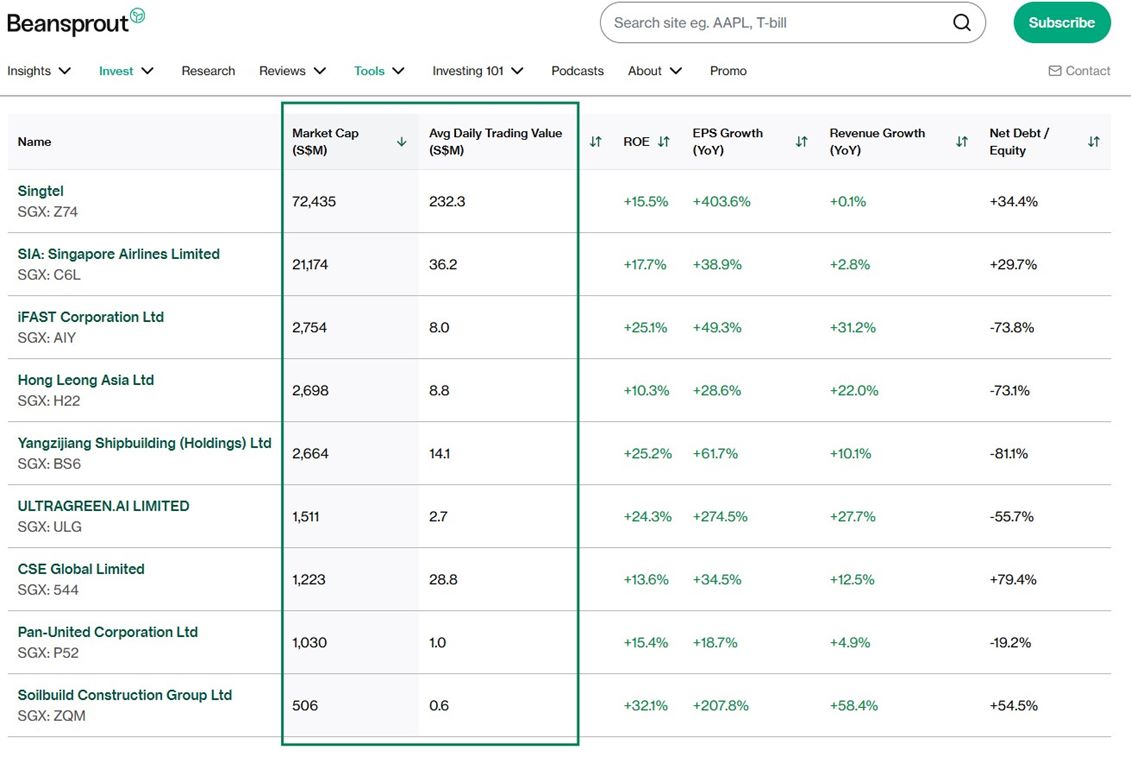
As a guide, we prefer companies with a market capitalisation of at least S$500 million and average daily trading value of at least S$500,000.
This may sound like a boring place to start. After all, investors are usually more interested in growth, profits and share price upside.
But liquidity matters.
If a stock is too small or thinly traded, it may be difficult to buy or sell without affecting the share price.
This becomes especially important when the investment thesis changes.
For example, if a company reports weaker-than-expected earnings or its growth outlook deteriorates, we would want the flexibility to exit the position. If trading volume is too low, exiting may become difficult or costly.
This is why size and liquidity are important risk management tools.
They do not tell us whether a company is attractive. But they help us assess whether the stock is practical to own.
For investors building an Opportunity Pot, this matters because higher-growth ideas can be more volatile. We want to be able to act when the facts change, rather than be trapped in an illiquid position.
That does not mean smaller companies should always be ignored.
Some smaller companies may have strong growth potential. But if the stock is very illiquid, I would usually size the position more carefully or keep it on a watchlist until liquidity improves.
You can screen for stocks that meet Beansprout’s 4-factor opportunity framework here.
Step 2: Look for revenue and earnings momentum
The second factor is growth momentum.
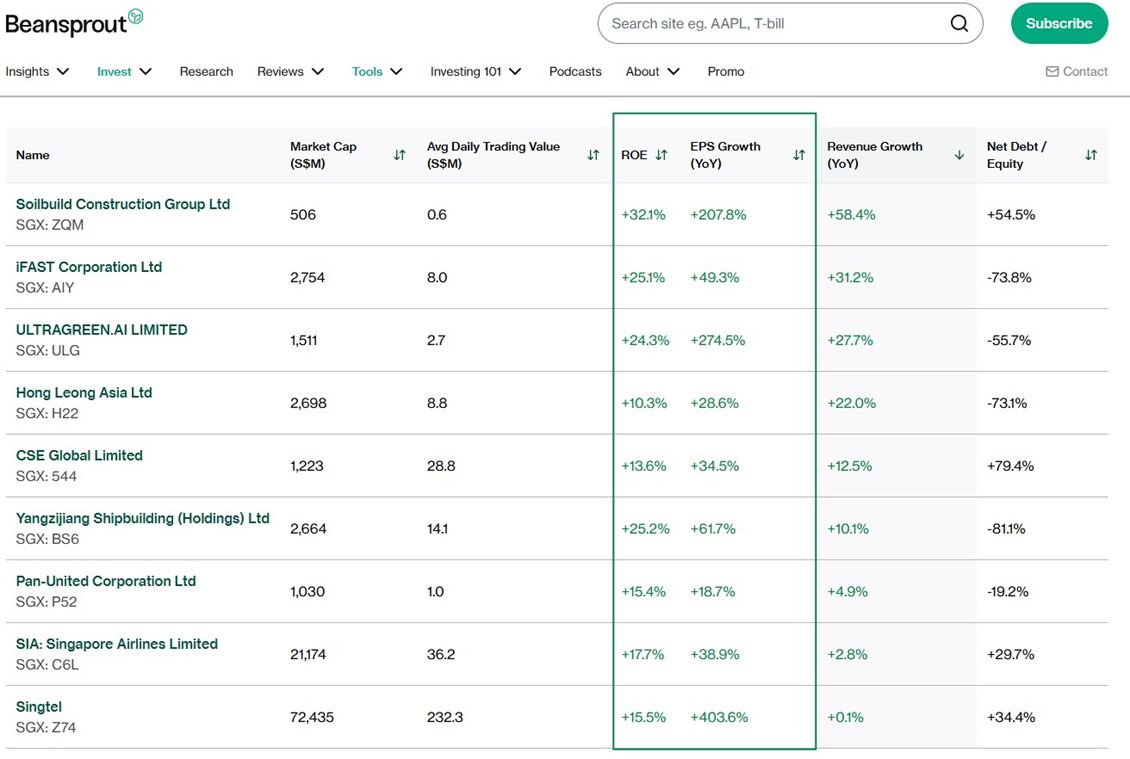
For a growth stock, we want to see revenue and earnings growing, or at least improving clearly.
Revenue growth tells us that demand for the company’s products or services is rising. Earnings growth tells us that the company is turning that demand into profits.
Both matter.
A company that grows revenue but does not grow earnings may still be struggling with costs, competition or poor execution.
For example, a business may be selling more, but if margins are falling, profits may not improve meaningfully.
That is why we prefer to see earnings growth keeping pace with revenue growth.
Ideally, earnings per share should grow faster than revenue. This may suggest that the company is benefiting from operating leverage, better margins or stronger cost discipline.
For example, if a company’s revenue grows by 10% but earnings grow by 20%, it may suggest that more of each additional dollar of sales is flowing through to the bottom line.
That is usually a positive sign.
We would also watch for repeated earnings misses.
One weak quarter may not be a major concern. Businesses can face temporary issues such as higher costs, project delays or weaker demand in a specific market.
But if a company keeps missing expectations, it may suggest that the growth story is less reliable than investors had hoped.
For growth stocks, execution matters a lot.
The market often prices these companies based on future potential. If earnings repeatedly disappoint, the valuation can come under pressure quickly.
This is why revenue and earnings momentum are important.
They help us check whether the growth story is showing up in the numbers.
You can screen for stocks that meet Beansprout’s 4-factor opportunity framework here.
Step 3: Make sure the balance sheet is not too stretched
The third factor is balance sheet strength.
Growth often requires investment. A company may need to build new capacity, expand overseas, hire more people, invest in technology or acquire another business.
There is nothing wrong with that.
But if growth is funded mainly by debt, the risks can increase.
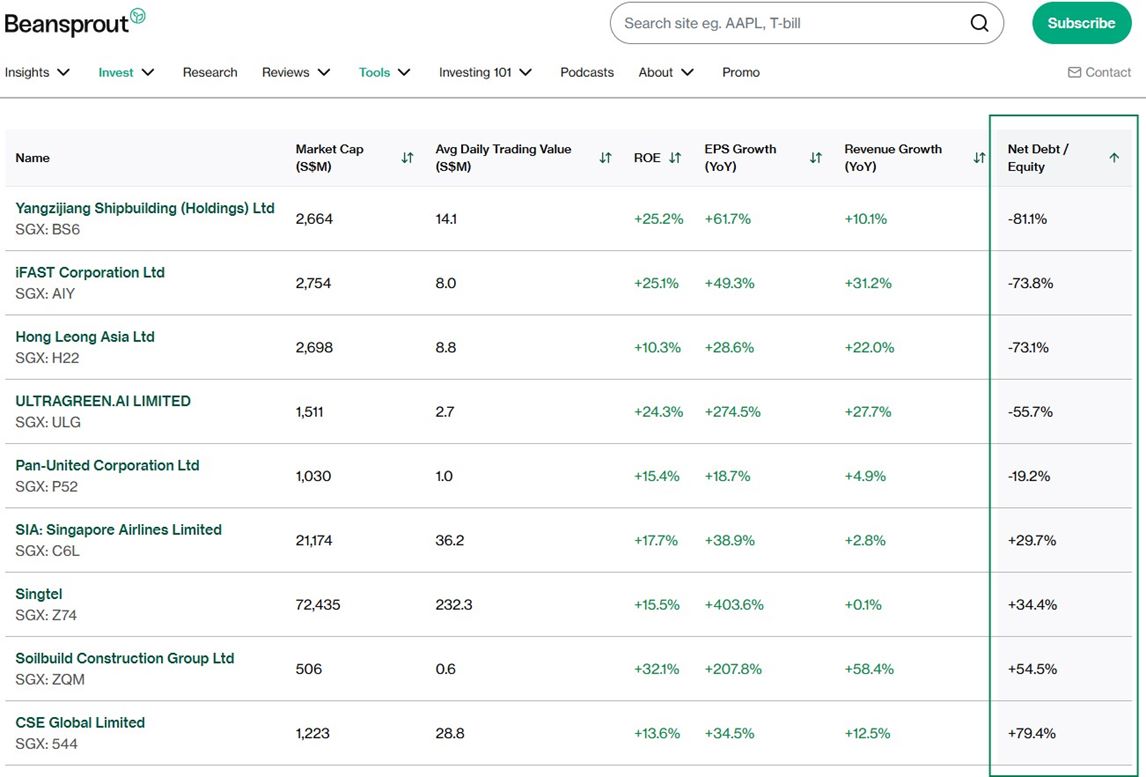
As a guide, we prefer companies with net debt-to-equity below 1.0 times. If net debt-to-equity is above 1.5 times, we would treat it as a warning sign unless the company has strong and consistent cash flow to support its borrowings.
Debt is not always bad.
Used carefully, debt can help a company expand faster and improve shareholder returns. But too much debt can make a company fragile when conditions change.
If interest rates rise, financing costs may increase. If demand slows, cash flow may weaken.
If the company needs to refinance its borrowings during a difficult period, it may face pressure.
This is especially important for growth stocks because investors are often paying for future expansion. If the company has to slow down growth in order to repair its balance sheet, the investment case may change.
A stretched balance sheet can also reduce flexibility.
A company with manageable borrowings can continue investing through a downturn. A company with too much debt may have to cut costs, sell assets, raise equity or reduce dividends.
This is why we do not want to look at growth in isolation.
A company may be growing quickly, but if the balance sheet is weak, the growth may not be sustainable.
You can screen for stocks that meet Beansprout’s 4-factor opportunity framework here.
Step 4: Check whether the company generates good returns
The fourth factor is return on equity, or ROE.
ROE measures how effectively a company uses shareholders’ capital to generate profits.
A simple way to calculate ROE is:
ROE = Net profit / Shareholders’ equity
Shareholders’ equity refers to what belongs to shareholders after deducting a company’s liabilities from its assets. In simple terms, it is total assets minus total liabilities.
Think of it like a hawker stall. Imagine you invest $100,000 to set up a chicken rice stall. At the end of the year, the stall earns a $15,000 profit. Your return on that $100,000 investment is 15%, that’s your ROE.
Now imagine your neighbour opens a noodle stall with the same $100,000 but only earns $8,000. Their ROE is 8%. Your chicken rice stall is the better business because it generates more profit per dollar you put in.
As a baseline, we would look for ROE above 10%. This helps us assess whether the business is generating meaningful returns for shareholders.
A company with a high ROE may have a strong brand, good pricing power, an efficient business model, cost advantages or capable management.
A company with a low ROE may be using a lot of capital but generating only modest profits.
For growth stocks, this matters because not all growth creates value.
A company can grow by spending heavily, acquiring assets or expanding aggressively. But if those investments do not produce attractive returns, shareholders may not benefit much.
This is why ROE is useful. It helps us ask whether the company is growing profitably, not just growing for the sake of growth.
However, ROE should not be viewed in isolation.
A very high ROE may sometimes be boosted by high leverage. That is why we also look at the balance sheet.
The best combination is a company that can grow revenue and earnings, maintain a healthy balance sheet, and generate strong returns on shareholders’ capital.
That would suggest that the business has both growth and quality.
You can screen for stocks that meet Beansprout’s 4-factor opportunity framework here.
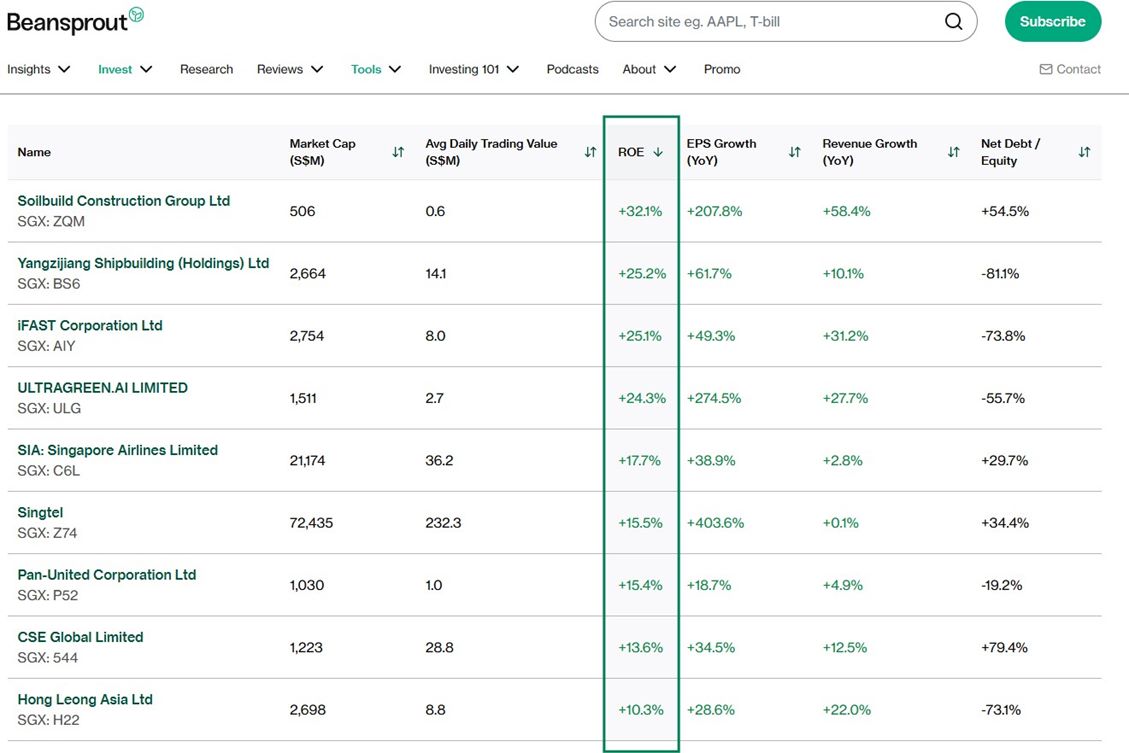
How to use Beansprout’s four-factor screen to filter for the best growth stocks
You can screen for stocks that meet Beansprout’s 4-factor opportunity framework here.
However, it is worth emphasising that the four-factor screen is not meant to give a final buy or sell answer. It is a filter.
A stock that passes the screen is not automatically a good investment. It simply means the company has met a basic standard of quality and may deserve deeper research.
If a stock passes at least three of the four factors, I may put it on a refined watchlist.
From there, I would still need to study the company’s business model, competitive advantage, management track record, catalysts, valuation and key risks.
If a stock fails most of the factors, I would be more cautious, even if the story sounds exciting.
Here is a simple way to think about it.
| Factor | What we prefer to see | Why it matters |
| Size and liquidity | Market capitalisation above S$500 million and average daily trading value above S$500,000 | Helps ensure we can enter and exit the position |
| Revenue and earnings momentum | Revenue and earnings growing or improving | Shows whether the growth story is supported by numbers |
| Balance sheet strength | Net debt-to-equity below 1.0 times preferred | Reduces financial risk when conditions tighten |
| Return on equity | ROE above 10% | Shows whether the company is generating decent returns on shareholders’ capital |
There can still be room for judgement.
For example, a company may pass the liquidity, growth and ROE tests, but temporarily fail the balance sheet test because it recently made a large acquisition.
In that case, we may not reject it immediately. Instead, we may keep it on a watchlist and wait for the balance sheet to improve, or for the share price to offer a better margin of safety.
Likewise, a company may have strong revenue growth but weak earnings because it is still investing heavily for the future.
That does not automatically make it a bad company. But it does mean we need to be more careful before calling it a good investment.
The key is to use the screen consistently.
This helps us avoid changing our standards just because a stock is popular or its share price has already gone up.
What would Beansprout do?
When looking for growth stocks, I would not buy a company just because it is linked to an exciting theme.
I would also not treat the four-factor screen as a final buy signal. For me, the screen is only a starting point.
It helps me decide whether a stock deserves to move from a broad list of ideas into a more focused watchlist for deeper research.
First, I would want to see that the stock has enough size and liquidity, so I am not trapped if the thesis changes.
Next, I would look for revenue and earnings momentum, so the growth story is showing up in the financials.
I would also want to see a manageable balance sheet, so the company is not relying too heavily on debt to grow.
Finally, I would check whether the company has decent ROE, so it is generating meaningful returns on shareholders’ capital.
If a stock passes at least three of these four checks, I may put it on a refined watchlist for deeper research. That does not mean I would buy it immediately.
I would still want to understand the company’s competitive advantage, management quality, growth catalysts, valuation and risks before deciding whether it belongs in the Opportunity Pot.
If a stock fails most of the checks, I would be more cautious, even if the story sounds attractive.
No screen can guarantee success. But a good screen can help us stay disciplined and avoid spending too much time on weaker ideas.
The aim is not to chase every exciting growth stock.
It is to build a more focused watchlist of companies where the growth story is supported by quality, financial strength and reasonable execution.
From there, the real work begins.
You can screen for stocks that meet Beansprout’s 4-factor opportunity framework here.
Thereafter, you can learn more about our key market growth themes here.
If you are looking for more Singapore stock ideas linked to long-term growth themes, you can explore our high-conviction curated stock opportunities here.
Learn more about Beansprout’s four pots of wealth framework to grow your wealth with clarity here.
Which Singapore stocks are you watching as long-term growth themes gain momentum? Share your thoughts in the comments below or join the discussion in our Beansprout Telegram community.
Planning to invest in stocks? Check out Beansprout’s guide to the best stock trading platforms in Singapore with the latest promotions and see the latest promotions and sign-up rewards available.
Enjoyed this insight? Follow Beansprout on Telegram, Youtube, Facebook and Instagram, and add Beansprout as your preferred source on Google so you never miss an update.