
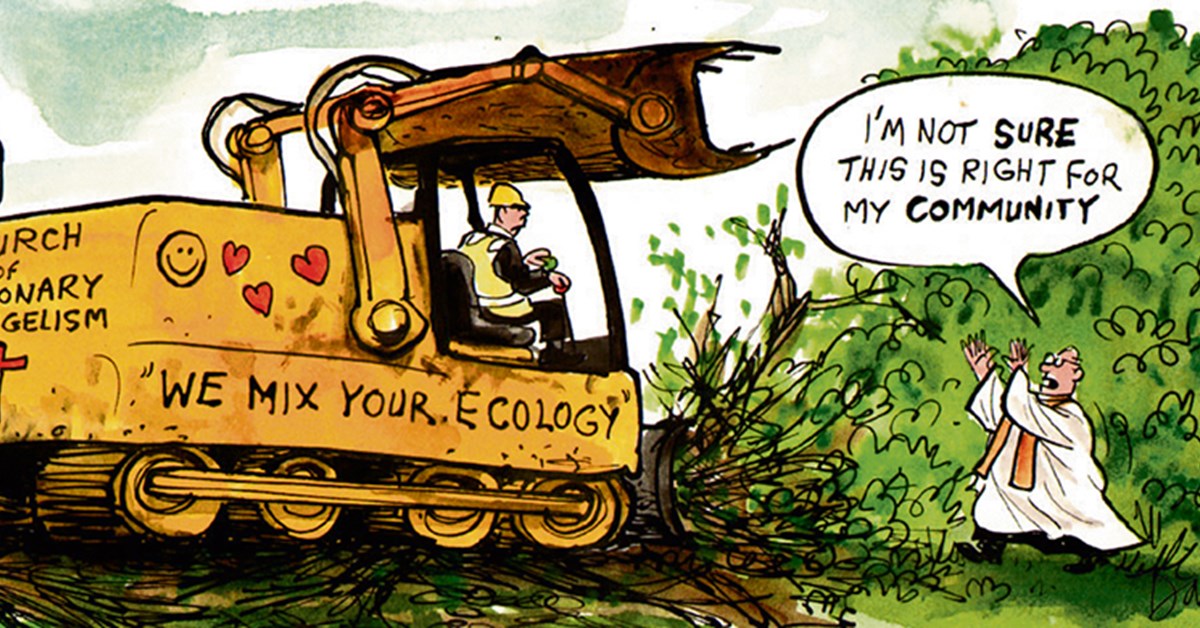
WHAT is a mixed-ecology church? I began briefly researching the term “mixed ecology” to understand where it comes from, as it is being prescribed as the normative ecclesiology for our Church. To my surprise, a definition proved elusive. There is much written and understood about what a mixed-ecology church does, but not what the term actually means.
Research suggests that the description “mixed-ecology” transitioned from “mixed- economy”. Contrary to popular perceptions, however, they mean two different things.
The mixed economy is a type of capitalist economic model, with a few bits of socialism thrown in. Predominantly, it is about utility maximisation, and is growth- and success-orientated. The mixed economy combines both a socialist and capitalist approach to the economic marketplace, while simultaneously permitting private producers or companies to engage in production and competition in the marketplace.
The mixed economy protects private property over the common good. It allows for supply and demand to determine prices in a neo-liberal, free-market fashion, and privileges economic transactions that are driven by private self-interest and incentives. By allowing competition, a mixed-economic model facilitates innovation and efficiency, where the most efficient succeed. Those who cannot compete will be either bought out or pushed out of the market.
In essence, socio-economically speaking, the mixed economy is “fragmentary” in nature. Unsuccessful initiatives are seen as “limiting factors” to the successful initiatives, and a burden on resources; therefore, resources need to be diverted away from “limiting factors” to strengthen successful initiatives. The United States is a classic example of a mixed economy.
The mixed economy as an ecclesiological model was gladly embraced in the Church of England two decades ago, primarily through the work of Fresh Expressions. It is also important to keep in mind that, globally, it is the mixed-economy approach to church, with flexibility and competition in the religious marketplace, which gave rise to megachurches and the accompanying church-growth model (Stephen J. Hunt, Handbook of Megachurches, Brill).
MIXED ecology, on the other hand, as a branch of biology, deals with the relationship of organisms to one another and to their physical surroundings, and advocates a healthy ecosystem built on a diversity of organisms (Hans Pretzsch (co-editor), Mixed-Species Forests, Springer). “Biodiversity is the infrastructure that supports life,” Dr Cristiana Paşca Palmer, a leading United Nations scientist, has written.
As we have been reminded by Sir David Attenborough, the preservation of existing biodiversity is at the heart of mixed ecology, which speaks about conservation alongside innovation, but not at the expense of endangered species. Aggressive growth of any one organism/species could endanger the survival of another; therefore, restoring and preserving the equilibrium is critical for a healthy ecosystem. Without safeguards, some of the aggressive organisms/species can dominate and eventually exterminate weaker and vulnerable life-forms.
Conservation is achieved by investing in the prevention of harmful effects and building in safeguards against serious adverse effects. Each organism has a distinct place in the overall health of the ecosystem. A resilient and healthy ecosystem is viable only when all diverse organisms (strong/successful and weak/vulnerable) are protected.
A healthy ecosystem is built not on competition and success, but by ensuring the survival of all living organisms through the critical enhancement of interdependency. Hence, the ecological model is inclusive, not fragmentary. Theologically, I would argue that the interdependency of the organisms is sacramental.
THIS brings me to the debate about mixed-ecology church as being the norm for the future of the Church of England. What we are seeing in these debates is a conflation of the economic and ecological models, without proper examination of either.
Some are presenting an “economic” model as an “ecological” one. A few proponents of mixed-ecology church suggest that the decision to use ecology instead of economy is a conscious one, because “ecological” metaphors are more palatable than “economic” ones, which sound more organic and less commercial.
What has not been explained, however, is that some of the core driving factors of “mixed ecology” are still driven by “mixed-economy” principles, such as the emphasis on success, multiplication, and growth. As the wider debate points out, some advocates of mixed-ecology church have clearly stated that some of the “limiting factors” (an economic expression) are impediments to the success of the Church (News, 2 July; Leader Comment, 9 July).
This is diametrically opposed to the ecological model of preserving the most vulnerable endangered organism for a healthy ecosystem. Biodiversity is not a limiting factor: it is the necessity. The reality is that, as long as the Church is preoccupied with growth and multiplication as the key indicators of a successful church-growth model, it is obvious that an economic transactional model continues to operate under an ecological paradigm.
The Vison and Strategy being presented to the Church of England offers an opportunity to reimagine afresh what it means to be disciples of Jesus Christ in our world today. The Archbishop of York has suggested that “it would be disastrously foolish to ignore God.” There is an acute need for strategies to be grounded in spiritual renewal, and, most importantly, guided by Holy Spirit, so that, as a Church, we can become participants in what God is already doing and calling us to join in.
It seems, however, that much of our ecclesiological imagination at present is dominated by fear, anxiety, and scarcity, and that, in the process, we are unhelpfully buying into a utilitarian model of success-orientated, rapid growth.
If that is the case, then I am afraid that we are not being faithful to the gospel, which calls us to be mindful of the most vulnerable, who are facing existential challenges such as racial injustice, social inequality, and environmental crisis, just as the “mixed-ecological” model commends.
WHY am I asking for caution? I am part of the fruit of missionary Christianity, and evangelisation is at the heart of my church upbringing in the global-majority world. Nevertheless, as a student of global mission history, I am acutely aware of how some missionaries, in the spirit of pioneering and innovation, practised scant respect for local culture and context.
Frequently, such aggressive church growth trampled on the lives of indigenous communities, destroying their tradition and memory. In the pursuit of swift numerical growth, many missionaries assimilated and integrated discriminatory practices, such as those relating to caste and race, into the fledgling Christian communities, and these continue to plague the Church to this day.
Many Christian churches are still coming to terms with the fallout from such culturally insensitive mission practices, whose practitioners included Anglican mission organisations. This should be a cautionary tale for any new “mission” initiatives in a Church that explicitly sees itself as the inheritor of such “mission” legacy.
As a nation, we have had to face the social fragmentation that manifested itself last week in racist abuse after the final of the European Championships (News, 16 July). In the context of such profound division in society along racial, political, and economic lines, if the Church adopts a fragmentary approach, it will only exacerbate underlying problems. If, however, it pursues a truly inclusive ecological model, then hope may be found. The Church will be questioning its relevance if it sacrifices the sacramentality of interdependence rooted in “love, justice, and mercy” on the altar of numerical growth.
As a national Church rich in diversity, tradition, and innovation, we must not allow ourselves to be carried away by a singular vision for the future, without questioning its origins and modus operandi. It is important to have our interdependence, and not to be carried away by any popular school of thinking which looks pejoratively at other ways being church.
In this time of significant re-evaluation of our mission and purpose, equanimity is of the essence. Perhaps, in our wider ecclesiological imagination, we should not limit ourselves to enforce a single normative ecclesiology of mixed-ecology church.
We need to take some time to ask, and answer, some fundamental methodological questions, such as: What definition of mixed-ecology church are we using in our broader ecclesiology? What are the values and motivating factors of mixed-ecology church? How can we ensure inclusivity, diversity, and safeguarding measures to care for the most vulnerable?
Without a thorough examination of our ecclesiology, we may unhelpfully slip into a tyranny of “mixed-ecology church”.
The Revd Dr Anderson Jeremiah is a senior lecturer in the Department of Politics, Philosophy, and Religion at Lancaster University, and a member of the General Synod.