
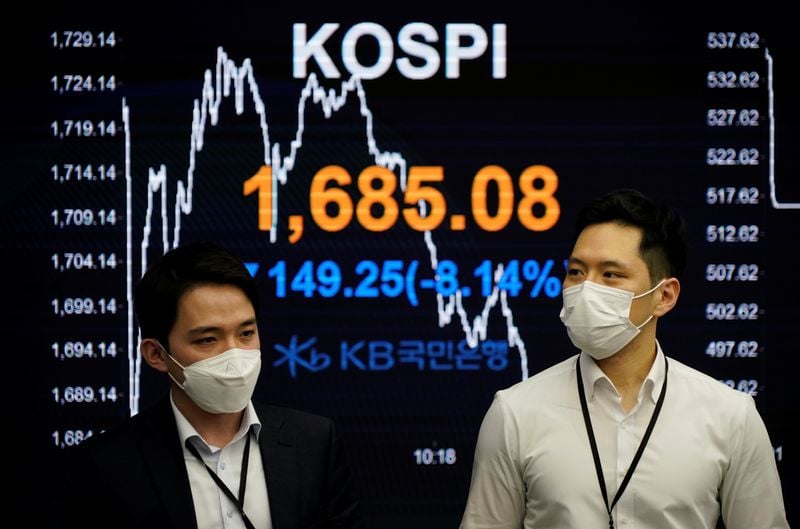
Investing.com–South Korea has become the most stretched equity market in the global rally, with mounting signs of speculative excess leaving investors increasingly exposed to a potential pullback, according to BCA Research.
The has rallied sharply since the Iran conflict began, gaining more than 50% over the past three months, while remaining up about 173% over the past one year and roughly 4.5% over the past month, underscoring the strength of the recent risk-on rally.
The research firm downgraded Korean equities to neutral from overweight, arguing the market has become the clearest expression of the global risk-on trade, driven by surging semiconductor stocks and an influx of retail investors.
“Korea has become the most extreme expression of the global equity rally,” BCA said, warning that the risk-reward profile for the market has deteriorated materially.
According to the report, Korea’s hardware technology stocks have soared this year, fuelled by artificial intelligence optimism and semiconductor momentum, while retail investors have aggressively shifted money into domestic equities in pursuit of gains. BCA said such momentum-driven rallies often become vulnerable when investor sentiment reverses.
The firm also highlighted several late-cycle warning signs extending beyond Korea. Cash held on the sidelines in Korea, the United States, Japan and the euro area has fallen to historically low levels, suggesting investors have already deployed much of their capital into equities. At the same time, market breadth has weakened and valuations have become increasingly stretched.
BCA said Korea’s narrow market leadership makes it particularly vulnerable to a correction. Only a small share of KOSPI-listed stocks are trading above their 200-day moving average despite the benchmark hovering near record highs, indicating the rally has been concentrated in a handful of large technology names.
The firm recommended investors take profits on its long Asian semiconductor/short U.S. hyperscalers trade, which it said has returned about 140% since it was initiated in November 2025. However, it maintained a constructive view on the and continued to favour , citing the country’s strong current account surplus and attractive bond yields.
Reporting by Roushni Nair