

When investors discover the impact of distributor commissions embedded in Regular mutual fund plans, the urge to switch to Direct plans is immediate. The math seems obvious: saving 0.75% to 1.00% every year in expense ratios compounds into a massive difference over decades.
Yet when long-term investors consult an advisor or open an Excel sheet to model the transition, they hit a major mental roadblock: Long-Term Capital Gains (LTCG) tax and Income Tax Surcharges.
About the author: Jay Sheth is a SEBI-registered investment adviser and a member of Fee-only India, a group of fixed-fee-only advisors. You can contact him via his website, shwealth.in.
Most investors either abandon the idea or make a purely emotional choice based on back-of-the-envelope mental math. Let’s break down how standard breakeven models miscalculate this decision, why income tax surcharges cause unnecessary paralysis, and how evaluating your portfolio on a Post-Tax Net Worth basis changes the verdict entirely.
- How the Decision Is Traditionally Modelled (And Where It Fails)
The conventional approach to deciding whether to switch from Regular to Direct funds follows a simple pre-tax formula:
🔥Secure your future with our Robo-advisory tool trusted by over 3,000 investors and advisors. From effortless retirement planning to funding your children’s biggest dreams, turn your financial goals into reality. 🔥
- Calculate the current market value of your Regular fund portfolio.
- Estimate the upfront LTCG tax hit (12.5% on gains exceeding ₹1.25 Lakh).
- Subtract the tax hit to find your reduced starting capital in the Direct fund.
- Calculate how many years it takes for the Direct fund’s lower expense ratio to catch up to the pre-tax growth of the Regular fund.
When modelled this way without surcharges, the breakeven point typically lands between 3 and 7 years. For equity investors with a 10+ year horizon, this is usually an easy “yes.”
- The Arbitrary Surcharge Panic: The Emotional Roadblock
The problem deepens for high-income earners or those liquidating large legacy gains (e.g., ₹20 Lakh to ₹60 Lakh+). Realising these gains in a single financial year spikes total taxable income past key thresholds:
- ₹50 Lakh Total Income: Attracts a 10% surcharge on tax.
- ₹1 Crore Total Income: Attracts a 15% surcharge on tax.
Crucially, the surcharge applies across your overall income tax liability—including your salary, professional fees, or business income.
The Mental Math Flaw
Instead of modelling the math quantitatively, investors perform “head calculations.” They see a sudden, massive tax outgo for the current financial year and panic.
When plugged into standard pre-tax breakeven models, a tax surcharge stretches the calculated recovery timeline from a manageable 5 years out to an intimidating 8 to 13 years. Facing a decade-long recovery horizon, investors freeze, postpone the decision, or attempt to stagger redemptions by harvesting just ₹1.25 Lakh of LTCG per year.
- The Shift: Pre-Tax Corpus vs. Post-Tax Net Worth
The surcharge calculation produces an intimidating 8–13 year timeline because it relies on a flawed metric: Pre-Tax Displayed Corpus.
Unpaid Tax is a Deferred Debt, Not Real Wealth
The displayed value of your Regular fund portfolio on your broker dashboard is an illusion. You do not own 100% of that number. A portion of that displayed corpus represents an unpaid tax debt owed to the government upon eventual redemption.
- In the Regular Fund: You keep the gross number on paper, but the unpaid tax debt compounds in the background while you continue paying a ~0.75%–1.00% annual distributor commission on the entire amount every single year.
- In the Direct Fund: You settle the tax debt today, reset your purchase cost basis to current market value, and eliminate the commission drag forever.
Because your purchase cost basis resets to current market prices in a Direct fund, future redemptions will incur tax only on new gains generated after the switch. In contrast, keeping your money in Regular funds accumulates an ever-larger legacy tax liability on top of ongoing commission drag.
When evaluated on a Post-Tax Net Worth basis (what you would actually walk away with if you fully liquidated today vs. fully liquidating at year $t$), the gap closes dramatically faster.
- Quantitative Analysis: Breakeven Timelines Compared
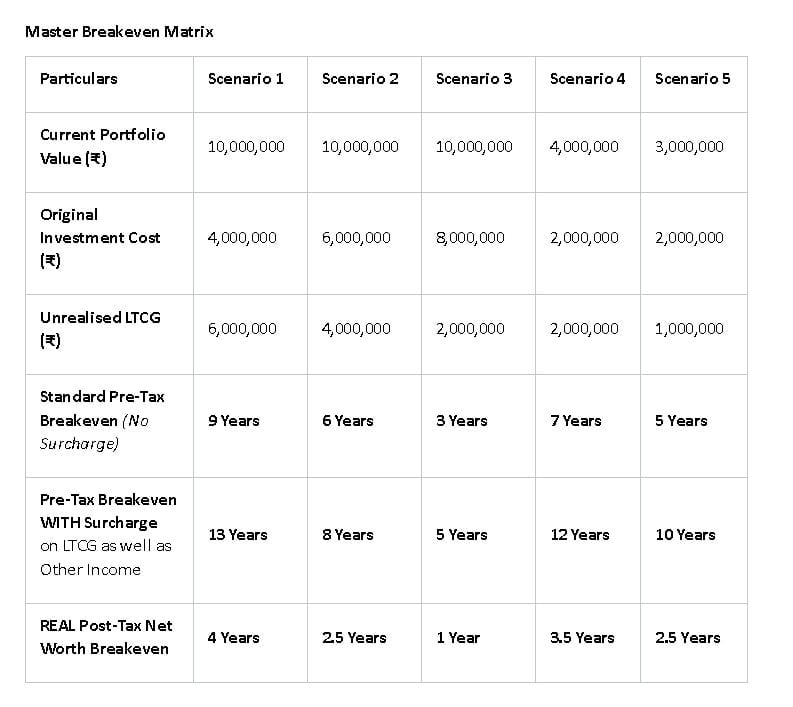
To see the difference between pre-tax perception and post-tax reality, let’s analyse five different portfolio scenarios assuming an expense ratio savings of 1% per annum and an expected market growth rate of 12% per annum.
Master Breakeven Matrix
What the Numbers Prove
- The Surcharge Illusion: Looking strictly at pre-tax numbers, a surcharge extends your recovery timeline to 8–13 years, making the decision seem irrational.
- The Post-Tax Parity Realignment: On a post-tax liquidable net worth basis, the true breakeven point drops to 1 to 4 years across all scenarios.
- Other Critical Pitfalls to Avoid
Beyond the breakeven math, two qualitative factors trap investors in sub-optimal Regular funds:
The “Carrot Chasing” Fallacy of Annual ₹1.25L Tax Harvesting
A common advice tactic is to stagger redemptions to realize only ₹1.25 Lakh of LTCG each year tax-free.
- On a ₹50 Lakh portfolio growing at 12% per year, the portfolio generates ₹6 Lakh in new gains every year. Realising ₹1.25 Lakh in tax-free gains leaves ₹4.75 Lakh of new gains untouched. Your unrealised gain bucket grows larger every year, trapping you in higher expense ratios indefinitely. You are essentially chasing a carrot while bleeding 0.75% to 1.00% annually on the main corpus.
- Also, if you are making new investments in Direct funds, the INR 1.25 lakhs exemption is available for this portfolio as well after 12 months for tax harvesting. Hence, it is only theoretical that you are utilising the INR 1.25 lakhs exemption for Regular funds.
Portfolio Pruning & Strategic Realignment
Switching to Direct funds is not just a fee-saving exercise—it is a portfolio cleanup opportunity. Most legacy Regular portfolios suffer from “scheme clutter” (NFOs pushed by distributors, duplicate large-cap funds, underperforming sector funds).
A clean switch lets you consolidate into a streamlined, goal-aligned portfolio.
Conclusion
If your investment horizon in equity mutual funds is longer than 3 to 4 years, postponing a switch to Direct funds due to LTCG tax or income surcharges is mathematically counterproductive.
Do not let the emotional shock of an upfront tax payment keep your wealth trapped in higher expense ratios. The tax hit is a deferred liability you will eventually have to pay anyway. By paying it today, you reset your cost basis, eliminate ongoing distributor commissions, and achieve higher real post-tax wealth in as little as 2 to 4 years.
Do share this article with your friends using the buttons below.

Use our Robo-advisory Tool to create a complete financial plan! More than 3,000 investors and advisors use this! Use the discount code robo25 for 20% off. Plan your retirement (early, normal, before, and after), as well as non-recurring financial goals (such as child education) and recurring financial goals (such as holidays and appliance purchases). The tool would help anyone aged 18 to 80 plan for their retirement, as well as for six non-recurring and four recurring financial goals, with a detailed cash flow summary.
🔥Join our community of 9000+ users! 🔥Avail massive discounts on our courses + freefincal investor circle!
Track your mutual funds and stock investments with our Google Sheet!
We also publish monthly equity mutual funds, debt and hybrid mutual funds, index funds, ETF screeners, as well as momentum and low-volatility stock screeners.
You can follow our articles on Google News

We have over 1,000 videos on YouTube!

Podcast: Let’s Get RICH With PATTU! Every single Indian CAN grow their wealth!
You can watch podcast episodes on the OfSpin Media Friends YouTube Channel

Now watch Let’s Get Rich With Pattu தமிழில் (in Tamil)!
- Do you have a comment about the above article? Reach out to us on Twitter: @freefincal or @pattufreefincal
- Have a question? Subscribe to our newsletter using the form below.
- Hit ‘reply’ to any email from us! We do not offer personalised investment advice. We can write a detailed article without mentioning your name if you have a generic question.
About The Author
Dr M. Pattabiraman (PhD) is the founder, managing editor and primary author of freefincal. He is an associate professor at the Indian Institute of Technology, Madras. He has over 14 years of experience publishing news analysis, research and financial product development.

Pattabiraman has co-authored three print books: (1) You can be rich too with goal-based investing (CNBC TV18) for DIY investors. (2) Gamechanger for young earners. (3) Chinchu Gets a Superpower! for kids. He has also written seven other free e-books on various money management topics. He is a patron and co-founder of “Fee-only India,” an organisation promoting unbiased, commission-free, AUM-independent investment advice.
Connect with him via Twitter(X) LinkedIn YouTube
Our flagship course! Learn to manage your portfolio like a pro to achieve your goals regardless of market conditions! More than 3,500 investors and advisors are part of our exclusive community! Get clarity on how to plan for your goals and achieve the necessary corpus no matter the market condition!! Watch the first lecture for free! One-time payment! No recurring fees! Life-long access to videos! Reduce fear, uncertainty and doubt while investing! Learn how to plan for your goals before and after retirement with confidence.
Increase your income by getting people to pay for your skills! More than 900 salaried employees, entrepreneurs and financial advisors are part of our exclusive community! Learn how to get people to pay for your skills! Whether you are a professional or small business owner seeking more clients through online visibility, or a salaried individual looking for a side income or passive income, we will show you how to achieve this by showcasing your skills and building a community that trusts and pays you. (Watch the 1st lecture for free). One-time payment! No recurring fees! Life-long access to videos!
Our book for kids: “Chinchu Gets a Superpower!” is now available!

Most investor problems can be traced to a lack of informed decision-making. We made bad decisions and money mistakes when we started earning and spent years undoing these mistakes. Why should our children go through the same pain? What is this book about? As parents, what would it be if we had to groom one ability in our children that is key not only to money management and investing but to any aspect of life? My answer: Sound Decision Making. So, in this book, we meet Chinchu, who is about to turn 10. The narrative revolves around what he wants for his birthday and how his parents plan for it, while also teaching him several key ideas of decision-making and money management. What readers say!

Must-read book even for adults! This is something that every parent should teach their kids right from their young age. The importance of money management and decision making based on their wants and needs. Very nicely written in simple terms. – Arun.
Buy the book: Chinchu gets a superpower for your child!
How to profit from content writing: Our new ebook is for those interested in getting a side income via content writing. It is available at a 50% discount for Rs. 500 only!
We publish monthly mutual fund screeners and momentum, low-volatility stock screeners.
About freefincal & its content policy
Freefincal is a News Media organisation dedicated to providing original analysis, reports, reviews and insights on mutual funds, stocks, investing, retirement and personal finance developments. We do so without conflict of interest and bias. Follow us on Google News. Freefincal serves more than three million readers a year (5 million page views) with articles based only on factual information and detailed analysis by its authors. All statements made will be verified with credible and knowledgeable sources before publication. Freefincal does not publish paid articles, promotions, PR, satire or opinions without data. All opinions will be inferences backed by verifiable, reproducible evidence/data. Contact Information: To get in touch, please use our contact form. (Sponsored posts or paid collaborations will not be entertained.)
Connect with us on social media
Our publications
You Can Be Rich Too with Goal-Based Investing

Published by CNBC TV18, this book is designed to help you ask the right questions and find the correct answers. Additionally, it comes with nine online calculators, allowing you to create custom solutions tailored to your lifestyle. Get it now.
Gamechanger: Forget Startups, Join Corporate & Still Live the Rich Life You Want

This book is designed for young earners to get their basics right from the start! It will also help you travel to exotic places at a low cost! Get it or gift it to a young earner.
Your Ultimate Guide to Travel

This is an in-depth exploration of vacation planning, including finding affordable flights, budget accommodations, and practical travel tips. It also examines the benefits of travelling slowly, both financially and psychologically, with links to relevant web pages and guidance at every step. Get the PDF for Rs 300 (instant download)