



The classic myth of capitalism holds that a bold visionary, with almost supernatural foresight, spots an opportunity that mere mortals fail to see – and then backs their hunch, either by investing their hard-earned savings, or having won the confidence of a bank or private backer. It’s an unpredictable scenario, where the huge returns available for success are counter-balanced by the risk of making large, possibly life-changing losses. The ‘winners’ in this game of business roulette create jobs, generate wealth and should be admired for their go-getting spirit.
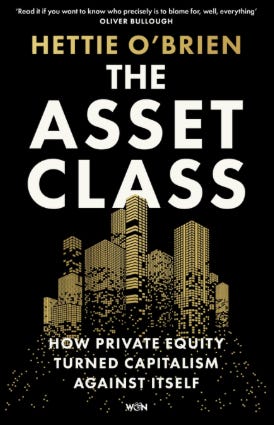
That’s the theory, anyway, but in her new book The Asset Class: How Private Equity Turned Capitalism Against Itself, Hettie O’Brien tells a different story; one where so-called entrepreneurs load the dice so that they can’t lose, leaving the taxpayer to pick up the tab, either through poor service, extortionate interest payments or a combination of both.
In an interview with the Byline Times Podcast, O’Brien pointed to care homes as a classic example of what she means. Large-scale accommodation for older residents which was once provided by local government is now increasingly run, on both sides of the Atlantic, by private equity (or investment) firms, focussed primarily on delivering a profit. “One study I came across in the US analysed something like 100 private equity takeovers of care homes, and found that after that, the mortality rate increased by an average of 11% ,” O’Brien said. “It was a similar story in the UK during the first wave of the Covid pandemic; at care homes with the highest amounts of leverage, which is another word for debt, the death rate was almost twice as great as it was at care homes with no leverage at all. That’s when you start to really see the human impact of these business decisions and how they’re affecting people’s lives.”
England’s water industry has also attracted private equity since being privatised in 1989, with investment firms – including some from overseas – spotting an opportunity to maximise returns from what are, in effect, local monopolies. In recent times, these water companies have been granted the right to charge customers above inflation price increases, partly to service expensive debts. O’Brien explained: “The purpose of that debt was, very often, to enrich those investors, rather than to invest in the thing that it’s supposed to fund, which is improvements to the service they’re providing. So we’re basically paying twice – once for the debt, and now for the actual improvements that were supposed to have happened already. If you live in England and Wales, something like 28% of that bill goes on paying off debt, dividends and other forms of financial extraction; and those things haven’t actually led to a better service. That’s something that rightly outrages people.”
O’Brien traces the rise of private equity to US businessman William Simon, who briefly served as Secretary to the US Treasury in the Nixon administration. Having visited the Soviet Union in the 1970s, he came to believe in the innate efficiency of private enterprise and pioneered leveraged buyouts of distressed companies. This was a process whereby money borrowed from financial institutions would be placed on the balance sheet of the organisation that was being taken over, allowing Simon and his colleagues to cream off profit from high interest payments and management fees. To maintain the flow of income, valuable assets from the troubled firm would be sold off; and if it went under, the external investor would mostly take the hit.
“Leveraged buyouts really were a way of instilling greater control across the whole economy, on the part of a very small group of very rich men – who basically remain unaccountable to the rest of us,” O’Brien observes. “It was very much an inspiration to others working on Wall Street.”
By funding company buyouts in this way, private equity upended the ideals of traditional capitalism, significantly reducing the risk factor. But it still carried a degree of uncertainty; or at least it did, until its proponents spotted a more reliable income stream by promising to deliver ‘efficiency’ to the public sector. O’Brien asks, “what are the efficiencies?” Reducing pay may be a factor, she says, but “actually, they’re about challenging the assumptions. So there’s an assumption that ‘we will provide the water at as high a quality as we can, without interruptions. Actually, though, we can challenge that assumption, because we’re not going to face a financial penalty if we don’t do those things. In fact, we can make more money by providing dirty water, by allowing interruptions, by having death rates in care homes that are higher because there is no financial penalty for it.’
“And so [when] efficiency in the private equity model comes into the public sector, with this guaranteed income stream, [there’s] also a guarantee that we’re going to perform worse on the things where there is no financial penalty. And it turns out that a great many of the things that we care about, that people’s quality of life depends on, are subject to these ‘efficiencies’”.
The profits of private equity firms are often enhanced by elaborate or opaque company structures, to the detriment of the public purse. Alex Cobham, Chief Executive of the Tax Justice Network, who is also featured on the Byline Times Podcast said that “by allowing the previous quid pro quo to be broken, we end up with people who just extract an income stream and don’t bear any of the risk, and you need to tackle this. Governments have decided that they need to give in to the lobbying of this very powerful industry and give them an even better deal.
“We have to reverse that. We have to at least require that all of the gains through private equity are taxed at the same level as anybody else’s income would be, because otherwise we’re making it more efficient for this to be the model that dominates our economy.”
Listen to the full episode of the Byline Times podcast, produced in conjunction with Naomi Fowler and The Taxcast here.