
Last Updated on September 24, 2026 at 9:27 am
We discuss the performance consistency of actively managed small cap funds by comparing them with the Nifty Midcap 150 index. Some readers may be surprised as to why we are not choosing a small cap index like the Nifty Small Cap 250.
This is because we are not trying to pursue a PhD here (I made that mistake once in my life). We are not trying to write a research report. We are trying to find out if the fees charged by active small cap funds are worth it by comparing their performance consistency with an index that is hard to beat. We have repeatedly shown that the Nifty Small Cap 250 index consistently underperforms the Midcap 150 index. Most recently, here: Nifty vs Nifty Next 50 vs Nifty Midcap 150 vs Nifty Smallcap 250: Return Comparison, Aug 2026.
We believe that the Midcap 150 is the most appropriate index to judge active small cap index performance. Also see: Why are you comparing Small Cap Mutual Funds with a Mid Cap Index?!
The freefincal active equity mutual fund screener, published monthly, uses the Midcap 150 to compare small cap funds.
🔥Secure your future with our Robo-advisory tool trusted by over 3,500 investors and advisors. From effortless retirement planning to funding your children’s biggest dreams, turn your financial goals into reality. 🔥
Note 1: Many of these small cap funds had significant mid cap exposure in the past!
Note 2: We have used only direct-plan small-cap funds. This limits both the number of schemes and their history. I am not enthusiastic about including regular-plan funds, as their higher fees (due to commissions) will reduce the outperformance margin.
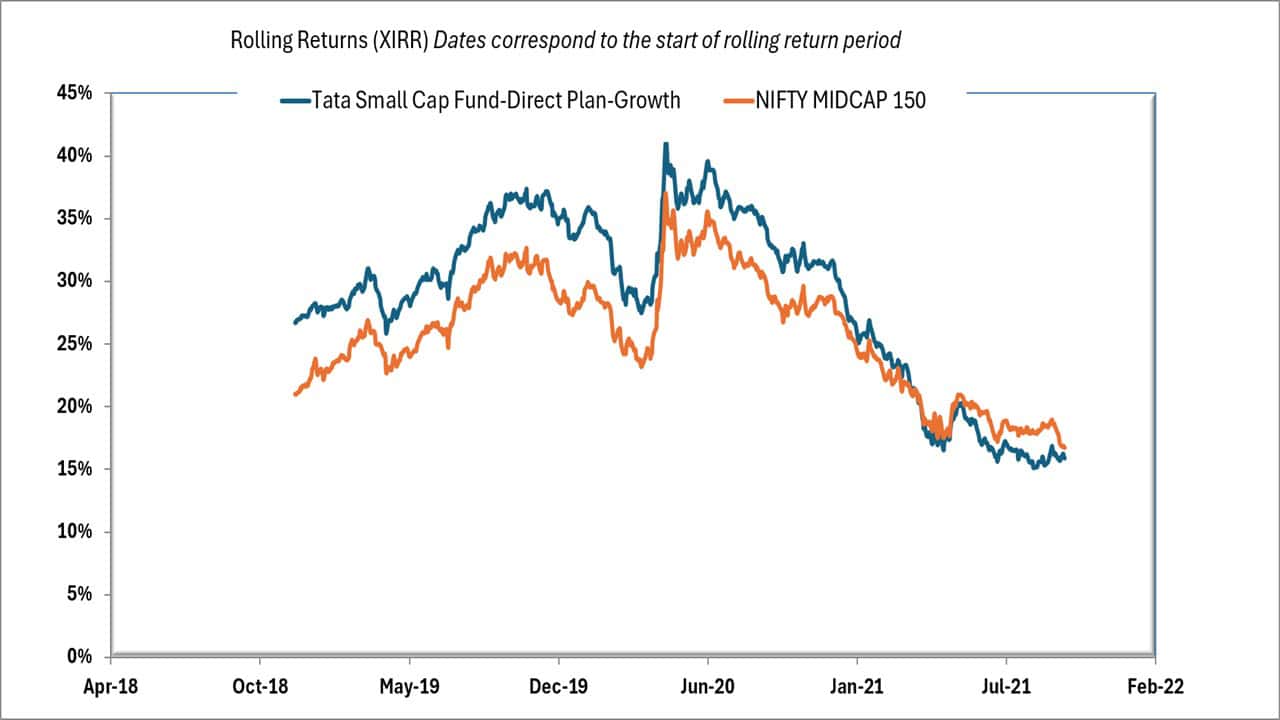
Rolling returns outperformance consistency. Rolling returns are a simple estimate of how consistently a fund has outperformed a benchmark. Take, for example, the Tata Small Cap Fund vs Nifty Midcap 150 (graph below) between November 13, 2018, and Sep 11, 2026. There are 698 5-year rolling returns. If we plot the fund and index returns for each duration together, we get a graph like this.
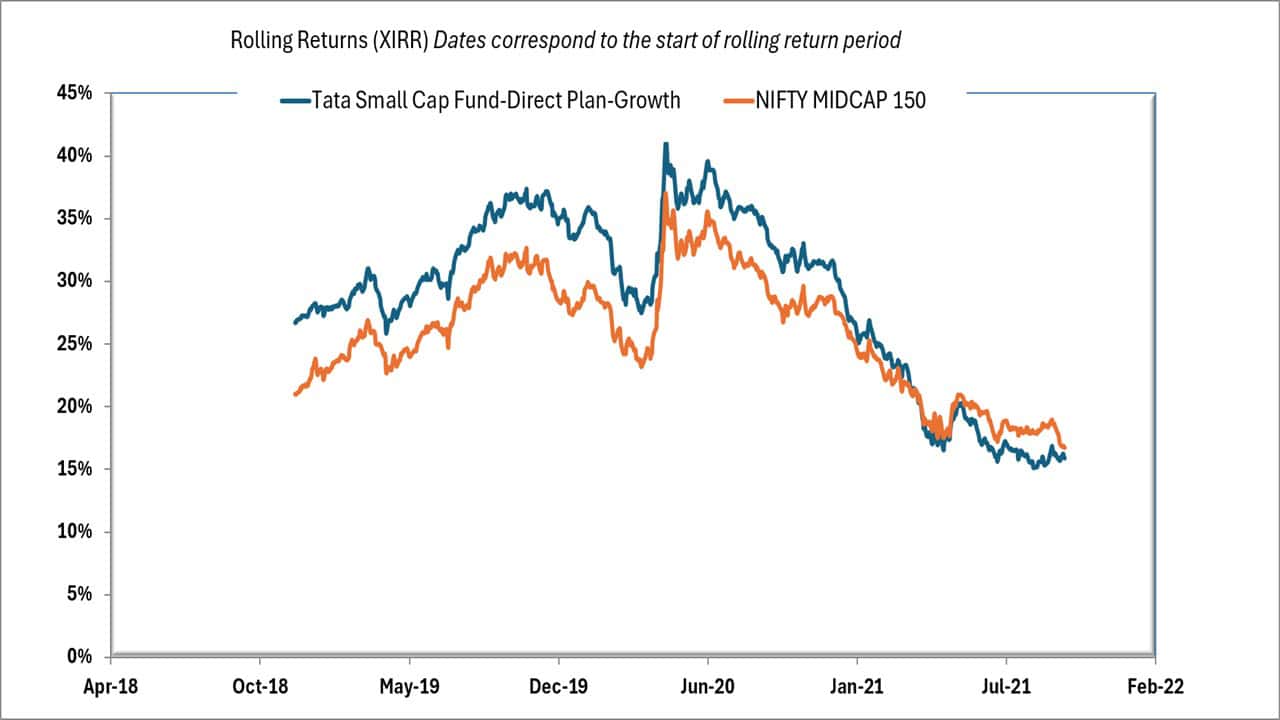
The fund has outperformed the index 563 out of 698 times. Thus, the rolling return outperformance consistency over seven years is 80.7%. A consistent performer should beat the index at least 60% to 70% of the time. So, the higher the rolling return outperformance consistency, the better.
Given the high fees AMCs charge, we expect 70% performance consistency. If they fail, they don’t deserve such high fees. We are better off with an index fund.
Active Small Cap Funds vs Nifty Midcap 150 TRI
- Over 3 years, 8 out of 22 funds qualified (rolling return outperformance consistency of 70% or more).
- Over 4 years, 6 out of 20 funds qualified.
- Over 5 years, 11 out of 20 funds qualified.
- Over 6 years, 10 out of 18 funds qualified.
- Over 7 years, 11 out of 16 funds qualified.
- Over 8 years, 6 out of 11 funds qualified.
- Over 9 years, 6 out of 11 funds qualified.
- Over 10 years, 5 out of 11 funds qualified.
Although the situation with small caps is marginally better than mid caps – Active Mid Cap Mutual Funds vs Nifty Midcap 150 – long-term performance report, the data does not support the large fee we pay to invest in active small caps.
Only 50% of small caps consistently beat the Nifty Midcap 150, and the funds on this “good list” would keep changing over time.
That is, even if you choose a good performer (based on past data) today, there is no guarantee, not even a reasonable chance, that it will continue to do well in future (see the image above). So we are better off without active small cap funds.
As mentioned before, using direct plan funds limits both the number of funds and the number of rolling return data points. However, I won’t put too much money into regular plan funds that are doing better.
I think the data is sufficiently clear that it makes little sense to pay high fees and keep the faith with an active small cap (or mid cap) fund in the hope that it will continue its past good performance or that it will do better in future.
So can I invest in a mid cap index fund?
As we noted recently – Nifty vs Nifty Next 50 vs Nifty Midcap 150 vs Nifty Smallcap 250: Return Comparison Aug 2026 -although it may be hard to prove conclusively*, it’s safer to assume the Midcap 150 may offer a higher risk-plus-potential-reward profile going forward than the Nifty Next 50.
* We are working on this.
A midcap index is not a terrible choice, but the only thing stopping me from getting 100% behind a Midcap index fund is that it hasn’t seen an abrupt crash so far when its liquidity suddenly evaporates. How the fund manager would cope then, especially when AUM swells, remains to be seen.
If you can remain content with larg cap-oriented portfolios, choose Sensex/Nifty 50 or Nifty 100 passive funds.
If you want some (occasional) outperformance, then opt for a Nifty Next 50 index. If you want to take on more risk, then choose the Nifty Midcap 150 index (keeping the above-mentioned caveat in mind).
If you want a one-fund equity portfolio with all market caps (except micro caps), then the Nifty 500 is a safe choice. However, please recognise that it is a large-cap-oriented index and that any outperformance vs the Nifty 50 may not be permanent. See: Nifty 50 or Nifty 500, which index fund should I choose?