
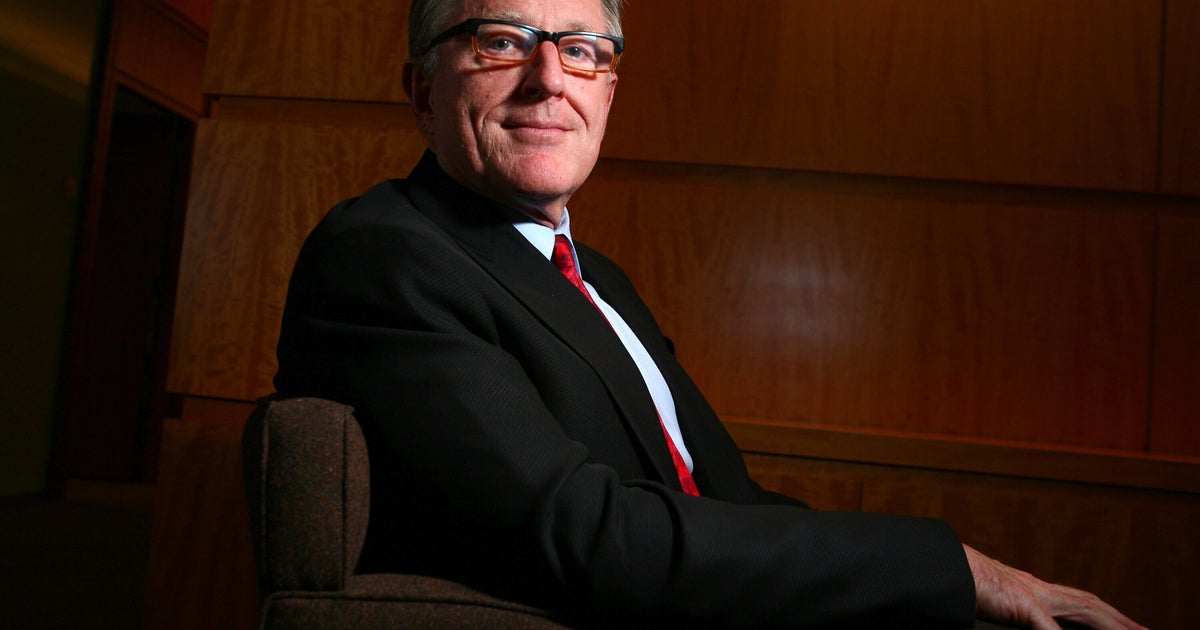
Index investing pioneer David Booth has a simple message for people navigating volatile financial markets: Stay calm and keep investing.
Booth, a billionaire several times over whose Dimensional Fund Advisors manages $1 trillion, expands on that advice in a new book, “Stay Calm: Learn to Embrace Uncertainty in Investing and Life,” scheduled for publication on Sept. 1. Part memoir and part investment guide, the book explains why investors should strive to accept the uncertainty inherent in the market rather than trying to outsmart it.
Dimensional Fund Advisors 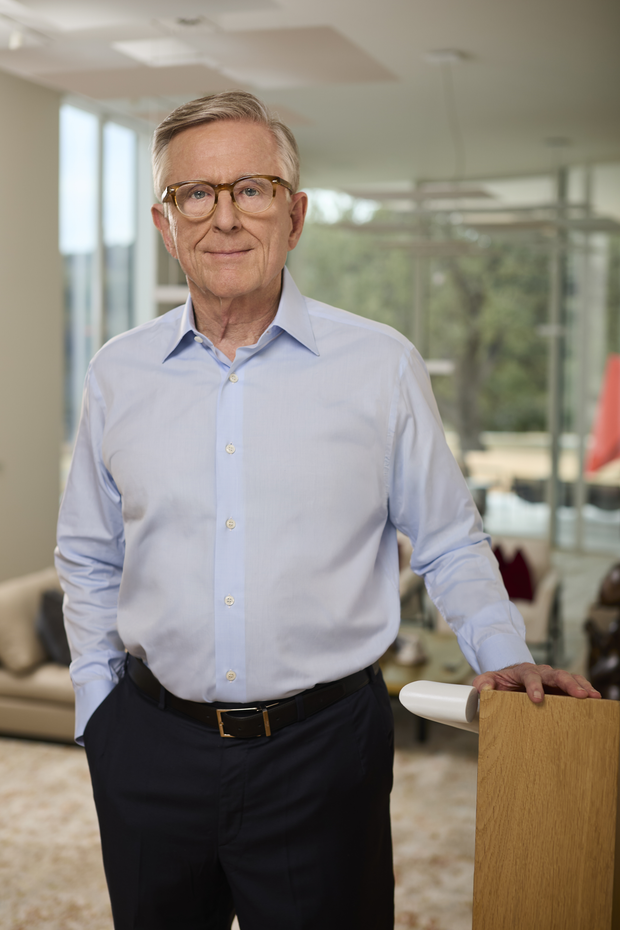
Until index investing emerged in the 1970s, Americans largely invested by picking individual stocks — a perpetual risk — or by putting their money in a fund “actively” managed by a portfolio manager, which can carry considerably higher fees than index funds. At the University of Chicago, Booth studied under economist Eugene Fama, a future Nobel laureate whose “efficient market hypothesis” helped pave the way for index investing.
In his book, Booth recounts how University of Chicago academics analyzed annual New York Stock Exchange returns from 1926 through 1960. They found that stocks returned an average of 9% a year, while most active managers failed to match the market, particularly after fees.
“If the experts couldn’t reliably win, it begged a larger question. How should you invest?” Booth writes.
That question helped drive the development of passive investing, an approach designed to provide broad market diversification with low fees and limited trading.
Booth spoke with CBS News about his book and his advice for investors. The interview has been edited for length and clarity.
You’ve spent five decades in finance and could have written this book at any time. Why now?
David Booth: People seem to have more anxiety than normal. I don’t know if that’s true or not, but there’s a lot of stress out there, and a lot of negative attitude about investing. Hopefully, people can feel a bit more optimistic and feel like they’re more likely to have a good investment experience and meet their financial goals over time.
People have more anxiety than they really need to have. They need to figure out how to stay calm and stay invested.
You write about the power of being an outsider when it comes to investing. Can you elaborate?
With respect to investing in public markets, there’s really nothing but great news here. If you look at all the research over the last 60 years, it looks like the pros can’t beat the market. They can’t beat an index. That’s got to be good news.
As an outsider, you can have the same investment experience as an insider. That’s path-breaking, and it works for everybody because everybody can buy a simple market portfolio and invest in the whole market at very low cost, very easily.
Part of the reason for writing the book is for those people out there who still haven’t invested. I’m trying to take away the excuse. Particularly if you’re a young person, you’ve got to start investing and get the magic of compounding working for you.
Data has long shown that actively managed funds tend to lag the market, yet investors still willingly hand their money to portfolio managers. Why?
Largely because, at first flush, it’s so counterintuitive. But you have to ask yourself why stocks do so well over the long haul. Yes, we have a lot of anxiety now. But go back to the Great Depression. Do you think there’s more anxiety now than during the Great Depression? Or during the Great Recession, or the pandemic?
There’s always a lot of anxiety. And if you look over the last 100 years, where we have research-quality data, stocks have returned over 10% a year through all of that. That’s about as good a story as I can come up with.
Why are the returns that high? The simple answer is it’s your reward for taking risk. But why is that reward so great? I think it comes down to human ingenuity. When something bad happens to you, you don’t just sit there and take it. You figure out how to get back on track.
One of the heartbreaks in this business is watching people get stressed out and get out of the market. The market doesn’t give you a do-over. If you sit on the sidelines and you miss that 50% gain, that’s 50% you’re never going to get. If I had another sentence to write about the title, it would be: Stay calm and stay invested.
Your subtitle promises lessons for investing and life. What can investing teach you about how to live?
There’s uncertainty in both. If there were no uncertainty, you probably wouldn’t have been able to progress in life. And in investing, if there were no uncertainty, all investments would have the same return — the riskless rate. So it’s not about eliminating uncertainty. It’s about managing uncertainty.
In a way, people really want to feel safe. Feeling safe is the feeling that, regardless of what happens, I think I’m going to be OK. I can handle it. You want to avoid the catastrophes. If you buy an individual stock, the price can go to zero. The stock market is not going to zero.
In your book, you talk about the promise of innovation. But Bill Gates has forecast that AI could eliminate many jobs, and a lot of younger people fear being replaced by AI and never being able to buy a home. You argue the pessimists are on the wrong track. What would you tell them?
First off, let me be clear. When I say the pessimists are on the wrong track, I’m talking about investing in stocks and bonds.
If you go back to life, I think there are some legitimate concerns. There are a lot of tech people who are a lot smarter than I am about technology and have their opinions, and we don’t know for sure. I don’t think you want to bet your last dollar on your ability to forecast what the effects of AI are going to be.
I see a lot of pessimism — and a lot of it well-earned — about people coming out of school, getting jobs. But I do have this fundamental belief that you can’t talk me out of, which is that people want to make their lives better and the lives of their family better. That’s the priority, and hopefully they’ll figure out ethical ways of doing that. There are ups and downs, but over the long haul, there’s progress.
Millions of Americans in their 50s and 60s haven’t managed to put much money away for retirement. Many also say they expect to work until they die. What would you say to people who feel behind?
We’ll start with the 401(k) participant: Don’t borrow against it. As long as you stayed invested, you’re probably in pretty good shape. It’s the people who didn’t fund it. And I know it’s very difficult when you have a big family and there’s not much after-tax money. I don’t think there’s magic out there. If I had a silver bullet, I’d share it.
So the problem is, how do we get more people making more money so they can invest more? That’s not my department. But if I were king, I’d be working on how we can educate people better and make them better prepared for that crazy world ahead of us.