
Close Menu
Aspire Market Guides
  • Home
  • Alternative Investments
  • Cryptocurrency
  • Economics
  • Equity Investments
  • Mutual Funds
  • Real Estate
  • Trading
What's Hot

A Step-by-Step Guide to Buying and Selling NFTs

September 18, 2026

Large-cap or aggressive hybrid? The mutual fund category that leads in returns may surprise you

September 18, 2026

Silver lining – Yale Alumni Magazine

September 18, 2026
Facebook X (Twitter) Instagram
Trending:
  • A Step-by-Step Guide to Buying and Selling NFTs
  • Large-cap or aggressive hybrid? The mutual fund category that leads in returns may surprise you
  • Silver lining – Yale Alumni Magazine
  • Henry Wise Unveils New Mystery in Promised Land
  • Grasim Industries Temporarily Shuts Canadian Pulp Facility Amid Challenging Macroeconomic Conditions
  • Vizsla Silver Stock Turns To Quarterly Loss After Prior Year Profit
  • Crypto Payments in Online Entertainment Explained
  • Trading Flat: Understanding Market Stability and Strategy
  • Low Cost September / October 2026
  • Hong Kong Five-Year Plan: Mapping the future of a global hub – news.cgtn.com
Friday, September 18
Facebook X (Twitter) Instagram
Aspire Market Guides
  • Home
  • Alternative Investments
  • Cryptocurrency
  • Economics
  • Equity Investments
  • Mutual Funds
  • Real Estate
  • Trading
Aspire Market Guides
Home»Mutual Funds»Large-cap or aggressive hybrid? The mutual fund category that leads in returns may surprise you
Mutual Funds

Large-cap or aggressive hybrid? The mutual fund category that leads in returns may surprise you

By CharlotteSeptember 18, 20263 Mins Read
Share
Facebook Twitter Pinterest Email Copy Link


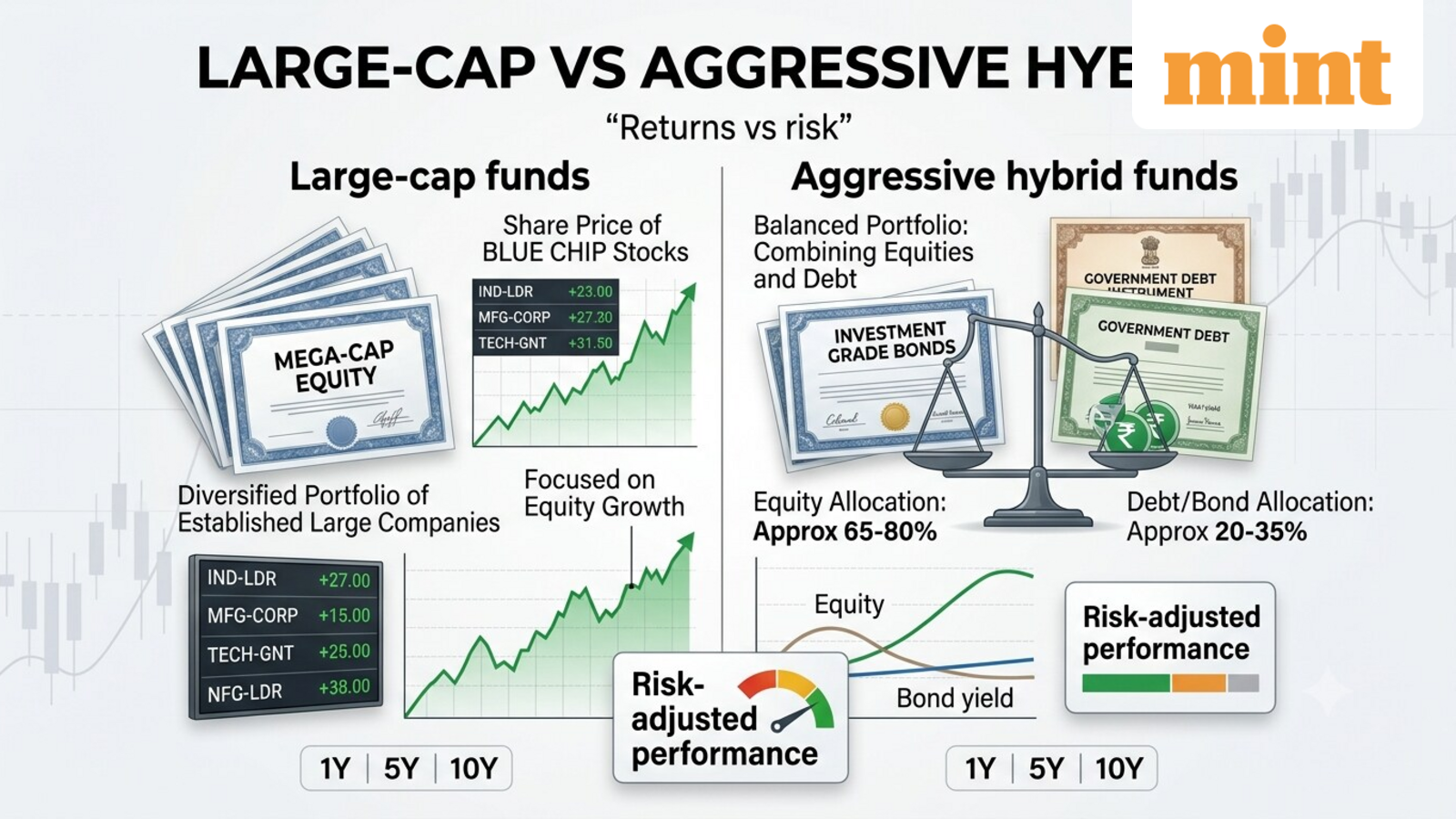
Investors looking to gain stock market exposure often turn to equity funds, especially large-cap funds, to reduce volatility. However, one hybrid category also offers meaningful equity exposure while combining it with debt.

Under SEBI‘s categorisation, aggressive hybrid funds invest 65–80% of their total assets in equity, with the remaining 20–35% in debt instruments. However, large-cap funds must invest at least 80% of their total assets in large-cap stocks.

A comparison of category-average returns shows that the two categories have delivered broadly similar returns over the long term. Here’s what you need to know about risk-adjusted performance.

Large-cap vs aggressive hybrid funds: How do their returns compare?

Period Large-cap funds Aggressive hybrid funds
1 year -3.72% 0.61%
3 years 9.52% 10.65%
5 years 8.98% 10.12%
7 years 14.30% 14.55%
10 years 12.04% 12.07%

*Source: Value Research, Category Average Returns, CAGR as on 17 September 2026

Aggressive hybrid funds recorded higher category-average returns across the 1-, 3-, 5-, and 7-year periods, while the 10-year returns were almost identical.

The gap was relatively small over the longer periods. For example, the 7-year annualised return was 14.55% for aggressive hybrid funds versus 14.30% for large-cap funds, while the 10-year figures were almost the same at 12.07% and 12.04%, respectively.

Also Read | Midcap roller-coaster: Sharp falls are part of the journey — here’s what to do

How are the equity portfolios of these categories different?

Segment/ Stocks Large-cap funds Aggressive hybrid funds
Large-cap 92.99% 61.00%
Mid-cap 7.71% 23.08%
Small-cap 4.78% 17.89%

*Source: Value Research, Category Average Allocation, Data as on 31 August 2026

According to the category average, the table shows that aggressive hybrid funds have considerably lower exposure to large-cap stocks and higher exposure to mid- and small-cap stocks than the other mutual fund category.

What does the Sharpe ratio reveal about the two categories?

The Sharpe ratio measures excess return earned for each unit of volatility. A higher ratio indicates better risk-adjusted performance of a fund or category.

Category Sharpe ratio (%)
Large-cap funds 0.44
Aggressive hybrid funds 0.57

*Source: Value Research; Risk measures have been calculated using calendar month returns for the last three years; Data as on 31 August 2026

The category-level Sharpe ratio was 0.57 for aggressive hybrid funds, compared with 0.44 for large-cap funds. This means that the aggressive hybrid category generated a higher amount of excess return per unit of volatility than the large-cap category.

The comparison shows that aggressive hybrid funds have delivered similar or higher category-average returns, while also recording a higher Sharpe ratio.

Also Read | Expectation vs reality: Why 20%+ returns may remain a dream for investors

It is important to note that the two categories have materially different mandates and portfolio structures. While category-level data provides a broad comparison, returns and risk measures can vary significantly from fund to fund.

Investors should look beyond category averages and consider a fund’s asset allocation, portfolio composition, and volatility before making a decision.

Disclaimer: This is purely for educational/informational purposes and should not be taken as any sort of investment advice. Always consult a SEBI-registered advisor before making any investment decisions.


Source link

Related Posts

Mutual Funds

Breaking the Buck: Understanding Money Market Fund NAV Drops Below $1

September 18, 2026
Mutual Funds

Tata Mid Cap Fund – Regular Plan: Overview, Performance, Portfolio

September 18, 2026
Mutual Funds

Bank of India Mid Cap Fund – Direct Plan: Overview, Performance, Portfolio

September 18, 2026
Mutual Funds

Best Equity Funds: Top Equity Mutual Funds to Invest in India in 2025

September 17, 2026
Mutual Funds

JioBlackRock Prism Hybrid Long Short Fund Direct Growth – Groww

September 17, 2026
Mutual Funds

Hong Kong targets stablecoin trading and tokenized real world assets

September 17, 2026
Add A Comment
Leave A Reply Cancel Reply

Editors Picks

A Step-by-Step Guide to Buying and Selling NFTs

September 18, 2026

Large-cap or aggressive hybrid? The mutual fund category that leads in returns may surprise you

September 18, 2026

Silver lining – Yale Alumni Magazine

September 18, 2026

Henry Wise Unveils New Mystery in Promised Land

September 18, 2026
SUBSCRIBE TO OUR NEWSLETTER

Get our latest downloads and information first. Complete the form below to subscribe to our weekly newsletter.


I consent to being contacted via telephone and/or email and I consent to my data being stored in accordance with European GDPR regulations and agree to the terms of use and privacy policy.

Featured

Crypto is finally getting its rulebook. Now it’s finding its role.

July 30, 2026

What Is Tokenomics? A Complete Guide to Crypto Token Economics

May 30, 2026

VF Corporation Director Richard Carucci Buys 20,000 Shares for $295,000 — Should Investors Buy Too?

August 20, 2026
Monthly Featured

Sullivan & Cromwell discovers private equity – Financial Times

September 16, 2026

BioXcel Therapeutics Announces Registered Direct Equity Financing

April 8, 2026

Yen Surges Over 3% at One Point, Hits Largest Intraday Gain Since 2022 at One Point.

May 2, 2026
Latest Posts

A Step-by-Step Guide to Buying and Selling NFTs

September 18, 2026

Large-cap or aggressive hybrid? The mutual fund category that leads in returns may surprise you

September 18, 2026

Silver lining – Yale Alumni Magazine

September 18, 2026
SUBSCRIBE TO OUR NEWSLETTER

Get our latest downloads and information first. Complete the form below to subscribe to our weekly newsletter.


I consent to being contacted via telephone and/or email and I consent to my data being stored in accordance with European GDPR regulations and agree to the terms of use and privacy policy.

© 2026 Aspire Market Guides.
  • Contact us
  • Privacy Policy
  • Terms and Conditions

Type above and press Enter to search. Press Esc to cancel.

SUBSCRIBE TO OUR NEWSLETTER

Get our latest downloads and information first.

Complete the form below to subscribe to our weekly newsletter.


I consent to being contacted via telephone and/or email and I consent to my data being stored in accordance with European GDPR regulations and agree to the terms of use and privacy policy.