

26th Aug 2026
If you’ve got cash sitting in your investment account waiting to be put to work – or you’re looking for somewhere less “boring” than a savings account but less risky than shares – you may have come across the term “money market fund.” They’re not new, but with UK interest rates still elevated, more beginners are asking what they actually are and whether they’re worth using.
In this guide, we’ll explain what a money market fund is in plain English, how it works, what it pays right now, and – importantly – the risks and trade-offs versus a standard savings account. By the end, you’ll know exactly what to check before putting any money in.

What Is a Money Market Fund? (Quick Jargon-Buster)
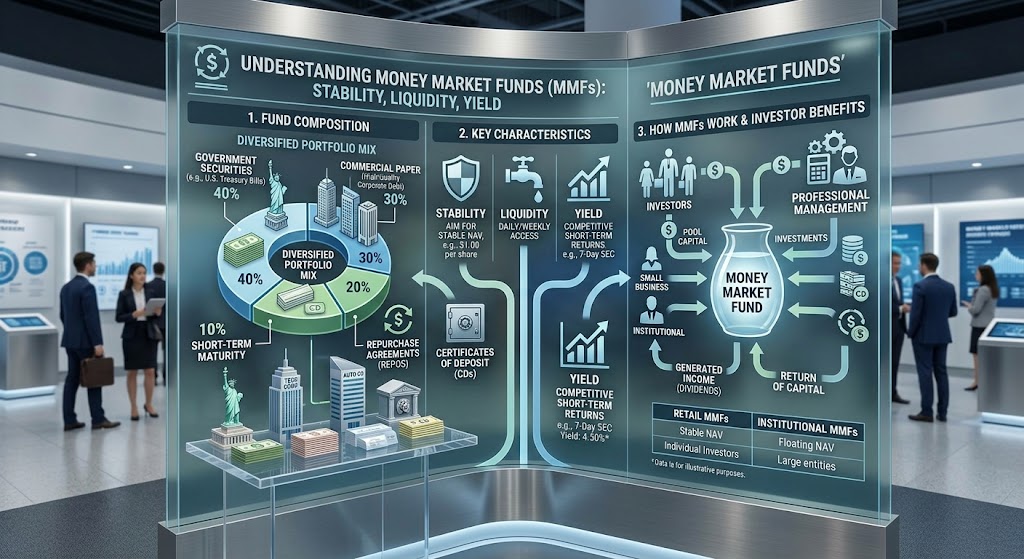
A money market fund is a type of investment fund that pools money from lots of investors and lends it out, short-term, to very safe borrowers – mainly governments, banks and large companies. Because the loans (called “money market instruments”) are due to be repaid within a year, often in just weeks or months, they’re considered one of the lowest-risk types of fund you can buy.
Think of it like this, instead of putting your spare cash in one savings account with one bank, a money market fund spreads it across dozens of short-term loans to different institutions, and pays you a return based on the interest those loans earn.
You can hold a money market fund inside a Stocks and Shares ISA, a SIPP (pension), or a general investment account, just like you would a shares fund or ETF.
How Do Money Market Funds Work?
A fund manager takes the pooled money and buys a mix of short-dated instruments – things like Treasury bills (short-term UK government debt), certificates of deposit (a type of fixed-term bank deposit) and commercial paper (short-term loans to large companies). Because everything matures so quickly, the fund manager is constantly reinvesting as loans are repaid, which keeps the fund’s yield closely tracking the Bank of England’s base rate.
Your return builds up daily as interest accrues, and most UK money market funds let you buy and sell on a same-day or next-day basis (known as “T+1” settlement), so your money isn’t locked away for months like it might be in a fixed-rate savings bond.
Money Market Funds vs a Savings Account: What’s the Difference?
This is the comparison most beginners actually want, so let’s be direct about it.
Protection: A savings account with a UK bank or building society is covered by the Financial Services Compensation Scheme (FSCS) up to £85,000 per person, per institution, if the bank fails. A money market fund is an investment, not a deposit, so it does not carry the same FSCS deposit protection. UK-regulated money market funds are, however, tightly controlled by the FCA on diversification, credit quality and liquidity, which keeps the risk of a fund actually losing money very low – but “very low” isn’t the same as “guaranteed,” which is the key trade-off versus cash.
Returns: Money market fund yields tend to track the Bank of England base rate closely, and can sometimes edge ahead of easy-access savings rates, especially when rates are elevated like they are now. Savings accounts vary hugely between providers, so it’s not automatically true that a money market fund beats every savings account – always compare the actual rate on offer.
Access: Both are generally easy to access, though money market funds typically settle in one business day rather than instantly.
Tax: Interest from a savings account outside an ISA counts towards your Personal Savings Allowance. Income from a money market fund held inside a Stocks and Shares ISA or SIPP is free from UK income tax; held outside a wrapper, it’s typically taxed as savings income too.
What Do Money Market Funds Actually Pay Right Now?
Yields move with the Bank of England base rate (currently 3.75%), so they change over time – but as a general guide, mainstream UK sterling money market funds have recently been yielding in the region of 3.5%-4.2%, depending on the fund and its charges.
Some money market ETFs (exchange-traded versions of the same idea) have shown similarly competitive yields.
Always check the fund’s current yield and ongoing charge figure (OCF) before comparing it to a savings account, since a headline yield doesn’t include fees.
The Risks You Need to Know About
Money market funds are widely seen as one of the lower-risk corners of the investing world, but “lower-risk” doesn’t mean “risk-free.” The main risks are: a borrower inside the fund defaulting (extremely rare given the short maturities and high credit quality UK funds are required to hold), the value dipping very slightly in unusual market stress (sometimes called “breaking the buck,” which has happened only rarely, mostly in the US during the 2008 financial crisis), and simply not having FSCS deposit protection the way a bank account does.
For most UK beginners using a mainstream, FCA-regulated sterling money market fund for short-term cash, these risks are considered low – but they’re not zero, and that’s worth being honest about.
How to Buy a Money Market Fund in the UK
Most major UK investment platforms, including AJ Bell, Hargreaves Lansdown, interactive investor and Vanguard, offer access to money market funds, either as traditional funds or as money market ETFs, inside an ISA, SIPP or general investment account.
You simply search for the fund by name in your platform’s investment search tool and buy it like any other fund, subject to your platform’s usual dealing charges.
What to Do Next
- Work out what the cash is for. Money market funds suit short-to-medium-term cash you don’t need locked away, not your entire long-term portfolio.
- Compare the fund’s current yield and OCF against your best available savings account rate before assuming a money market fund is automatically better.
- Check whether your platform offers money market funds, and what dealing or account charges apply to holding one.
- Consider holding it inside an ISA or SIPP so any income is free from UK tax.
- Remember it’s an investment, not a savings account – there’s no FSCS deposit protection, even though the risk of loss is generally considered low.
Risk Disclaimer
This article is for information and education only – it isn’t regulated financial advice, and nothing here is a personal recommendation. Money market funds are investments, not deposits, and are not covered by the same FSCS deposit protection as savings accounts. The value of investments can go down as well as up, and you could get back less than you put in. Yields mentioned are indicative and change over time. Please do your own research or speak to a regulated financial adviser before investing.
