
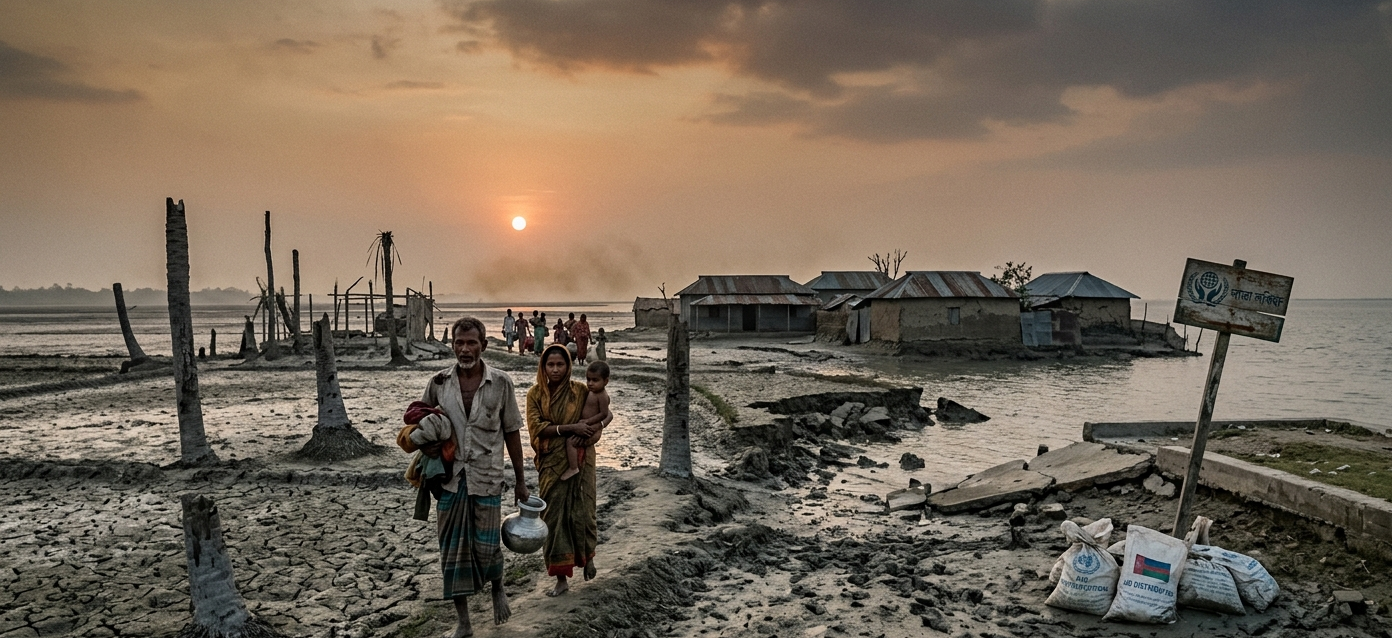
There is a quiet contradiction at the heart of Bangladesh. It is a country defined by fertile land—built by rivers, sustained by sediment, and historically capable of feeding millions. Yet today, that same land is steadily losing its ability to sustain life. Not through a single shock, but through a slow, cumulative process that is far more difficult to confront: degradation.
Each year, an area roughly the size of Dhaka city deteriorates. Soil fertility declines, salinity spreads across coastal zones, erosion reshapes entire landscapes, and agricultural land is pushed beyond its natural limits. More than three-quarters of the country’s land is now degraded to some degree. These are not isolated environmental symptoms—they are signals of a deeper systemic strain.
Bangladesh has not reached this point through neglect or lack of awareness. On the contrary, it has demonstrated remarkable resilience and progress, particularly in ensuring food security for a rapidly growing population. Agriculture has been intensified, cropping cycles extended, and productivity maximized. But this success has come at a cost that is now becoming visible.
Yet the environmental dimension alone does not capture the full weight of the issue. Land degradation in Bangladesh is not evenly distributed in its impacts. It follows existing patterns of inequality and deepens them. Those who depend most directly on land—smallholder farmers, rural laborers—experience declining returns and rising vulnerability. But for communities already excluded from land ownership, the consequences are far more severe.
The Bede community offers a stark illustration. Traditionally nomadic and living along river systems, they exist at the margins of both land and governance structures. Without secure land rights, they are excluded from formal systems of support, from access to services, and from long-term economic opportunities. As riverbanks erode and environmental pressures intensify, their displacement becomes not just more frequent, but more permanent. In their case, land degradation is not simply an environmental challenge—it is a direct pathway to social exclusion.
This is where the crisis in Bangladesh reveals its most important insight: environmental degradation and social inequality are not separate problems. They are interconnected outcomes of how land is managed, governed, and accessed.
Despite a range of policies—on land use, agriculture, environmental protection, and social welfare—the challenge persists. The issue is not the absence of frameworks, but the fragmentation between them. Land is treated through sectoral lenses: agriculture seeks higher yields, environmental policy focuses on conservation, urban planning drives expansion, and social policy addresses poverty in isolation. But land itself does not function in sectors. It is a single, interconnected system.
Without integration, well-intentioned interventions can undermine each other. Increased agricultural intensity can degrade soil health. Infrastructure expansion can reduce productive land. Environmental protections may not align with local livelihood realities. The result is a system that continues to operate, but without coherence.
What is unfolding in Bangladesh should not be seen as an isolated national issue. It reflects a broader global pattern. This is where international cooperation becomes critical. Support for Bangladesh has historically focused on climate resilience, disaster response, and agricultural productivity. These areas remain essential. However, the nature of the challenge is evolving. It is no longer sufficient to address symptoms in isolation. What is required is a more integrated approach that connects environmental sustainability with governance and social inclusion.
This means strengthening land-use planning across sectors, improving coordination between institutions, and ensuring that policies are not only designed, but effectively implemented. It also means recognizing that local communities—particularly those most affected—must be part of the solution. Their relationship with land, their knowledge, and their priorities are not peripheral; they are central to any sustainable pathway forward.
There is also a broader responsibility. The pressures facing Bangladesh are not entirely domestic. Global supply chains, consumption patterns, and climate dynamics all play a role in shaping local realities.
Standing in Bangladesh, the land still looks productive. Crops grow, markets function, life continues. But beneath that surface, the system is under strain. The question is not whether the land can continue to support current demands—it is for how long, and at what cost.
Addressing this challenge requires more than technical solutions. It requires a shift in perspective: from viewing land as a resource to be maximized, to understanding it as a system that must be sustained. It requires bridging the gap between policy and practice, between environmental goals and social realities.
Ultimately, the future of Bangladesh’s land will depend on whether it is possible to realign these elements—to restore not only soil health, but the connection between land, governance, and people.
Because when land fails, the impact is never limited to the environment. It reshapes economies, displaces communities, and redefines what development means in practice. And in a world facing similar pressures, the lessons from Bangladesh are not just relevant—they are urgent.