
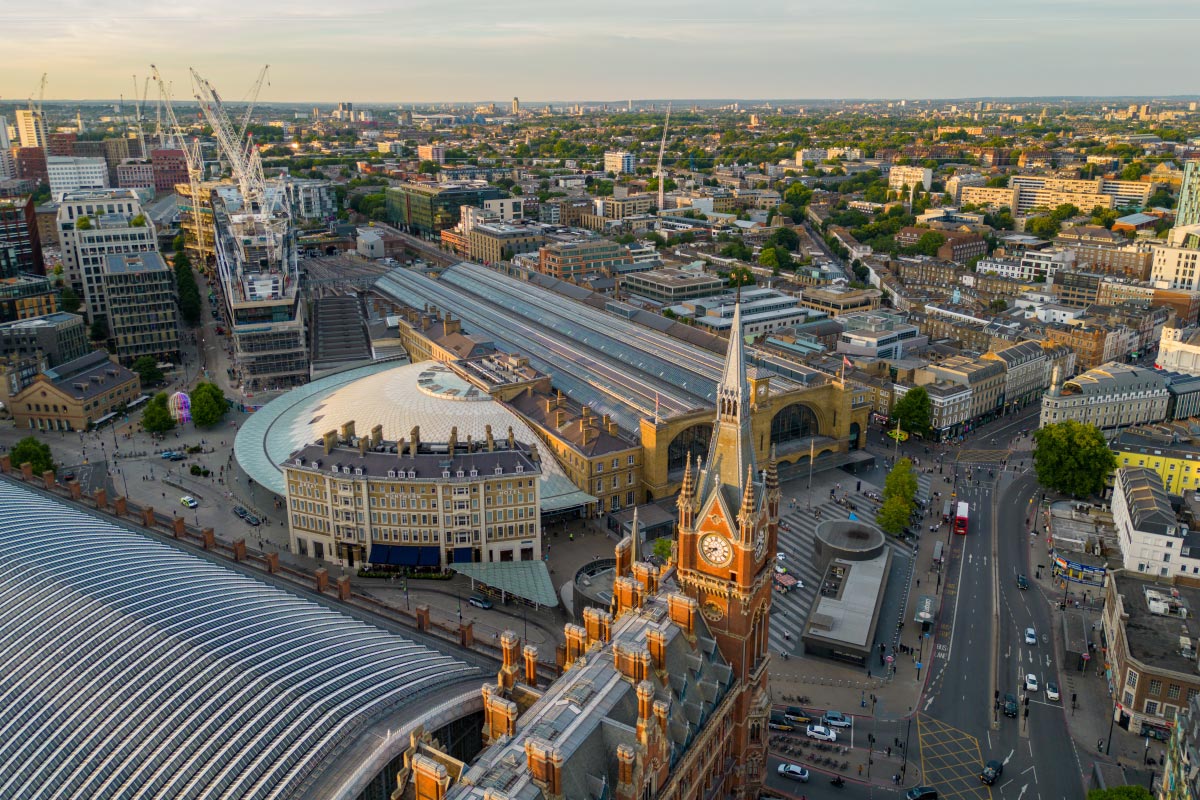
Most large-scale urban regeneration projects share a common failure. They deliver the buildings, the infrastructure, and the amenity mix, and they still feel like developments rather than places. The architecture is coherent to the point of monotony. The public spaces are technically adequate and emotionally empty. The history of the site, whatever it was, has been erased in favor of something cleaner and more marketable.
King’s Cross in London took a different approach, and the results have made it one of the most studied urban regeneration projects in the modern office era. The number of firms on the 67-acre site roughly doubled to 800 between 2010 and 2021. Jobs increased from 8,000 to 27,000 between 2011 and 2019. Estimated office rents went from 48% below the London city centre average in 2010 to 19% above it by 2022.
The clearest measure of whether the placemaking worked is that people show up, with King’s Cross now welcoming more than 19 million visitors each year across a site where 41,000 people live, work, and study. Part of the reason for the success lies in a decision made early in the process about how the site’s history would be treated. King’s Cross was one of the UK’s most significant industrial heritage sites, a Victorian railway and goods yard built around coal, gas, and canal freight. The conventional development logic would have been to clear it and start fresh. Argent, the lead developer, and its masterplanning team at Allies and Morrison and Porphyrios Associates chose instead to treat the industrial fabric as the organizing structure of the new district. Allies and Morrison described the masterplan as a work of “urban repair” that respects the dramatic character of the existing fabric while introducing a diverse mix of new uses.
PROPMODO PARTNER OFFER

Level Up: The State of AI in Commercial Property Management
A candid look at what’s moving the dial, with a 12-to-18-month roadmap to move from pilot to embedded and reliable.
Insights from JLL’s CTO, GGP’s VP of IT
The gasholder storage tanks are the most noticeable expression of that thinking. Built in the 1850s as part of Pancras Gasworks, the cast iron frames held gas for over a century before being decommissioned in 2000. Gasholder No. 8, the largest of the group, once held 1.1 million cubic feet of gas. Rather than demolishing them, the development dismantled the frames piece by piece, restored them, and relocated them across the canal. Gasholder No. 8 now encases a sculpted canopy and a circular lawn as Gasholder Park. The three adjacent gasholder frames were repurposed as the structural envelope for residential buildings, with apartments built inside the Victorian ironwork. The Coal Drops, where coal was once transferred from rail to road, became Coal Drops Yard, a retail and dining quarter that preserved the Victorian brick arches and cobbled streets. The Granary Building, which stored wheat for London’s bakers, became the campus for Central Saint Martins.
Central Saint Martins opened on the site in 2011 as an early occupier, bringing thousands of art and design students to the site daily. Google, which acquired a million square feet at King’s Cross, reported valuing the vibrancy that Central Saint Martins contributed to the area. Louis Vuitton, a longtime sponsor of the college, moved its UK headquarters to the site in 2014.
The natural assets of the site received a similar reverence. The Regent’s Canal, opened in 1820 and carrying 100,000 tons of goods within its first year, runs directly through the development. Rather than treating it as an obstacle, the masterplan made it the primary east-west spine of the public realm, with new pedestrian and cycle bridges improving connections between Camden and Islington, and a landscape strategy running the length of the corridor. Camley Street Natural Park, a two-acre nature reserve created from an old coal yard in 1984, sits on the opposite bank. The park’s woodland, grassland, and wetland habitats support kingfishers, herons, amphibians, and rare fungi, and it holds designation as a Site of Metropolitan Importance for Nature Conservation and a statutory Local Nature Reserve. It sits within the Regent’s Canal Conservation Area, and Camden’s conservation statement explicitly celebrates the juxtaposition of the natural reserve against the industrial gasholders as a defining characteristic of the place. The development connected to it rather than around it, building the Somers Town Bridge in 2017 specifically to link the reserve to the new district.
The architectural strategy also separates King’s Cross from typical master-planned development. Argent appointed more than 30 different architects to design individual plots, including Maki and Associates, David Chipperfield Architects, Heatherwick Studio, Wilkinson Eyre, Eric Parry, and Niall McLaughlin. Each was given the parameter plans and design guidelines that governed density, scale, massing, and the obligations of each building within the broader placemaking strategy, and then given genuine freedom within those constraints. As the masterplanners described it, every plot had guidelines explaining its obligations while architects retained latitude to design what they wanted, respecting the context and adjacency of neighboring plots. The result is a district where every building has its own unique materials, textures, and styles. That variation is deliberate. It reproduces the accretive quality of a city that grew over time rather than one that was designed at once.
The public realm commitment underlying all of this was substantial and expensive. Forty percent of the total land area was given over to public space, including 10 new parks and squares and 20 new streets. The development includes 50 buildings, 1,700 homes, 30 bars and restaurants, and office capacity for 30,000 jobs. Granary Square, the centerpiece, hosts a continuous program of public events, from fountain displays and outdoor cinema to markets and installations. The programming is not incidental. It is what converts public space from something residents walk through into something Londoners travel to.
The heritage refurbishments were loss-making on their own terms, and preserving low-rise Victorian buildings meant forgoing the taller, denser development that could have occupied those sites. King’s Cross provides less floorspace for every square metre of ground, than other master planned communities like Canary Wharf or Paddington. Given how much demand for office space in King’s Cross has subsequently materialized, it is reasonable to argue that more commercial space would have produced more economic value. The heritage and public realm investments were subsidized by the profits from the rest of the development, which only worked because the site was commercially viable enough to carry them.
That trade-off is the real lesson of King’s Cross for anyone attempting something similar. The placemaking that makes the district distinctive was enabled by patient institutional capital from pension funds rather than short-term debt financing. What King’s Cross demonstrates is not that heritage preservation and public realm investment always pay for themselves. It is that when the conditions allow for it, treating a site’s history as an asset rather than an obstacle produces a place that people actually want to be in, and that turns out to be worth a great deal.