
Vietnam’s new policy framework for the foreign-invested sector – the Politburo’s Resolution No. 10, is expected to benefit industrial real estate, technology-semiconductor, banking, securities, logistics and energy companies, as the country shifts its focus toward higher-quality investment, according to brokerage Mirae Asset.

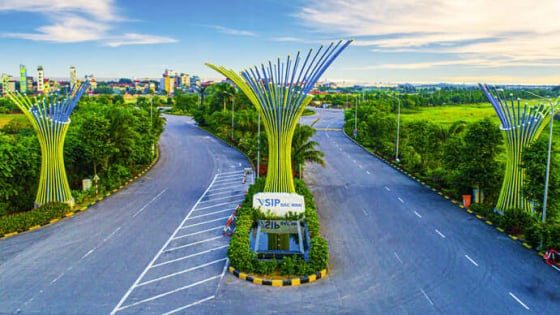
VSIP Bac Ninh industrial park in Bac Ninh province, northern Vietnam. Photo courtesy of VSIP.
Resolution No. 10-NQ/TW, signed by Party chief and President To Lam on June 8, marks a strategic shift in Vietnam’s FDI policy from prioritizing investment volume to emphasizing quality, technology transfer, value creation and stronger linkages with domestic businesses.
Analysts at Mirae Asset said the resolution completes the government’s broader policy framework covering the state sector (Resolution No. 79-NQ/TW), the domestic private sector (Resolution No. 68-NQ/TW), and the foreign-invested sector (Resolution No. 10-NQ/TW).
The resolution prioritizes attracting next-generation FDI into semiconductors, artificial intelligence, big data, biotechnology, new materials and clean energy, while encouraging research and development activities and promoting innovation-driven growth.
It also places greater emphasis on strengthening supply-chain integration between foreign investors and domestic companies by increasing localization rates and expanding the domestic supplier base.
Under the resolution, Vietnam aims to attract between $200 billion and $300 billion in registered FDI capital during 2026-2030, equivalent to $40-50 billion annually, while realized FDI is targeted at $150-200 billion over the same period.
Authorities also aim to raise localization rates in key manufacturing industries to 45-50% and develop around 10,000 Vietnamese firms participating in FDI value chains, including 500-1,000 first-tier suppliers.
According to Mirae Asset, the new resolution represents a strategic upgrade rather than an expansion of Vietnam’s FDI ambitions. Compared with Resolution No. 50 issued in 2019, which focused on improving the quality and efficiency of FDI, Resolution No. 10 (2026) represents a stronger shift towards developing the FDI sector strategically, selectively, and closely linked to the internal capacity of the economy.
A notable feature of the resolution is its integration of foreign direct investment (FDI) and foreign portfolio investment (FII) within a single strategic framework, positioning capital market reforms – including efforts to upgrade Vietnam’s stock market classification – as a tool to support industrial policy and national investment strategies.
Mirae Asset said linking stock market status upgrade with the FDI strategy could encourage renewed foreign capital inflows and improve valuations of leading listed companies, particularly if barriers related to foreign ownership limits, disclosure requirements and trading infrastructure are gradually addressed.
The brokerage also described the relationship between FDI and FII as mutually reinforcing: stronger FDI inflows can enhance the competitiveness of domestic companies and make them more attractive to foreign investors, while deeper capital markets can provide long-term financing that helps domestic firms expand and better absorb technology and investment spillovers.
The resolution features expectations for sustainable business growth, vision for 2045: FDI sector to account for approximately 30% of GDP.
By sector, Mirae Asset expects industrial park developers to be among the biggest beneficiaries as demand for factory land, industrial facilities and supporting infrastructure rises alongside new investment projects. Developers with large land banks, strategic locations and strong environmental, social and governance (ESG) credentials are expected to enjoy a competitive advantage. Some of the companies mentioned include KBC, IDC, PHR, SZC, BCM, VGC, SIP, NTC, and TIP.
Technology companies, particularly those involved in semiconductors and artificial intelligence, are also expected to benefit as those industries have been explicitly identified as priorities for future foreign investment.
Meanwhile, higher FDI inflows are likely to boost demand for banking services, including credit, trade finance, foreign exchange and investment banking, while stock market reforms aimed at attracting overseas investors could support securities firms.
Logistics providers, port operators, construction and infrastructure companies, and electricity producers are also expected to benefit from increased factory development, semiconductor projects and supply-chain expansion as Vietnam attracts more high-quality foreign investment in the coming years.