
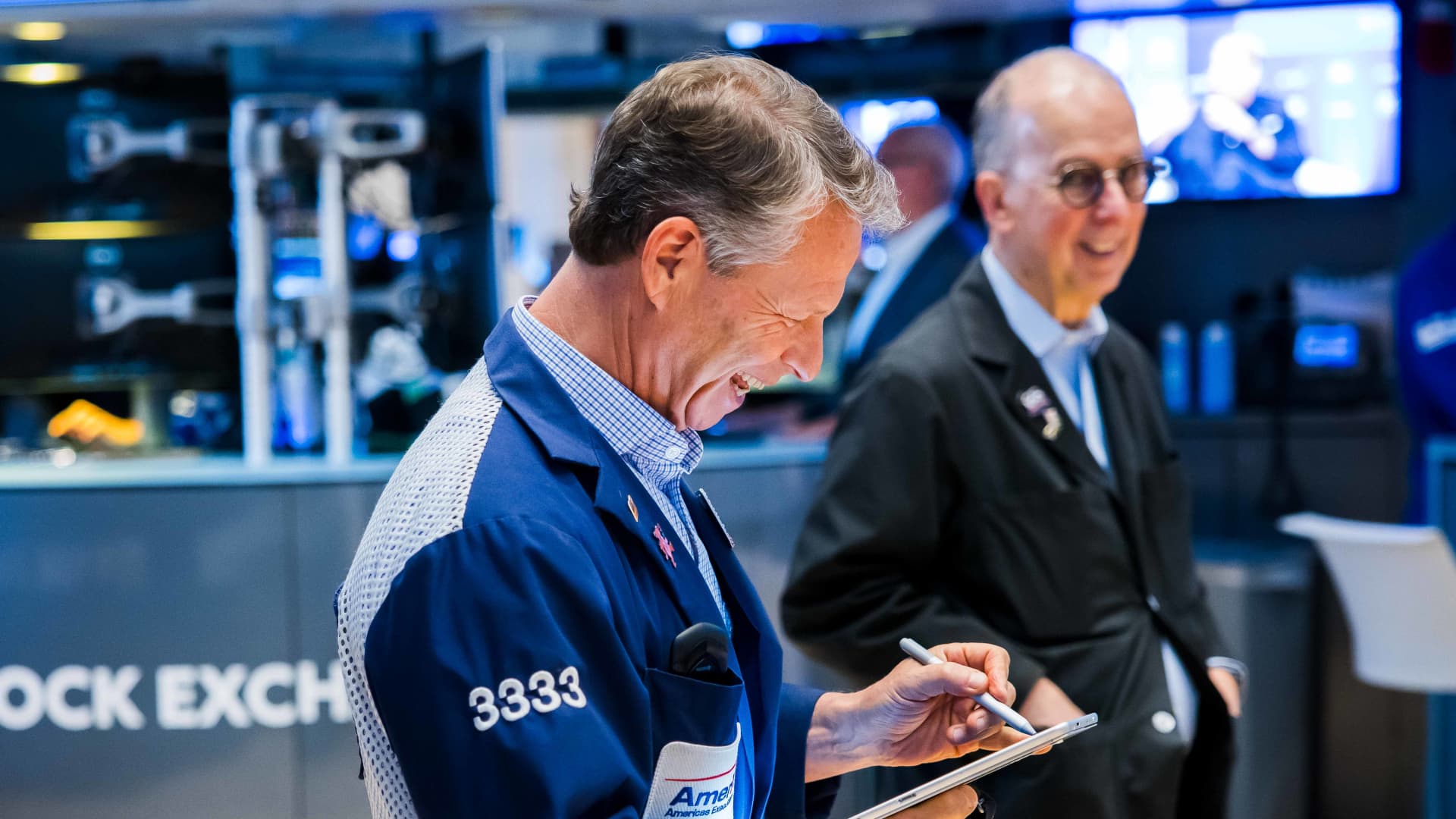
Traders work at the New York Stock Exchange on May 28, 2026.
NYSE
The S&P 500 rose on Monday, even as oil prices advanced, with Nvidia leading technology higher following the launch of a new chip for PCs.
The broad market index advanced 0.26% to close at 7,599.96, while the Nasdaq Composite gained 0.42% to close at 27,086.81. The Dow Jones Industrial Average added 46.42 points, or 0.09%, and ended at 51,078.88. All three indexes reached new all-time intraday highs and closed at records.

S&P 500, year-to-date
Nvidia shares offered support to the broader market, climbing more than 6% after the company unveiled a new processor for personal computers. Dell Technologies and HP Inc followed Nvidia higher, rising more than 10% and 8%, respectively. Intel, which for years dominated the PC chip market, fell over 4%.
Beyond tech, energy was the only other S&P 500 sector in the green Monday. Marathon Petroleum was a standout in the group, with shares moving about 4% higher, while Exxon Mobil and Chevron increased 2.8% and 1.9%, respectively.
Oil prices also rose to start the trading week. West Texas Intermediate crude futures gained 5.93% on Monday to settle at $92.54 a barrel, while Brent crude added 4.24% to settle at $94.98. In May, the U.S. benchmark posted its steepest monthly decline since April 2025, tumbling nearly 17%.
Those moves follow Iranian state media reporting that the country’s negotiators are stopping communication with the U.S. and that Tehran will completely shut the Strait of Hormuz because of Israeli attacks on Lebanon.
President Donald Trump told CNBC in response that he doesn’t care if peace negotiations with Iran are over, saying to CNBC’s Eamon Javers in a phone interview, “I really don’t care. I couldn’t care less.” He also said that he was “going to ask” Israeli Prime Minister Benjamin Netanyahu “what’s going on with Lebanon.”
Over the weekend, Netanyahu praised the country’s forces in capturing Beaufort castle in southern Lebanon as troops advanced into the territory.
Trump later said in a Truth Social post that he “had a very productive call” with Netanyahu, adding that “there will be no Troops going to Beirut, and any Troops that are on their way, have already been turned back.”
In a separate post, the president wrote that talks with Iran “are continuing, at a rapid pace.”
The U.S. and Iran exchanged strikes this past weekend, with U.S. Central Command saying Monday that U.S. forces intercepted two Iranian ballistic missiles overnight that were targeting American forces in Kuwait.
U.S. and Iranian negotiators last week arrived at a 60-day memorandum of understanding to extend the fragile ceasefire, which sent stocks to fresh highs. But Trump ended a meeting in the White House Situation Room without announcing his final decision on the deal.
“It’s sort of two steps forward, one step back, it seems with the U.S. and Iran, but clearly the market is not expecting a re-acceleration of hostilities to where we were” in the first two to three weeks of the conflict, Orion’s Tim Holland told CNBC. “We’re still closer to the off-ramp, I think, than the on-ramp.”
The chief investment officer expects that energy prices will remain below where they were roughly four to six weeks ago. For energy prices to go above that threshold, Holland believes the conflict would have to escalate beyond the hostilities seen at its peak.