
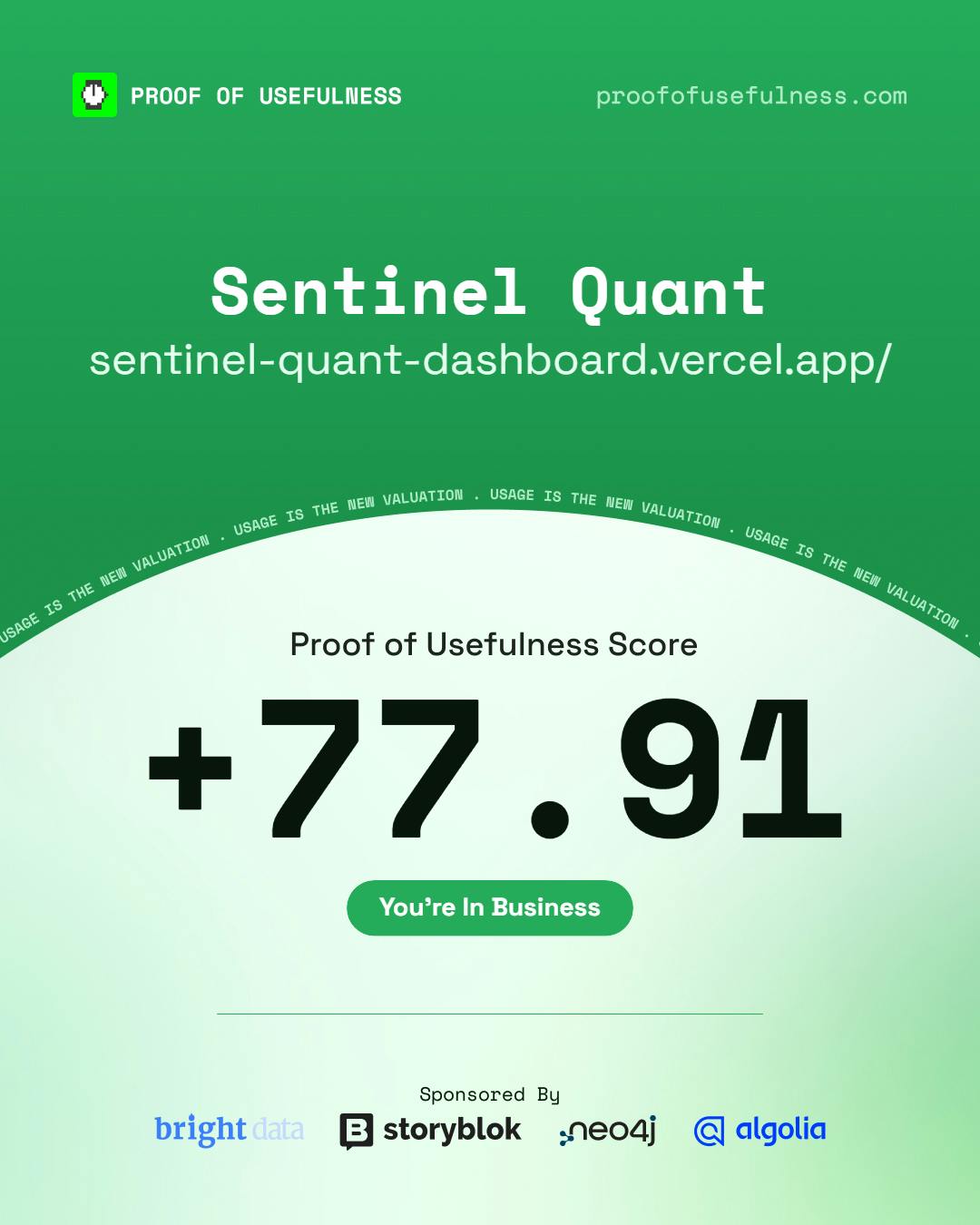
In this interview, we sat down with Iyanuoluwa Enoch Oke, the creator of Sentinel Quant, to discuss his innovative human-in-the-loop portfolio management system. We explore how the project combines LLM-based market analysis with deterministic risk controls to ensure safe, human-approved execution.
What does Sentinel Quant do?
Sentinel Quant is a human-in-the-loop portfolio management system that combines LLM-driven market analysis with deterministic risk controls and a dual-model AI governance architecture. A supervisory model proposes trading actions, while a separate execution model can act only on human-approved instructions after passing strict validation. It runs three strategy sleeves across dual-broker execution (Alpaca, Trading212) with eight independent risk checks. Live since March 2026; documented on Zenodo (DOI: 10.5281/zenodo.19284847). Now’s a good time for Sentinel Quant to exist because the rapid advancement of LLMs in finance demands robust governance frameworks where AI serves as a tightly regulated advisor rather than an autonomous, unconstrained decision-maker.
Who does your Sentinel Quant serve? What’s exciting about your users and customers?
Developers, quant researchers, and AI practitioners exploring safe patterns for deploying LLMs in high-stakes decision environments, specifically where an AI can advise but must never be allowed to act autonomously. Also relevant to retail/independent traders wanting AI-assisted analysis without ceding execution control to the model.
What technologies were used in the making of Sentinel Quant? And why did you choose ones most essential to your techstack?
Sentinel Quant leverages Python alongside a dual-model LLM architecture using Claude Opus for supervision and Claude Sonnet for execution. The platform is hosted on Hetzner with Docker, relies on Vercel for its dashboards, and integrates directly with Alpaca and Trading212 APIs to enable seamless, human-verified dual-broker execution.
What is the traction to date for Sentinel Quant?
Since launching in continuous production in March 2026, Sentinel Quant has established a strong technical foundation with a published report on Zenodo (DOI: 10.5281/zenodo.19284847) and a public GitHub repository. Early visibility has come from the AI governance and quant communities, with its announcement post generating solid initial engagement among software and AI professionals.
What excites you about this Sentinel Quant’s potential usefulness?
Most LLM trading agents chase autonomy and speed; Sentinel Quant instead treats the hard problem as governance, not signal generation. By structurally separating the advisory model (which proposes) from the execution model (which can only act on human-approved, constraint-validated instructions), it demonstrates a reusable pattern for deploying LLMs anywhere the cost of an ungoverned AI decision is high, finance being just the first proving ground.
Walk us through your most concrete evidence of usefulness.
The clearest evidence isn’t a usage metric, it’s the risk engine’s block rate. Over the observation period, roughly 53% of AI-proposed actions were rejected by the deterministic risk layer, mostly on global exposure limits, minimum trade size filters, and sector concentration caps. That number is the whole thesis in one figure: an unconstrained LLM would have executed on more than half its own proposals, and a system without a governance layer would have taken all of that risk. The fact that the model kept proposing trades the risk engine correctly vetoed, cycle after cycle, is the proof that separating “propose” from “approve to execute” isn’t a nice-to-have, it’s load-bearing.
How do you measure genuine user adoption versus “tourists” who sign up but never return?
At this stage there isn’t a multi-user retention story to tell, and I’d rather say that plainly than dress it up. Sentinel Quant is individually built and operated; the only continuous “user” is me, running it in production daily since March 2026. The honest adoption signal right now is operational: the system has stayed in continuous live production without a single kill-switch trigger, through multiple market regimes (including a sustained HIGH_VOL period), which says more about whether the architecture is trustworthy than any signup count would.
If we re-score your project in 12 months, which criterion will show the biggest improvement, and what are you doing right now to make that happen?
Traction and reach, most likely. The architecture and governance model are already mature relative to comparable published work, and that’s documented (the Zenodo report, DOI: 10.5281/zenodo.19284847); what’s underdeveloped is distribution. Right now I’m turning the system’s operational history (bug taxonomy, failure modes, live audit trail) that hasn’t made it into the published report yet into further technical writeups aimed at the quant/AI-governance developer community, since that’s where the early engagement already came from organically.
How Did You Hear About HackerNoon?
Journal reading and research led me to HackerNoon; it kept surfacing as a place where technical builders write up real engineering work rather than polished marketing copy, which made it a natural fit for a project like Sentinel Quant where the interesting parts are the failure modes and governance tradeoffs, not a launch pitch.
Given your initial announcement reached ~350 professionals with 25 engagements, what is your strategy to convert this early interest into a steady base of active quant researchers and developers?
The strategy is substance over reach: publish the operational data (the Zenodo report, the bug taxonomy, the failure-mode writeups) rather than repeat the pitch. The initial post generated engagement because it described a real governance problem, not because it was promotional. The plan is to keep surfacing genuinely load-bearing engineering detail (regime-based performance breakdowns, risk engine block-rate analysis) to the same communities, since that’s what a quant researcher actually wants to evaluate before adopting a pattern.
As an individually built project currently in its early stages, what are the next major milestones for scaling Sentinel Quant’s reach to a wider audience of independent traders?
Three things: (1) a public writeup of the failure-mode taxonomy, since that’s the most reusable artifact for anyone building similar systems; (2) opening up the public-facing agent/dashboard as a reference implementation independent traders can study even before they’d trust it with capital; (3) a second Zenodo report once enough regime diversity has accumulated to make the performance data statistically meaningful rather than preliminary.
Your dual-model architecture prioritizes governance over pure signal generation. What is a specific edge case or dangerous proposition that the supervisory model caught, proving the absolute necessity of this human-in-the-loop system?
The clearest case was the “phantom position” problem. After a legacy ETF swap updated broker state without syncing the internal virtual capital tracker, the system’s records no longer matched reality, and the supervisory model, working off stale internal state, recommended selling a position that no longer existed. Because execution requires validation against live broker truth, not just the model’s belief state, the trade was rejected rather than silently failing or worse, executing against the wrong asset. It’s a good example of exactly the failure an autonomous, ungoverned agent would be exposed to: the AI’s internal picture of the world drifted from reality, and only the deterministic checkpoint caught it.
Bright Data: Bright Data is the leading web data infrastructure company, empowering over 20,000 organizations with ethical, scalable access to real-time public web information. From startups to industry leaders, we deliver the datasets that fuel AI innovation and real-world impact. Ready to unlock the web? Learn more at brightdata.com.
Neo4j: GraphRAG combines retrieval-augmented generation with graph-native context, allowing LLMs to reason over structured relationships instead of just documents. With Neo4j, you can build GraphRAG pipelines that connect your data and surface clearer insights. Learn more.
Storyblok: Storyblok is a headless CMS built for developers who want clean architecture and full control. Structure your content once, connect it anywhere, and keep your front end truly independent. API-first. AI-ready. Framework-agnostic. Future-proof. Start for free.
Algolia: Algolia provides a managed retrieval layer that lets developers quickly build web search and intelligent AI agents. Learn more.