What You Should Know
South Korea is one of the more distinctive cases in global economic development. From an agriculture-based economy in the postwar period, it has evolved into a major manufacturing powerhouse centered on semiconductors, automobiles, and shipbuilding. In semiconductors in particular, Samsung and SK hynix have long dominated the global memory market. In recent years, the rise of AI, rapid data center expansion, and surging HBM demand have further strengthened South Korea’s central role in the AI infrastructure supply chain, driving a powerful rally in the South Korean stock market, which at its peak this year had gained as much as 120%.
However, the sharp rise in stocks also reflects South Korean investors’ strong appetite for leveraged trading. Following the recent market correction, has the deleveraging process in the South Korean stock market come to an end? And how should investors track the fundamentals of the South Korean economy?
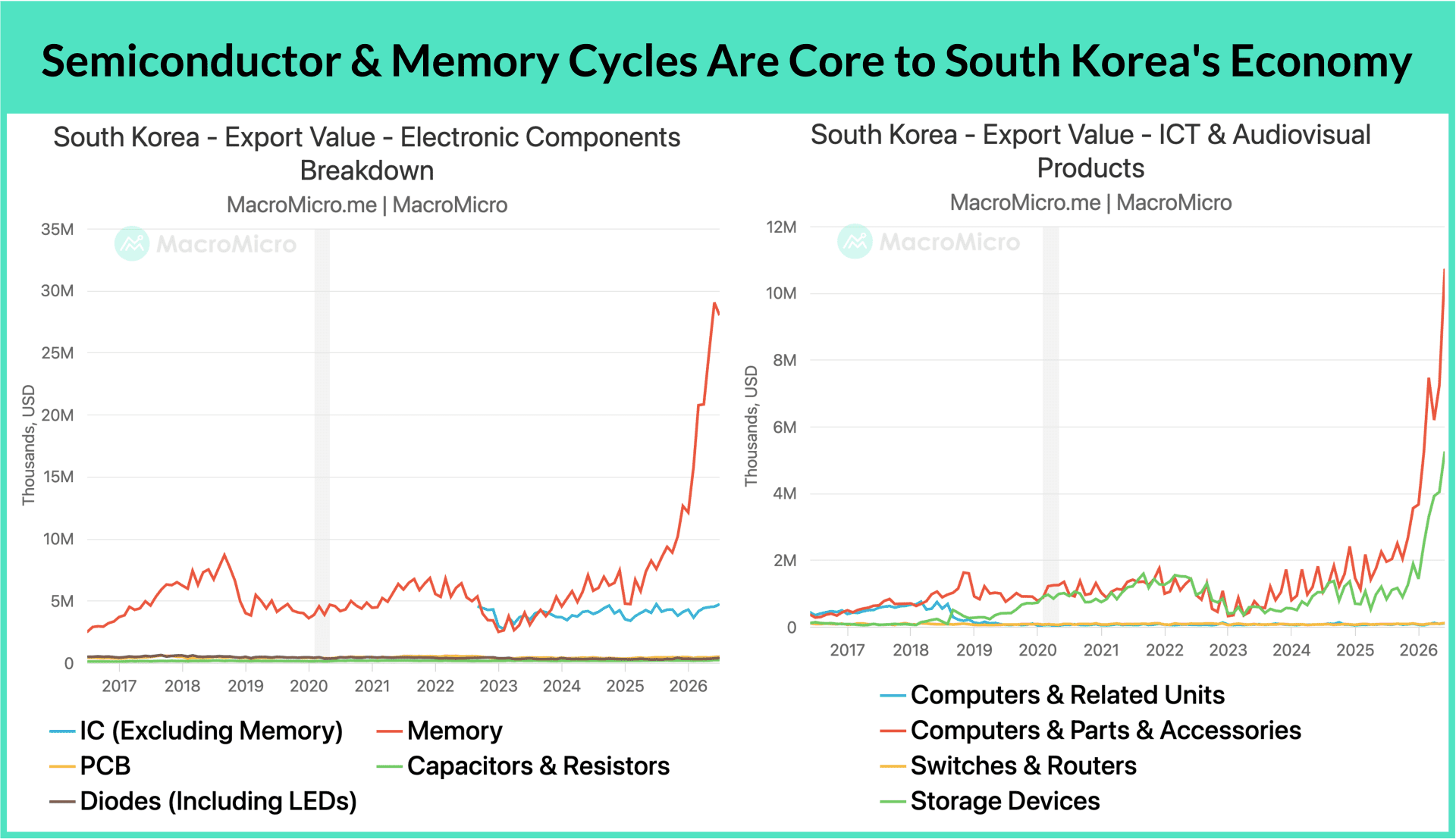
In this report, we use data and charts from our newly launched Korea Macro Monitor to take an in-depth look at the structural issues facing the South Korean economy and the key indicators worth monitoring going forward.
Key Takeaways
- South Korea’s leveraged investment culture can be traced back to its historical economic development, including the chaebol system and the Jeonse housing system.
- Three key South Korean economic indicators: memory exports, semiconductor & parts inventory-to-shipment ratio, and manufacturing PMI.
- Five key South Korean stock market indicators: central bank interest rates, margin financing / investor deposit balances, short-to-long ratio, forced liquidation amounts, and securities lending balances.

I. Leveraging Debt to Pursue Growth: How Did South Korea’s Leveraged Investment Boom Develop?
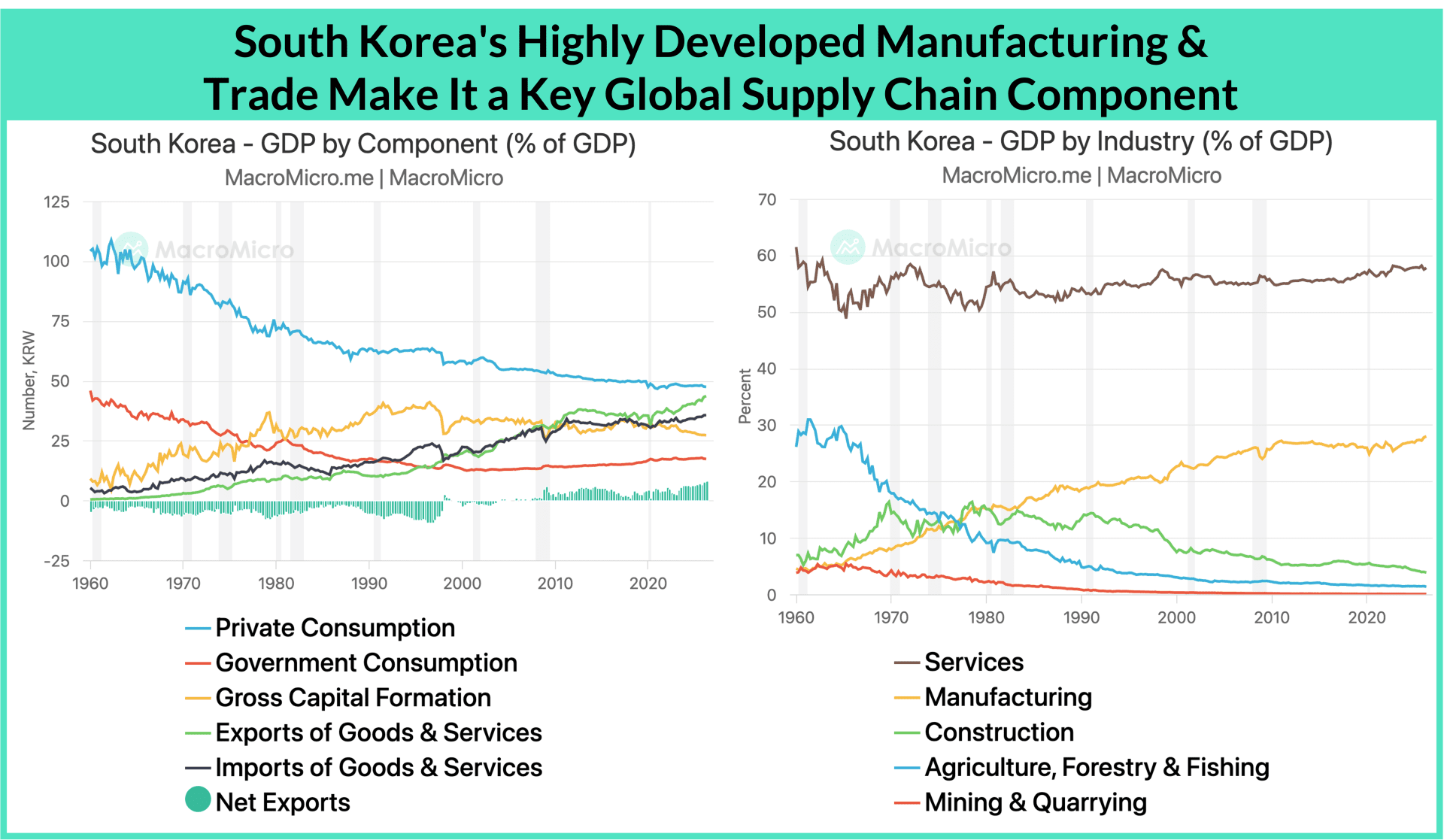
First, let’s start with South Korea’s economic structure. In the 1960s, South Korea was still primarily an agriculture-based economy. By the 1970s, the rapid expansion of urbanization, industrialization, and infrastructure demand drove a massive wave of construction in housing, factories, and public infrastructure, causing the construction sector’s share of GDP to rise significantly. South Korea’s industrial policy subsequently shifted from light industries such as textiles and apparel toward heavy and chemical industries including steel, shipbuilding, machinery, and automobiles. It was not until semiconductors and high-tech manufacturing emerged after the 1980s that the economic structure we recognize today took shape: a highly concentrated economy centered on large export industries such as semiconductors, electronics, automobiles, and ships, with exports accounting for more than 40% of GDP.
The Rise of Large Corporations and Highly Concentrated Resources Fostered a Preference for Leverage
Large corporations played a critical role in South Korea’s industrialization. The government adopted a strategy of “highly concentrated resource allocation,” using policy-driven finance, low-interest loans, export quotas, and other mechanisms to support a small number of private business groups, which eventually became known as “chaebols.” Under this economic structure, a small number of large corporations controlled a significant share of high-paying jobs and resource allocation, making ordinary households more reliant on entering large corporations or accumulating wealth through assets such as real estate and stocks.
Housing Market: The Distinctive Jeonse System
Data show that South Korea’s household debt-to-disposable net income ratio stands at a high 174%, the seventh-highest among OECD countries. This stems in part from South Korea’s distinctive “Jeonse” system, under which tenants are required to pay a large deposit, often exceeding 50% of the property’s market value, when moving into a home. Landlords treat these substantial deposits as “interest-free loans” and use them for additional financing and repeated property purchases. At the same time, tenants often rely heavily on “Jeonse loans” to finance the deposits. Together, these mechanisms create an exceptionally high level of credit leverage.
Stock Market: Retail Investors Favor High-Risk, High-Leverage Trading
At the same time, stock market participation and trading turnover in South Korea are also significantly higher than in most developed markets. According to statistics from the Korea Exchange, as of July 31, 2026, individual investors accounted for 40.1% of trading volume in the KOSPI market, including ETFs, compared with just 17% for US individual investors in Q1 2026, according to JPMorgan estimates. South Korean investors not only participate actively in the stock market, but also…
Already a subscriber? Click here to log in.

Comprehensive data at your service
with key indicators for investment insights

Exclusive flash reports
on key events and data

Create your own charts and analysis
including performance backtesting

Hub of professionals to engage
in meaningful discussions and insights

Get answers from MM AI.
What are the historical origins of South Korea’s leveraged investment culture?
💡South Korea’s leveraged investment culture originated from its historical economic development, specifically the chaebol system and the distinctive Jeonse housing system. The chaebol system, characterized by highly concentrated resource allocation to a few large corporations, made households reliant on these entities or asset accumulation. The Jeonse system, requiring large tenant deposits used as interest-free loans by landlords and often financed by ‘Jeonse loans’ by tenants, created exceptionally high credit leverage in the housing market.
How do the chaebol system and Jeonse housing system contribute to South Korea’s leverage?
💡The chaebol system and Jeonse housing system foster leverage by concentrating resources and encouraging debt. Under the chaebol system, a small number of large corporations controlled high-paying jobs and resource allocation, prompting households to accumulate wealth through real estate and stocks. The Jeonse system, with its substantial tenant deposits, allows landlords to use these as ‘interest-free loans’ for further financing, while tenants often rely on ‘Jeonse loans’ to pay these deposits, thus intertwining credit leverage throughout the economy.
Which five key stock market indicators are crucial for South Korea?
💡Five crucial stock market indicators for South Korea are central bank interest rates, margin financing/investor deposit balances, the short-to-long ratio, forced liquidation amounts, and securities lending balances. These indicators collectively offer insight into funding conditions, retail investor sentiment, liquidation pressure, and overall market liquidity, which are essential for assessing the health and risks associated with South Korea’s highly leveraged stock market.
How has South Korea’s economic structure evolved since the 1960s?
💡South Korea’s economic structure has evolved significantly since the 1960s, transforming from an agriculture-based economy into a manufacturing powerhouse. By the 1970s, industrialization and infrastructure demand boosted the construction sector. Policy then shifted to heavy and chemical industries like steel and shipbuilding. After the 1980s, semiconductors and high-tech manufacturing emerged, creating today’s highly concentrated, export-driven economy with exports accounting for over 40% of GDP, centered on electronics, automobiles, and ships.
What role do Samsung and SK Hynix play in the global memory market?
💡Samsung and SK hynix play a dominant role in the global memory market, particularly in DRAM, NAND, and HBM. Their leadership has strengthened South Korea’s central position in the AI infrastructure supply chain due to the rise of AI, rapid data center expansion, and surging HBM demand. This concentration of memory production makes their performance directly reflective of the global memory cycle, influencing South Korea’s exports, corporate earnings, and broader economy.
How does South Korea’s household debt-to-disposable net income ratio compare globally?
💡South Korea’s household debt-to-disposable net income ratio is notably high at 174%, ranking as the seventh-highest among OECD countries. This elevated ratio stems partly from the distinctive Jeonse housing system, where tenants provide large deposits, often exceeding 50% of property value, which landlords treat as interest-free loans and tenants often finance with Jeonse loans, creating significant credit leverage.
How does the semiconductor & parts inventory-to-shipment ratio indicate the industry cycle?
💡The semiconductor & parts inventory-to-shipment ratio indicates the industry cycle by tracking the balance between inventories and shipments, categorizing it into four stages: Upcycle (Passive Destocking), Upcycle (Active Restocking), Downcycle (Passive Restocking), and Downcycle (Active Destocking). As of June 2026, South Korea’s ratio remained low, indicating the industry cycle is positioned between “passive destocking” and “active restocking,” signifying that the upcycle remains intact due to strong demand and previous inventory reduction.
How do central bank interest rates affect South Korea’s leveraged assets and stock market?
💡Central bank interest rates significantly affect South Korea’s leveraged assets and stock market through three channels: valuation repricing, higher financing costs for corporations, and increased household debt-service ratios. Higher rates compress equity risk premiums, raise discount rates, increase corporate borrowing costs, and reduce retail investors’ disposable income for leveraged stock positions, thereby suppressing market liquidity and investment willingness. The Bank of Korea raised its policy rate to 2.75% in July, with potential for another 25-basis-point hike.
What does the forced liquidation amount for unsettled payments tell us about deleveraging?
💡The forced liquidation amount for unsettled payments provides a key signal about deleveraging. When this indicator surges, it signifies a deleveraging process is underway, as investors are forced to liquidate positions due to sudden market downturns after making short-term credit transactions. Conversely, a fall from elevated levels, as observed, indicates that liquidation pressure has gradually subsided and the deleveraging wave is beginning to end.
How does the securities lending balance reflect market liquidity and institutional participation?
💡The securities lending balance reflects market liquidity and institutional participation. A higher balance indicates greater flexibility for institutional investors in managing funds and executing trades, as securities are borrowed for various strategies like hedging and arbitrage, not solely short selling. Conversely, an excessively low balance suggests limited lending activity or inability to borrow, indicating low institutional participation and a lack of market depth and liquidity. The balance significantly rose after March 2025, partly reflecting the normalization of market regulations.
Vivianna speaks at SEMICON TAIWAN’s Market and Industry Trend Forum, Sept 1. Code [88MXQ] for ticket discount.