
Key Points
- German industrial policy is aimed at preserving existing strengths in manufacturing.
- Germany benefits from a highly skilled workforce and a group of innovative small and medium enterprises.
- The government acts mainly to rationalize declining sectors like coal and steel.
Editor’s Note
In 1986, the American Enterprise Institute published The Politics of Industrial Policy, a collection of essays edited by AEI Senior Fellow Claude Barfield and Hudson Institute Senior Fellow William A. Schambra. The volume emerged from an AEI conference convened in response to shifting dynamics abroad, especially relating to foreign and trade policy, and a reexamination of American economic priorities at home. The conference approached the issue of industrial policy through a “historical, political, cultural, and institutional” lens, bringing together contributors with diverse perspectives and backgrounds for discussion and debate.
The resulting edited volume, though 40 years old, is strikingly relevant to present-day domestic and international policy challenges. As then-President of AEI William J. Baroody Jr. wrote in his preface,
The United States now faces serious challenges abroad. Changing dynamics in the international marketplace as well as deliberate actions by some governments in restraint of free trade have combined to diminish the competitiveness of many American goods and services. This challenge to America’s competitive standing in the international economy has stimulated a reevaluation of U.S. policies on several fronts. Indeed, it has prompted a reevaluation of basic questions concerning the role of the public sector itself in fostering economic growth, technological advance, and sectoral and regional development.
These concerns have returned with renewed urgency. Of course, the specifics of today’s policy debates—whether over supply-chain resilience, semiconductor manufacturing, biotechnology, artificial intelligence, green industrial policy, or strategic competition with China—differ in important respects from those on display in the 1986 volume. But the underlying questions remain the same: Can governments effectively guide industrial development? How do—or how should—political institutions shape scientific research and economic development? What are the risks of intervention versus nonintervention? How can the United States preserve its edge in an increasingly competitive and uncertain geopolitical climate?
This report will be part of the upcoming new edition of The Politics of Industrial Policy. The new edition will contain an updated foreword by Claude Barfield and AEI Senior Fellow and Center for Technology, Science, and Energy Director M. Anthony Mills, as well as updated chapters from some of the volume’s original contributors.
Executive Summary
First published in the 1986 volume The Politics of Industrial Policy by AEI Press, Jeffrey A. Hart’s “German Industrial Policy” is republished here with updates by the author. Rather than attempting to replicate the original chapter’s comprehensive mapping of the German industrial policy landscape for the present day, the revisions preserve the original chapter’s scope and argument while touching on major developments that bear most directly on the author’s original framework.
The original analysis described a system of industrial policy that combined decentralized decision-making with a growing willingness by the federal government to intervene in regional and sectoral crises. Even so, the German model generally relied first on state governments, banks, firms, and other social actors to manage industrial adjustment. Hart found this approach reasonably effective in sectors such as steel and automobiles but less successful in digital electronics.
The updated chapter revisits these institutional arrangements in light of new developments, including intensifying international competition and Germany’s renewed efforts to expand domestic semiconductor manufacturing and strengthen its position in strategically important technology industries.
Introduction
German industrial policy differs from that of all the other large capitalist industrial countries; it combines a low degree of centralization of government-run industrial policy institutions with a highly centralized “corporatistic” or “concertative” bargaining system, especially during crises.1 Germany is like the United States and Britain in its governmental decentralization and more like France and Japan in its bargaining arrangements. The German system is often praised for its ability to maintain economic stability (especially low inflation and unemployment rates) while ensuring labor peace. Critics, however, fault it for failing to innovate or incorporate more marginalized sectors of the workforce into the mainstream.
In this report, I describe the main institutions responsible for industrial policymaking, providing some historical background and identifying elements of continuity, not just in the institutions themselves but also in the justifications for government intervention. Then I discuss several major industrial crises and their resolutions. Finally, I summarize the lessons learned from both normal and crisis policymaking.
The updates I made to the original 1986 version of the report are necessarily selective. A full account of how Germany’s industrial policy institutions, instruments, and political economy have evolved over the past four decades lies beyond the scope of this revised report and warrants further dedicated academic study.
Recent geopolitical and economic developments have introduced new pressures on the German industrial model. Russia’s invasion of Ukraine exposed the precarious nature of Germany’s energy security and made energy costs more salient. China’s growing dominance in the technology industry has introduced new concerns around trade dependence and raised questions surrounding the competitiveness of German manufacturing. These pressures are particularly noticeable in the automobile industry, a pillar of Germany’s export-oriented industrial model. The global market shift toward electric vehicles has challenged German automakers and has brought the industry to a critical juncture.
Background on the German Institutional Setting
In a discussion of economic and industrial policies, the most important government institutions are the chancellor’s office; the German Central Bank (Deutsche Bundesbank); the Federal Ministry for Economic Affairs and Energy (Bundesministerium für Wirtschaft und Energie [BMWE]); the Federal Ministry of Research, Technology, and Space (Bundesministerium für Forschung, Technologie und Raumfahrt); the Council of Economic Experts (Sachverständigenrat Wirtschaft); and the regional governments (Länder). As in all large capitalist nations, these institutions work within a wider policy network that includes the political parties, unions, employer associations, and other social actors.
As the head of the largest party in the ruling coalition, the chancellor of the Federal Republic proposes and implements new policies. But the chancellor must win approval for all legislative changes in the German parliament’s lower house, the Bundestag, and has limited control over certain parts of the bureaucracy. A particularly important limit on the chancellor’s economic policymaking power is the Deutsche Bundesbank’s independent authority.
The Bundesbank coordinates the regional banks’ activities, is autonomous from the rest of the federal government, and has sole control over monetary policy. It was created in 1948 during the Allied occupation and modeled after the US Federal Reserve System. The Bundesbank in Frankfurt, however, serves as a true central bank, unlike the branches of the Federal Reserve System in the United States. The Bundesbank’s Central Bank Council (Zentralbankrat) is composed of the Bundesbank’s directors and the presidents of the central state banks (Landeszentralbanken), which, unlike the state banks (Landesbanken), have no real independence but are merely the Bundesbank’s administrative units. Members are appointed by the federal government and have eight-year terms, ensuring that the Bundesbank can be independent from the chancellor and the ruling party.2
Since the formation of the European Central Bank (ECB) in 1998, the Bundesbank has played a central role in the ECB and in European monetary policymaking generally. The Bundesbank lobbies for limits on governmental debt-to-GDP ratios and to keep inflation levels as low and stable as possible.
The BMWE, which shares control over fiscal policy with the Federal Ministry of Finance (Bundesministerium der Finanzen),3 has been headed by relatively conservative political figures since World War II. Ludwig Erhard was the minister of economics during the Konrad Adenauer administration (1949–63). At that time, the BMWE had no real rivals in the federal government for control over economic or industrial policy. In 1972, however, the creation of the Ministry for Research and Technology (Bundesministerium für Forschung und Technologie [BMFT])—now the Federal Ministry of Research, Technology, and Space—presented the BMWE with an important rival. The BMFT developed an elaborate research planning system and was given authority over administering various technical aid programs for specific industries. During the 1970s, most of this aid went to nuclear energy programs or the state governments.4
The Council of Economic Experts was created in 1963 to produce an annual report on the economy. The federal government appoints its five members to five-year terms. Composed mostly of academic economists, the Council of Economic Experts tends to take a relatively conservative (that is, neoclassical) view toward economic policies. It disapproves of excessive government involvement in domestic economic affairs while favoring liberal free trade policies in external economic affairs. It was an early proponent of national-level bargaining between management and labor, especially if the bargaining resulted in wage increases that reflected productivity gains.5 The Council of Economic Experts continues to generate annual reports on the state of the German economy, but it has lost much of its influence in recent decades.
Antitrust or competition policy is the jurisdiction of the Federal Cartel Office (Bundeskartellamt), which operates under the BMWE’s supervision. However, until the Act Against Restraints of Competition’s passage in 2021,6 antitrust administration was effectively a paper tiger. Since then, the Federal Cartel Office has initiated proceedings directed at the allegedly anticompetitive practices of large digital platforms like Amazon, Apple, Google, Meta, and Microsoft.7
Finally, one cannot describe the Federal Republic’s formal institutions for economic policy without considering the state governments, which have the power to collect taxes (but not to set tax rates), distribute state revenues (a certain percentage of which comes from federal income taxes) according to the mandate of state assemblies, and use state banks for development and aid purposes. As a result, state governments have considerable power, and economic policy in the Federal Republic is truly federal. Yet the state governments remain subordinate to the federal government in many important areas.8
The Evolution of Economic and Industrial Policy in Germany
German economic policy is strongly market oriented. The main goals policymakers pursue are increased growth, price stability, low unemployment, and external equilibrium.9 When a trade-off between price stability and increased growth has been needed in macroeconomic policies, the German government has generally favored price stability.10
Macroeconomic cycles have driven the evolution of German industrial policy since World War II. The period between 1950 and 1967 showed relatively high average growth, with swings between fast growth and recessions. Recovery from World War II and membership in the European Economic Community accounted for a large proportion of the growth during that period. Besides price stability, macroeconomic policies stressed promoting exports through a somewhat undervalued exchange rate for the deutsche mark.11
From 1950 to 1967, the ruling coalition parties—the Christian Democratic Union (CDU), the Christian Social Union (CSU), and the Free Democratic Party (FDP)—favored a market-oriented and generally noninterventionist approach to economic policy. Even the Social Democratic Party (SPD) moved in that direction after the Godesberg Program of 1959. The CDU’s economic policies were consistent with the widely accepted notion of a social market economy (Soziale Marktwirtschaft). This concept embraced four basic principles:
- (1) The focus should be on the general desirability of competition in the economy, and central planning should be avoided.
- (2) The state’s most important role in the economy should be to promote competition and avoid monopolies.
- (3) The government should adopt anti-cyclical policies, but monetary policy, the manipulation of the money supply, is more desirable than fiscal policy, also called Keynesian demand management, because of the latter’s possible inflationary effects.
- (4) A competitive market economy and a libertarian political system go hand in hand, and both should be maintained.12
The Godesberg Program stated that “free competition and free initiative of entrepreneurs are important elements of Social Democratic economic policy. . . . The Social Democratic Party is in favor of the free market whenever real competition exists.” The paragraph continues, however, to invoke planning as a necessary response to “preserve the freedom of the economy” when markets are dominated by individuals or groups.13 During the Adenauer administration, the SPD opposed cartels, while the CDU favored them. The SPD during that period stressed consumer and worker interests in competition and free trade.14
The recession of 1966–67 was a major turning point for German economic policy because it was the beginning of the end of CDU control of the federal government. The Deutsche Bundesbank, angered by an increase in public spending before the 1965 elections, implemented highly restrictive monetary policies in August 1964 and maintained them for 18 months. The resulting recession was quite marked. GDP decreased by 15 percent, and unemployment increased by 140,000 workers. In all of Europe, only Germany experienced such a deep recession at that time.
The Bundestag responded in 1967 with the Act to Promote Economic Stability and Growth, which mandated federal countercyclical policies to avoid future shocks of this sort.15 The German political system, and especially the SPD, perceived a need to increase governmental intervention to reduce the effects of business cycles.
In 1967, a coalition government combining the CDU and the SPD initiated an informal process called “concerted action” (konzertierte Aktion), which brought together government representatives, the Bundesbank, major employer groups, and trade unions to establish greater consensus on economic policies (especially wage policies). At the end of the 1960s, a short burst of wildcat strikes and an increase in labor militancy occurred. In response, the CDU-SPD coalition government intervened actively in national wage negotiations to avoid strikes.
Konzertierte Aktion ended in 1977 when the unions withdrew because the Confederation of German Employers’ Associations challenged the 1976 Codetermination Act. The unions also decided to more actively pursue codetermination (Mitbestimmung) by insisting on worker representation on corporations’ supervisory boards.16
In 1978, the Industrial Union of Metalworkers (Industriegewerkschaft Metall [IG Metall]), the main autoworkers and metalworkers’ union, first called for a 35-hour workweek to maintain employment levels during a period of rapid productivity increases.17 IG Metall was concerned that jobs in traditional manufacturing industries that were lost to automation would not be replaced elsewhere. It also feared that the rationalization of production might produce extremely unpleasant working environments. Thus, IG Metall’s position on both the 35-hour workweek and humanization of the workplace stemmed from fears about the effects of new production technologies.
The 1966–73 period was one of intense debate within the SPD about planning and structural policy (Strukturpolitik). Although the SPD-FDP coalition’s economics minister, Karl Schiller, added the concept of “global steering”18 to the policy lexicon after the 1966–67 recovery, some SPD members pushed for more ambitious planning and sectoral industrial policies.19 These members were mainly young socialists and SPD technocrats, a relatively weak wing of the party. Nevertheless, one result of their efforts was the establishment in 1972 of the BMFT, which, through its ability to allocate credit to specific firms, became the main institutional focus of sectoral industrial policy in Germany.20
The OPEC oil-price increases of 1973 put a temporary end to the experiment with Keynesian policies, since the Bundesbank, with Economics Minister Helmut Schmidt’s concurrence, again used restrictive monetary policies to reduce inflation through induced economic recession. When Schmidt became chancellor in 1974, he introduced a reflationary package against the Council of Economic Experts’ advice.21
At that point, the domestic debate over the economy changed focus. Whereas previously the main debate had been between the interventionists and noninterventionists, now the debate was between policymakers who preferred macroeconomic policy interventions and those who preferred additional sectoral interventions. The oil-price increases of 1973 created a major problem of adjustment for German industries. Higher energy prices had an immediate negative effect on energy-intensive industries—which included most of the heavy-manufacturing and durable-goods industries in Germany. As a result, there was an immediate demand for government aid to promote alternative energy production and energy-conserving technology.
In 1974, even the bastion of neoclassical economics and most prestigious of the five main economic think tanks in Germany, the Kiel Institute for the World Economy, began to point out that German economic problems were not merely cyclical but structural. Problems in the textile, shoe, and clothing industries spread to other sectors. Some economists at Kiel began to advocate sector-specific policies consistent with the BMFT’s mandate. According to Jeremiah Riemer, “Structural policy seemed to go along with the emphasis on selective competitiveness, increased research and development, and a new international division of labor articulated by the Kiel School.”22
The economists at Kiel were not alone, however. In 1976, the chancellor’s office received a report on the structural sources of unemployment in Germany from the Swiss consulting firm Prognos.23 Together with Kiel economists’ arguments, this report created an impetus for more sector-specific industrial policies.
The main opposition to sector-specific policies came from the FDP leadership, particularly Count Otto von Lambsdorff, the minister of economics. The FDP preferred macroeconomic measures, such as tax reductions, while the SPD preferred sector-specific ones, such as subsidies. The SPD prevailed when the government decided in 1977 to approve research on specific industries. In 1978, Germany’s five economic think tanks were asked to prepare annual structural reports.24
In 1978, the main governmental response was to reduce business taxes. For example, that summer, the government decided to inject DM 13 billion into the economy to stimulate growth. The BMFT came up with an ambitious proposal for directing DM 12 billion for research and development into five sectors: (1) ecology and environmental improvement, (2) humanization of the workplace, (3) alternative energy technology, (4) water treatment, and (5) general promotion of innovation. Again, the FDP opposed the sector-specific measures, considerably reducing BMFT funding increases.25
Thus, the FDP’s views on how to stimulate the economy prevailed over the SPD’s preferences for a structural approach. The effect of tax reductions was dramatic: a 14 percent increase in investments in plant and equipment.26 However, the economic recovery spurred by that investment was interrupted in 1979 by the second round of OPEC price increases.
After 1979, the Schmidt government returned to the traditional deflationary policies advocated by the Bundesbank and the Federal Ministry of Finance. The restrictive monetary policies adopted by the Reagan administration in 1981 prolonged the resulting global recession. Even before the recession, several German industries began to suffer difficulties that forced them to request government assistance.
Previously, the German government dealt with bankruptcies and plant closures in a hands-off manner. Rescues of firms in trouble were generally handled by the major investment banks, the regional governments, or sometimes both acting together.27 After 1975, the federal government began to intervene in industry crises. The first major case of this was the Saar Valley steel industry.
The German government became more involved in resolving industry crises in the late 1970s and early 1980s for three reasons: (1) It had adopted new policy instruments that made such intervention possible, (2) the German banks had become vulnerable to an increasing number of firm failures,28 and (3) the number and importance of firm failures increased because of heavier international competition and ill-advised firm strategies. Thus, intervention became more necessary and more possible for the federal government than it had been in the previous 20 years.
The German federal government’s increased involvement in rescuing industries led directly to a conflict within the SPD-FDP coalition between Chancellor Schmidt and Minister of Economics von Lambsdorff. The ultimate cause of the coalition’s breakup in 1982 was an open letter from von Lambsdorff to Schmidt concerning the former’s disagreement with the continued growth of subsidy and social-welfare expenditures. Von Lambsdorff and Schmidt also argued openly over the BMFT’s decisions, especially its use of public funds to support Siemens.29 Thus, the internal debate over economic and industrial policies was central to the SPD-FDP coalition’s fall and the new CDU-FDP coalition government’s election in 1982.
The reunification of Germany in 1989–90 was a major turning point in government intervention. The great disparity between the East German and West German economies, and Chancellor Helmut Kohl’s commitment to address it, meant his government would commit major resources to upgrading East German infrastructure and social-welfare programs. Kohl’s decision to replace East Germany’s ostmark with West Germany’s deutsche mark on a one-to-one basis had the unfortunate effects of giving West German firms an incentive to purchase the strongest East German firms at relatively low prices and inflating East German workers’ wages. One-third of the firms in East Germany were liquidated after reunification, which had a negative effect on employment and incomes in the East.
Another turning point occurred in the 1970s, when the OPEC price increases provoked a serious turn toward structural policies and the use of state-controlled investment funds to promote specific new technologies. From 1973 to 1979, the German government came close to adopting a supply-side economic policy, especially later in that period, when it used tax reductions for businesses to spur investment.
In short, German economic policy evolved from the relatively noninterventionist policies implicit in the concept of the social market economy to somewhat more ambitious forms of intervention. In 1966, the German system moved decisively toward anti-cyclical policies. This shift was interrupted in 1973 and 1979 by brief periods of anti-inflationary austerity measures.
In the 1990s, the German economy maintained its traditional strengths in engineering-intensive, export-oriented industries such as motor vehicles, machinery, chemicals, and pharmaceuticals, but German firms began to lag in information technology. Exports and foreign investment continued to grow, but many German firms delayed adopting digital technologies. Large high-technology firms like Siemens and SAP were exceptions, as were smaller family-owned firms like Trumpf and Pittler (both machine tool manufacturers), which were part of the so-called Mittelstand (small and medium-sized enterprises).30
The German government’s most recent challenges have been geopolitical: the Russian attack on Ukraine, increasing economic competition from China, and the United States’ increasingly protectionist trade policies. Russia’s attack on Ukraine made Germans question their earlier views toward depending on Russia for oil and gas via pipelines (i.e., that it was not a problem). Also, Germany became more concerned about the environmental and economic impacts of continued reliance on exports of gas-powered vehicles. Germany was somewhat late in investing in electric vehicles. This was particularly problematic when China began to compete internationally in this portion of the automobile market.
Policies for the Steel Industry
In 1945, Western occupation authorities confiscated two major German enterprises: IG Farben (a huge chemical combine) and the Krupp steel complex. The British military trusteeship controlled the iron and steel production of occupied Germany. The Allies planned to dismantle the Nazi-created Salzgitter ironworks and steelworks, but they abandoned those plans when the workers protested. Labor unions were suppressed until 1947, when German workers were permitted to organize at the zonal level.
France, like the Soviet Union, wanted to permanently limit Germany’s ability to retake its world leadership position in steel production. That aim was expressed in French proposals to internationalize Ruhr Valley steel production. The French position helped create political support later for the creation of the European Coal and Steel Community.
In contrast, the United States was initially concerned primarily with breaking up the large combines in steel (and other industries) to deconcentrate control over production, thereby spreading the principles of US antitrust laws. The United States succeeded in codifying that goal in the Potsdam Agreement, which called for the division of trusts and cartels in postwar Germany. The United Steelworks (Vereinigte Stahlwerke), created during the Weimar years and second only to Krupp in importance to the Nazi steel industry, was divided into 13 smaller firms.
But the United States relaxed its position on deconcentrating German industry in 1947–48 as the Cold War began. As Ernst-Jürgen Horn commented, “It was one of the basic ideas underlying the Marshall Plan that an enhanced economic recovery of Western Europe crucially depended on the economic development of Germany.”31 So even the less ambitious policy of deconcentration lost its initial appeal to the occupation forces.32
How the Germans stood on those issues was clear from the beginning. They believed the steel industry’s deconcentration would prevent Germany from resuming its prewar eminence. Thus, the immediate response to the occupation efforts at decartelization was the formation of the steel consortia (Walzstahlkontore), which coordinated production among the small firms created by the breakup, allowing them to maintain economies of scale.33 These steel consortia were partly the German banks’ creation.
The occupation authorities realized that the deconcentration of steel production also required the deconcentration of banking, because the smaller German banks that were formed after 1945 quickly began to merge into larger financial institutions. Of particular importance for the steel industry was the Deutsche Bank’s emergence, which had its directors on the supervisory boards of almost all the major steel firms.34
In 1962–63, after a period of rapid growth, a crisis developed in the steel industry because of an overproduction of several million tons. The leading banks for the steel industry (especially the Deutsche Bank) persuaded Mannesmann AG to stop its planned increased production of sheet steel in exchange for an eight-year contract with Thyssen to supply slabs for Thyssen’s new sheet steel production.35 Thus, the German banks reverted quite early to their traditional role of structuring the nature of competition and specialization in the steel industry.
The next major crisis occurred in 1967 during the general economic recession in Germany. The Krupp steelworks had been allowed to resume operations early in the Cold War. In 1967, the Deutsche Bank president, Hermann Abs, took over Krupp’s management. The president of Thyssen, Hans-Günther Sohl, made a statement at that time that explained the industry’s position: “We don’t want state intervention that submits our industry to external influences. We hope that the time when prices and incomes in our sector were considered political factors belongs to the past.”36 Thus, the firms preferred bank intervention over state intervention to limit the industry’s politicization. The banks had strong financial incentives to intervene, while the state had an ideological stake in avoiding overt intervention. Therefore, the major actors agreed on a bank-led restructuring policy.
Also, in 1967, the steel consortia were replaced with the rationalization groups (Rationalisierungsgruppen). The northern rationalization group, for example, consisted of Klöckner, Salzgitter AG, and Maximilianshütte. Klöckner had made major investments in engineering and technology and owned 26 percent of Korf Engineering, which innovated a method of producing steel by direct reduction. Using crude steel products supplied by Salzgitter and Maximilianshütte, Klöckner tried to carve out a niche in the specialty-steels markets. In 1977, Klöckner purchased a controlling share of Maximilianshütte. Thus, although Klöckner eventually ran into financial difficulties in the 1980s, the existence of the rationalization groups arguably contributed to the reconcentration of control over steel production.37 In 1960, for example, the two top German firms controlled only 23 percent of production; by 1984 they controlled 52 percent.38
In the early 1970s, a Dutch holding company called Estel was jointly established by Hoesch AG (a struggling German steel firm) and Koninklijke Hoogovens (the largest Dutch concern). Koninklijke Hoogovens gained access to the German market in exchange for new investments made in Germany through Estel. This was the German steel industry’s first major attempt to deal with specific firms’ problems by internationalizing control.39
The next major crisis in the German steel industry occurred in 1977. Deutsche Bank again took a leading role in restructuring Krupp. This time, three other banks and the minister of economics were involved in the bargaining. One result was the so-called Krupp discount—a lower interest rate the firm paid to its major lenders, which amounted to a private subsidy.40 The Saar Valley’s small steel firms were also particularly affected. Between 1974 and 1977, employment fell by 6,000 workers. In 1977, two firms—Röchling-Burbach and Neunkircher Eisenwerk—threatened layoffs or bankruptcy. That threat sparked negotiations that involved the firms, the state and federal governments, the unions (especially IG Metall), and eventually the Luxembourg-based enterprise ARBED.
The restructuring plan that emerged in 1978 was quite complex. ARBED agreed to take control of the Saar Valley firms in exchange for a onetime infusion of DM 1 billion in aid from the federal government. IG Metall accepted despite a drastic reduction in industry jobs (9,000 lost over five years) because the union received guarantees of jobs for certain workers and social aid for those who would be displaced. Adjustment assistance also would come from the European Community under Article 56 of the Treaty of Rome, and arrangements would be made to allow older workers to retire early without losing their pensions. Because the least efficient units were closed, production capacity declined by 20 percent.
This restructuring plan was hard to swallow, but it had some desired effects. Unemployment in the region decreased from 7.6 percent in 1977 to 6.6 percent in 1980.41 Nevertheless, by November 1982, ARBED was in financial trouble. Soon after Chancellor Kohl’s election, the possibility of ARBED’s bankruptcy necessitated arranging a special bridging loan of DM 2.2 billion to avoid the loss of 30,000 jobs in the Saar. However, by 1982, the region’s unemployment level had soared to 12 percent.42
The steel crisis in 1977–78 also affected the Estel group and therefore the Ruhr Valley firm Hoesch. During the crisis, the German government decided not to give loans to companies that were not 100 percent German owned, leaving Estel out of the picture. Additionally, the Estel venture’s success depended on progress toward implementing the Werner Plan, which had stabilized exchange rates between the deutsche mark and the Dutch guilder, but no such progress was forthcoming. Thus, by 1982, the Estel venture was dead. Hoesch was incorporated into a new group of Ruhr Valley firms.
By the end of 1984, bargaining over the Ruhr firms’ rationalization had not resulted in a stable solution. In 1981, Krupp and Hoesch took the first step to create a firm called Ruhrstahl, an idea that the IG Metall union and state and federal economic ministers supported. In June 1982, Ruhrstahl requested DM 14 billion in assistance from the federal government.
In January 1983, the federal government appointed three mediators to recommend a course of action for the Ruhr Valley. Those mediators suggested that the five Ruhr firms should merge into two groups: a Rhine group composed of Thyssen and Krupp and a Ruhr group composed of Hoesch, Klöckner, and Salzgitter. Federal and state government aid was given, but only DM 3 billion was promised. IG Metall and the North Rhine–Westphalian government opposed that solution.
By March 1983, Klöckner was nearly bankrupt.43 Thyssen had refused to merge with Krupp because of Finance Minister Gerhard Stoltenberg’s demand that Thyssen pay cash to cover differences in valuation between the two firms. Because of the merger deal’s collapse, the leading banks were unhappy with Thyssen Chairman Dieter Spethmann’s decisions, the result of which would render Thyssen ineligible for state subsidies. Thyssen lost $173.7 million from September 1983 to September 1984. The majority of this was accounted for by losses at its American subsidiary, the Budd Company, purchased in 1978.44
Germany’s steel industry, like that of all other major industrial countries, struggled greatly in the late 1970s and early 1980s. Attempts at internationalization in the Saar and Ruhr Valleys were only partially successful. The Ruhr’s problems, of course, were much more important than the Saar’s, since the largest and most modern steelmaking facilities were in the Ruhr. The German federal government was increasingly involved in negotiations for the restructuring. Neither the banks nor the state governments could handle that alone. Nevertheless, the German government avoided both nationalizations and restrictive trade measures in its efforts to assist the industry. Instead, it relied primarily on its ability to sanction mergers and provide grants, loans, and loan guarantees.
Increased competition from Chinese and Indian steel producers and the resulting overcapacity forced large German steel companies to agree to mergers and joint ventures. In 1999, Krupp and Thyssen merged to form ThyssenKrupp. In 2018, ThyssenKrupp and Tata Steel of India tried to merge to create a 50–50 joint venture called ThyssenKrupp Tata Steel.
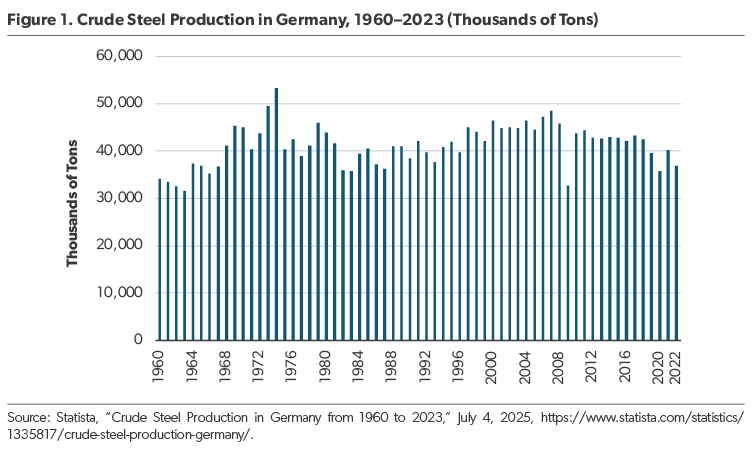
Between 1999 and 2018, ThyssenKrupp’s worldwide employment fell from 100,000 to fewer than 50,000.45 German crude steel production declined from over 40 million tons per year in the 2000s and 2010s to just over 30 million tons in 2023 (Figure 1). Employment in the industry remained relatively stable at between 90,000 and 100,000 (Figure 2).


Recently, the German steel industry has been challenged to transition to greener low-carbon production methods. Instead of using coal-fired blast furnaces to produce steel, building plants using hydrogen-powered direct reduction furnaces would greatly reduce carbon dioxide emissions. The federal government recently adopted a National Hydrogen Strategy to support those efforts.46
Policies for the Auto Industry
As in many other countries, the German auto industry was an oligopoly, dominated by a small number of firms: BMW, Daimler-Benz, Ford, Opel (the German subsidiary of General Motors), Porsche, and Volkswagen (VW). BMW, Daimler-Benz, and Porsche produced only low-volume, high-priced automobiles, whereas VW, Ford, and Opel produced high-volume, lower-priced automobiles.
German drivers believed that foreign-made vehicles were of lower quality than German ones and therefore would not be as able to tolerate high-speed driving. Therefore, they were less inclined than consumers in other countries to buy imported vehicles. Nevertheless, by 1980, Japanese imports already accounted for 10 percent of the domestic market.47
The auto industry was an important source of export revenues for Germany: Roughly half its export revenues in the early 1980s were motor vehicle exports. Net motor vehicle exports produced a trade surplus of DM 58 billion in 1982.48
The motor vehicle industry’s importance in creating employment and export revenues, combined with German firms’ relatively strong international competitiveness, has reinforced the federal government’s general tendency to defend free trade at home and abroad. While one expects to see free trade policies meshing with noninterventionist domestic economic policies, in Germany, the state has been deeply involved in the auto industry’s evolution. The best example of this involvement is the government’s policies for VW, the largest German auto firm.
The Case of VW
The German government’s role in the auto industry has been shaped, to some degree, by VW’s origins and importance in Germany.
VW was started in 1937 under the Nazi government’s tutelage. After negotiations with Ford and General Motors failed to produce a satisfactory agreement, the National Socialist government “asked” several German firms, including Porsche and Daimler, to help it form a new firm to produce a “people’s car.”
The government wanted to demonstrate that Germany could produce mass-consumption items like automobiles that could eventually compete globally. In the meantime, it was prepared to subsidize the development of this capability through direct state aid and investment, in addition to establishing a system of forced savings, under which families would periodically set aside small sums to qualify for purchasing a vehicle at a later date. The VW plant’s workforce at Wolfsburg was mostly German, but Italian workers were imported through a 1939 agreement between Adolf Hitler and Benito Mussolini.
After World War II, VW was allowed to continue production. In 1960, 60 percent of VW shares were offered to the public. The federal government retained a 20 percent share (which it sold off in 1988), as did the Lower Saxony state government (which still owns 12 percent of VW shares). The federal government intervened occasionally during crises but otherwise left the firm mostly to its own devices.
The company introduced the VW Beetle after the war. In the 1960s, VW made major inroads into foreign markets with that model, and prospects for VW looked rosy. However, Japanese auto producers were already gaining. VW eventually became vulnerable because of its slowness in developing new models. Although the firm tried to deal with this problem by purchasing Audi from Daimler-Benz in 1965 and NSU Motorenwerke in 1969, it remained highly dependent on the Beetle. The resistance to mergers by minority stockholders of the acquired firms produced intense political opposition to further acquisitions, which resulted in Kurt Lotz’s dismissal as VW’s head in 1971.
Rudolf Leiding, who replaced Lotz, tried to introduce new models. By 1974, however, the firm was in severe financial trouble. Increasing competition in foreign markets and difficulties making the transition to multi-model production hurt profits. In addition, the floating of the deutsche mark after 1972 reduced the trade advantages of an undervalued currency for all German exports, especially automobiles.
During this transitional period, Leiding called for wage restraints from autoworkers. That appeal made him extremely unpopular with IG Metall, which had five of the 20 seats on the supervisory board (Aufsichtsrat). The workers’ displeasure was also expressed through the SPD coalition government. Leiding himself stated that perhaps he had “underestimated the influence of the Federal and Lower Saxony SPD governments who are part-owners of VW.”49 In 1974, Leiding was replaced by Toni Schmücker, who had overseen the Rhine Valley steel group’s reorganization in the early 1970s and was trusted by the SPD and the unions.50
In 1974, VW unit sales fell by 11 percent, reflecting the firm’s heavy dependence on exports. In 1973, 70 percent of production was exported; by 1975, that figure was only 56 percent.51 A decline in demand in the United States, provoked by the 1974 recession and increased competition from Japanese firms, created severe difficulties for VW. The company had begun to set up plants in Belgium, Brazil, Mexico, Nigeria, South Africa, and Yugoslavia, but the substantial capital outlays those ventures required did not always pay off. Although sales growth was buoyant in oil-producing countries like Mexico and Nigeria, it was sluggish elsewhere.
In 1974, the Lower Saxony government and IG Metall’s representative co-chaired the supervisory board of VW, after which the firm secured an agreement with IG Metall to reduce the workforce by 40,000 workers (roughly one-fourth of the total) in exchange for distributing layoffs across different plants and generally avoiding plant closures. About 2,000 of those workers were Turks, who had to leave Germany after being laid off. Italian workers could not be expelled from Germany under the Treaty of Rome, so they were offered generous severance payments. To provide for dismissed German workers, the Lower Saxony and federal governments agreed to implement a special regional assistance program. In addition, older German workers were encouraged to retire early. By 1976, VW was back in the black.52
VW introduced several new models, including the Golf in 1974, the Polo in 1975, the Jetta in 1979, the Touareg in 2002, and an updated Passat in 2019. VW purchased half the shares of Audi in 1964 and owned the rest by 2020. The VW Group made major investments in production facilities in the United States and began a joint venture with Nissan to produce a new model called the Santana, which was sold in Japan and Southeast Asia. In 1983, the company signed an accord with the Spanish national firm SEAT to produce several models in Spain.53 VW was quickly becoming a multinational enterprise with multiple overseas production facilities and a wide variety of models.
The German Auto Industry in General
German governmental policies toward VW demonstrated a preference for letting the state governments and major banks preside over restructurings, but when those policies failed, as in 1974, the federal government smartly stepped in. IG Metall was deeply involved in policymaking for VW through its representation on the supervisory board (a result of the campaign for codetermination) and its alliance with the SPD in the Lower Saxony and federal governments. That arrangement among the company, the governments, and the union worked reasonably well for VW.
BMW had serious financial problems in the late 1950s but was restructured by the Bavarian state bank (which is strongly influenced by the CSU) and its major private lenders—another example of the federal government’s general preference to allow the state governments and leading banks to do the restructuring. The federal government has not always let state banks do the rescuing. Given the CSU’s predominance in Bavaria and Franz Josef Strauss’s predominance in the CSU, national party politics were projected to some extent onto certain state banks’ policies. Thus, and only thus, could one explain the DM 1 billion loans from the Bavarian state bank to the East German government.54
Foreign subsidiaries in Germany went along with the general pattern. That is, all auto firms operating in Germany have been relatively free of effective federal government intervention in normal times while remaining subject to the actions of banks, unions, and local governments.
For example, when Ford began to increase production in Germany in 1960, it did not want to allow IG Metall to represent its workers or join the main association of German auto firms, the Verband der Automobilindustrie (VDA). However, IG Metall organized the main Ford plant in 1962, forcing the company to join the VDA or forgo the advantages of bargaining at the national rather than the plant level for wage contracts. In the late 1960s, Ford planned to build a greenfield plant in Dortmund to be near its major steel suppliers. However, the steel firms, which controlled the land in the area, refused to sell to Ford because they feared Ford would bid up wages in the region.
Although the German government generally avoids involvement in restructuring unless all else fails, it does assist the auto industry by subsidizing research and development rather than adopting other industry-specific measures. An example of this preference is the Auto 2000 program, which the BMFT launched in 1978. The program’s purpose was to subsidize the development of exotic technologies relevant to the automotive industry by funding projects proposed by the firms themselves for models not under development. The German government, uncomfortable with France’s or Japan’s heavy-handed style of administrative guidance, was comfortable with the fuzzy policy of supporting research and development.
In 2015, VW was engulfed in a scandal called Dieselgate after the US Environmental Protection Agency issued a notice of violation of the Clean Air Act because the company had cheated on emissions tests for its diesel-engine vehicles. After this, the firm began to invest in developing greener products.
German firms, including VW, lagged behind Tesla and Chinese firms like BYD and Xiaomi in producing electric vehicles. In 2023, the European Union mandated that all vehicles sold in the EU would be “zero emission” by 2035.55 In 2024, VW announced a 50–50 joint venture with Rivian Automotive of the United States to produce electric vehicles, and Tesla began to build car and battery factories in Germany for the German market. Despite these challenges, the German auto sector has succeeded in maintaining a steady rate of vehicle production, as demonstrated in Figure 3.

However, the auto industry has continued to face immense pressure due to high domestic production costs and weak demand. Recent developments and employment cuts across suppliers suggest that the industry’s earlier resilience may be giving way, warranting further analysis of the role of German industrial policy as the sector navigates the transition to electric vehicles, intensifying international competition, and domestic cost pressure.
Policies for Microelectronics
Although the German auto industry has been a pillar of strength, and therefore relatively autonomous from state intervention except during crises, the same cannot be said for the German microelectronics industry. Germany is Europe’s biggest semiconductor market, yet, to date, only Infineon Technologies (a spin-off from Siemens) has managed to remain competitive with the other major global semiconductor firms. Until recently, Siemens could not foresee developments in demand to produce the right types of integrated circuits. A Siemens executive “ruefully” described the 1970s as “years of dismal failure.”56
There were other signs of general German weakness in information technology. For example, Siemens was marketing Fujitsu mainframe computers in the 1970s because it could not develop competitive systems itself. IBM dominated the German market for mainframes, and Japanese firms like Fujitsu were its main challengers in that market. In November 1981, IBM outbid Siemens and AEG (the other large German electronics firm) for a $22.5 million contract to build a videotex system for the federal post office (Deutsche Bundespost). It was unusual for the Bundespost to award such a contract to a foreign bidder. Ultimately, IBM experienced several delays and cost overruns.
The biggest crisis in microelectronics did not involve Siemens but its nearest German competitor, AEG. AEG’s near collapse and subsequent rescue are an important addition to the overall picture of German industrial policy—illustrating once again the state’s general tendency to avoid involvement in rescues unless absolutely needed and private banks’ relatively important role.
The Case of AEG
AEG has deep roots in German industrial history.57 It was founded at the end of the 19th century. An early innovator in radio and electronics, it was always Siemens’s main rival. By the 1970s, AEG had become a highly diversified holding company with equity participation in nuclear engineering, consumer electronics, and various other businesses. In 1983, it was the fourth-largest electronics firm in Europe and the 12th largest in the world.58 It employed 120,000 workers worldwide, more than 100,000 of whom were in Germany.
AEG played a crucial role in establishing Germany as a major industrial nation. Thus, its fall from grace in the late 1970s and early 1980s was a shock to most Germans. Part of the company’s problems can be traced to the mid-1970s, when AEG and Siemens, which were partners in the nuclear engineering concern Kraftwerk Union, suffered major losses in that firm’s restructuring. For AEG, the cost was between DM 1 billion and DM 1.5 billion.59 The main problem, however, was that AEG, which failed to see that its consumer electronics business could not compete with foreign firms, delayed too long in diversifying out of consumer electronics and shoring up its other businesses.
AEG paid no dividends to its shareholders after 1973. Losses in 1979 amounted to approximately DM 1 billion. On October 24, 1979, the CEO, Walter Cipa, informed the firm’s supervisory board that big problems existed and that major layoffs were likely. The next day, IG Metall issued a press release opposing those layoffs. Representatives of major shareholders accused IG Metall of leaking confidential internal information, but union representatives defended themselves by arguing that management’s first recourse was always to lay off people rather than acting more creatively to maintain employment levels.
On November 8, 1979, four AEG representatives met with the minister of economics, von Lambsdorff, and the minister of finance, Hans Matthöfer, to persuade them to involve the federal government in resolving AEG’s problems, but their efforts were unsuccessful. On December 4, 1979, a rescue plan put together by the major banks under Dresdner Bank and Deutsche Bank was announced. That plan included a major write-down of AEG shares’ nominal value, a restructuring of its debt, the layoff of 12,000 employees, the closure of a gas turbine plant, and a “solidarity contribution” from German manufacturing firms (an agreement to purchase DM 200–450 million of unsecured debentures at less than the market interest rate).60
The banks were anxious to avoid federal government intervention, and so were many firms. At the time, a German businessman made the following observation:
Small firms get into trouble all the time and go under. But a business of this size can’t be allowed to fail. The State won’t let it. We saw that the United States did not abandon Chrysler, and Canada won’t abandon Massey-Ferguson either. We were therefore of the opinion that in Germany, as well, the State would not allow a company like AEG to go bankrupt. We concluded that if we wanted to preserve our economic system we had to make an attempt to save the company without leaving that task to government.61
The businessman was also concerned that AEG’s failure would reduce competition in the German market further. But the problem of not encouraging other large firms to expect bailouts was also clearly evidenced in the rescue’s ungenerous terms.
In 1980, when Dresdner Bank’s Hans Friderichs was elected chair of AEG’s board of directors (Vorstand), he brought in a new manager, Heinz Dürr, who had previously run Bosch, a producer of automobile components and electronic products. Along with Bosch and Mannesmann, AEG made some new investments in telecommunications, and the firm’s situation began to look a little brighter. In the summer of 1982, however, AEG rejected an offer from GEC (a British heavy electrical equipment firm) for 40 percent of AEG’s capital goods business, and AEG’s stock fell precipitously.
By July 1982, the firm was once more on the edge of bankruptcy. This time, the federal government devised a new rescue plan, coming up with DM 1.1 billion in credit guarantees and 85 percent of a package of DM 0.6 billion in export credits. As a result, the banks agreed to grant the firm DM 1.1 billion in new credit. Then the firm filed for composition (Vergleich), which is roughly equivalent to reorganization under Chapter 11 of US bankruptcy laws. Composition is possible in Germany only if debt write-offs are less than 65 percent of existing debt and 75 percent of all creditors agree to the package. A writer for The Economist made the following observation about this:
West Germany’s way of financing industry puts most of the burden of rescues onto the banks for two reasons. The universal banking system makes banks more deeply committed to industry than elsewhere. And the government’s laissez-faire approach to industrial finance leaves banks to pick up the tab when things go wrong.62
The final episode of this sad story is the sale of AEG’s consumer electronics subsidiary, AEG-Telefunken, to the French firm Thomson-Brandt in March 1983. That sale came about largely because the Federal Cartel Office blocked the sale to Thomson-Brandt of a somewhat larger German consumer electronics firm, Grundig. While the official story was that Grundig’s purchase would reduce the level of competition in consumer electronics to an unacceptably low level, the fact that Philips owned 24.5 percent of Grundig and that Grundig was a major purchaser of semiconductors produced by Siemens had a lot to do with the federal government’s opposition to the deal.
Despite that, AEG was not dead as a semiconductor producer. In 1982, AEG’s components production wing, Telefunken Elektronik Gesellschaft (TEG), formed a joint venture called Eurosil with the United Technologies Corporation and the Diehl Group, taking an 85 percent share. Eurosil owned a new plant for producing advanced semiconductors. TEG was a major chip supplier for VW and BMW. United Technologies’ subsidiary, Mostek Corporation, was an important supplier of complementary metal-oxide semiconductor and N-type metal-oxide semiconductor circuits in Europe, while Eurosil supplied components to Europe’s watch and telecommunications firms. The hope was that AEG would be able to recover some of its lost glory by cooperating with its new partners.
The Federal Government’s Belated Promotional Policies
The German electronics industry was not composed of just Siemens and AEG. One must also include as important actors in Germany, and Europe generally, firms like Advanced Micro Devices, Bosch, IBM-Germany, Intel, Motorola, Nixdorf Computer, Standard Elektrik Lorenz (owned by ITT), Texas Instruments, and Valvo (owned by Philips). However, German-owned firms were clearly in a weak position overall. For that reason, Uwe Thomas, director of electronics research at BMFT, said in 1982: “The main emphasis of this ministry is to see what we can do in strengthening the application of microelectronics.”63
Until the 1980s, a large percentage of German governmental research and development funds went to mainframe computers, while the government gave insufficient attention to semiconductor development. From 1974 to 1979, BMFT spent $1.7 billion to advance German semiconductor and computer research in a program that unfortunately failed to achieve the desired results. One problem with the ministry’s approach was its overreliance on aid to the two largest firms: Siemens and AEG. Roughly $1.3 billion went to Siemens and $400 million to AEG.64
Between 1974 and 1981, total BMFT research and development funds remained constant in relation to gross national product (around 0.7 percent). The funds devoted to promoting high-technology industries accounted for a nearly constant 22 to 24 percent of the total.65 Thus, despite the BMFT minister’s desire to increase the emphasis on high-technology spending, as of 1981, he had not been able to prevail against opposing forces, mainly in the form of the minister of economics.
Von Lambsdorff’s resignation as minister of economics in 1984 removed one of the more effective obstacles to a shift in German research policy. His replacement by a minister who was more interested in promoting small- and medium-sized firms allowed the BMFT minister to make several changes that previous ministers had advocated.
From 1984 to 1989, BMFT called for $1.2 billion to support research on integrated circuits, data processing, and industrial automation. The minister of technology and research, Heinz Riesenhuber, defended those efforts, stating: “If we want to be internationally competitive and create new jobs, we absolutely must use the big potential for innovation and growth in [electronics] technology.”66
Part of the overall strategy for promoting German microelectronics was using state agencies like the Bundespost and the national railway (Deutsche Bundesbahn) to purchase more advanced technological products. For example, the Bundespost met with Siemens and AEG before establishing specifications for purchasing telecommunications equipment contracts. IBM’s ability to penetrate that system was a testimony to its technological strength and political savvy.
In 1994, the Federal Ministry of Education and Science (Bundesministerium für Bildung und Wissenschaft) merged with BMFT to become the Federal Ministry of Education and Research (Bundesministerium für Bildung und Forschung [BMBF]). One reason for the merger was the need to increase the number of skilled workers in high-technology industries, especially in East Germany after reunification. One method adopted to do this was to upgrade existing vocational education and internship programs.
In 2006, BMBF began to issue periodic High-Tech Strategy reports. In 2007, BMBF adopted a “foresight process” to identify areas of future growth in the economy.67 Every two years since 2008, BMBF has published a Federal Report on Research and Innovation, the latest in 2024. Microelectronics and information technology often appear in those reports, along with necessary upgrades to digital skills programs in schools and universities.
Much of Germany’s current economic activity is directed toward providing chips for the automotive and renewable energy industries (Figure 4). In 2022, after receiving a $7.5 billion government subsidy, Intel announced it would build a chip factory in Magdeburg. Infineon Technologies announced it would spend €5 billion on two new plants in Dresden with the German government’s help. German government funding is part of a larger European effort to support semiconductor manufacturing: In 2023, after the European Union adopted the European Chips Act, it began to fund that effort with a program called Important Projects of Common European Interest.68

Overall, German industrial policy allows firms to do whatever they can on their own to meet international competition. When problems arise, the banks take the first step to rescue larger firms. The government only steps in when it must, trying to limit itself to loan guarantees rather than issuing direct subsidies. That approach has been moderately successful. AEG is still alive, Siemens appears to be prospering, and several newer and smaller firms like Infineon Technologies, Bosch, and SAP are finding market niches in which to grow and prosper. The Germans have learned not to become overly dependent on national champions to lead them out of industrial crises, having studiously avoided administrative guidance of the French and Japanese varieties.
Conclusion
German industrial policy combines decentralized control with increasingly ambitious goals. The federal government’s growing intervention in specific regional and industrial crises has been substantial, but the government remains firmly committed to allowing other social actors (especially the banks) to try resolving crises before it gets involved.
However, the case of steel highlights that strategy’s weaknesses for three primary reasons. First, the government ultimately has become much more involved than it intended. Second, because the banks had incentives to rescue very large, ineptly managed firms, government intervention has tended to be costly when it occurs. And third, because of trade unions’ power, older and younger workers paid a larger share of adjustment costs than did middle-aged workers.
The case of automobiles shows that the combination of strong firms and avoidance of administrative guidance can produce desirable results, as VW’s rapid adjustment to changed world market conditions attests. The case of semiconductors shows how wrong pursuing a national-champions policy can be when the national champions are chronically unable to catch up to global leaders. The German government learned that lesson well in the 1980s.
Therefore, German industrial policy is much like US industrial policy. What you see depends on where you look. Merely to say that German industrial policy works would be a mistake. It is neither interventionist nor noninterventionist. It works for some people and some industries some of the time. Since 1945, it has gone through major evolutionary changes. The main lesson of German industrial policy is that it is desirable to match public policy with market conditions and industrial capacities in specific industries.