
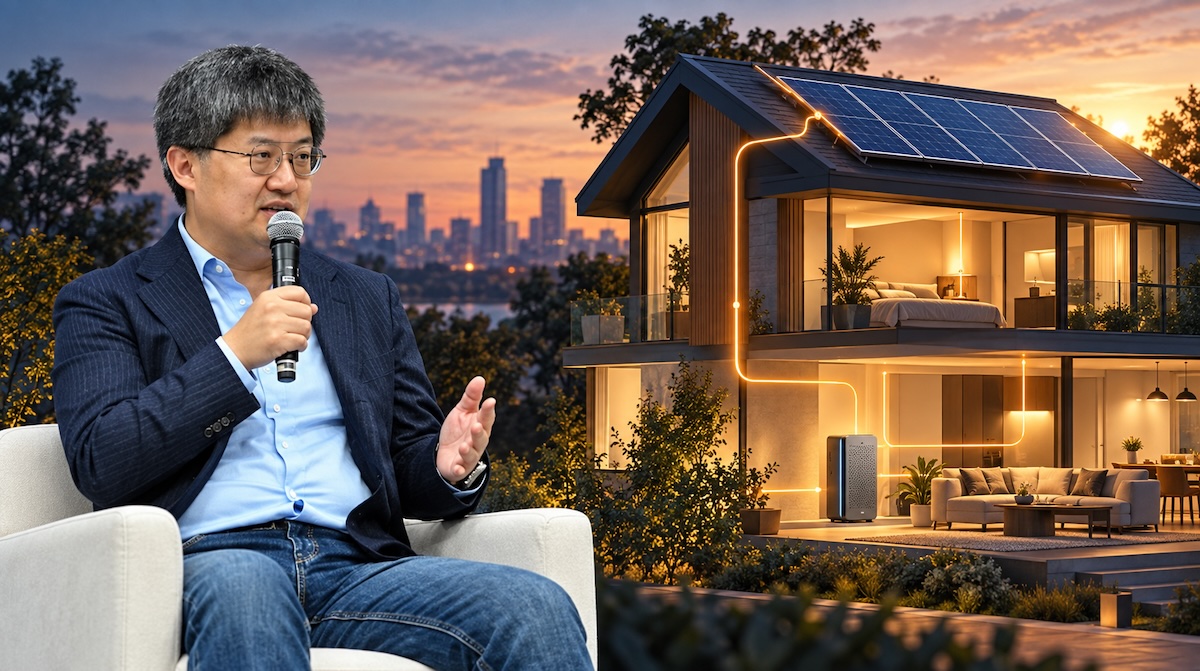
This op-ed was written by NG Zhang, founder, chairman, and chief executive of Canaan (NASDAQ: CAN) Inc. The views expressed are his own and do not reflect those of TEM.
For most of its history, the personal computer worked only when a person was sitting in front of it. You opened it, you used it, you closed it.
Now, an AI agent can operate a computer on your behalf, open applications, read and write files, manage workflows, and keep going while you sleep or travel. Current models already handle tasks that run for hours without supervision. The machine no longer waits for you. Even when the model runs in a data center, the work has to land somewhere. Something local holds the files, the applications, the credentials, and the long-running workflows. That host is already in the house. It is the first piece of household AI infrastructure, and it arrived without anyone announcing it.
This doesn’t just change things at the software level. A computer has gone from being a tool to infrastructure with physical consequences: sustained power draw, waste heat, noise, uptime, and a place to live without anyone resenting it.
With Bitcoin mining, tens of thousands of homes have been running one continuous, high-power computing load for years.
Mining has always been the least demanding workload in computing. It has no service level agreement and no latency floor. It can stop and restart within a second. It touches no sensitive data. And its waste heat, which is a cost everywhere else, is useful in a building that needs warmth.
These properties become even more important now that the house is increasingly becoming an electricity generator. A solar panel on the roof produces most of its power in the middle of the day, when nobody is home.
The household needs a load that can absorb power the moment it appears and drop it the moment it does not. A mining machine does that, and it converts the electricity it draws into heat, which makes it a heater that happens to earn something while it runs.
To be clear, I don’t know if every household should mine. But mining is a mature, working example of the thing the rest of computing is now dealing with: a machine that draws considerable power, runs without pause, produces heat, and has to coexist with normal domestic life. We have solved a version of each of these in our own household mining products: noise control, heat management, physical form, and continuous operation inside a normal living space.
Products such as DGX Spark and the Mac mini sit in a home comfortably, but their capability is still limited. The moment you need more, you are back to a large workstation with its fans running, hot and loud, and demanding enough technical knowledge that most people would not want it in a room where they live. That is the gap. A machine expected to run continuously in the home also has to be quiet, unobtrusive, and simple enough that its owner rarely needs to think about it.
As open-source models improve, hardware capability improves, and costs fall, edge devices in the home will be able to run models in the 200B to 500B parameter range.
Running local models improves performance and reduces cost. It also changes who holds your data. I give a great deal of information to AI service providers because the services are useful, and I am also conscious that I should keep my own complete copy. Personal data matters more in the AI era than it did in the internet era. A sufficiently complete collection of someone’s messages, documents, preferences, history, voice, and behavior begins to resemble a copy of that person. Letting that copy exist entirely outside the individual’s control is a long term risk. Most people using a web service are handing it over without keeping a usable copy.
When your agent runs locally, you can fully preserve files, history, preferences, and workflows, which makes the cloud provider replaceable. When local models become good enough, you’ll be able to shift from cloud-first to local-first without having to rebuild from scratch.
What is missing is not a smaller server. It is a household appliance: quiet, simple, reliable, thermally useful, and able to host cloud-based agents today and increasingly powerful local models tomorrow.
I have spent years building for people who enjoy configuring things. That was the right customer for the first stage. It is not the customer for the next one.
For over a decade, bitcoin mining has been figuring out how to put a machine that never stops inside a building where people live. Quiet enough to sleep beside. Cool enough not to need a room of its own. Flexible enough to follow a solar curve down and back up again. Useful enough that the heat is a feature instead of a problem. The AI industry is now arriving at the same questions, and it will not get to skip any of them.