
What is macroeconomics, and what does it tell us about how an economy really works?
In this episode of Understanding Economics, I explain why macroeconomics is about much more than GDP, economic growth, inflation and unemployment. It is about understanding the economy as a whole system in which households, businesses, banks and government are interconnected.
Conventional macroeconomics often starts from the assumption that markets tend towards balance, people behave rationally, and government plays a secondary role. But real economies do not work like that. They are constantly changing, markets do not always self-correct, and rising GDP does not necessarily mean that everyone is becoming better off.
I explain why money and government are central to understanding a modern economy, why government finances are fundamentally different from household finances, and why one person’s spending is another person’s income.
Most importantly, I argue that macroeconomics should begin with people. The real questions are whether an economy can provide useful work, stable prices and rising well-being, while using the resources available to us within the limits of the planet.
Understanding macroeconomics means understanding how all these things connect, and how government policy can change the outcome.
This is part of my Understanding Economics series.
This is the audio version:
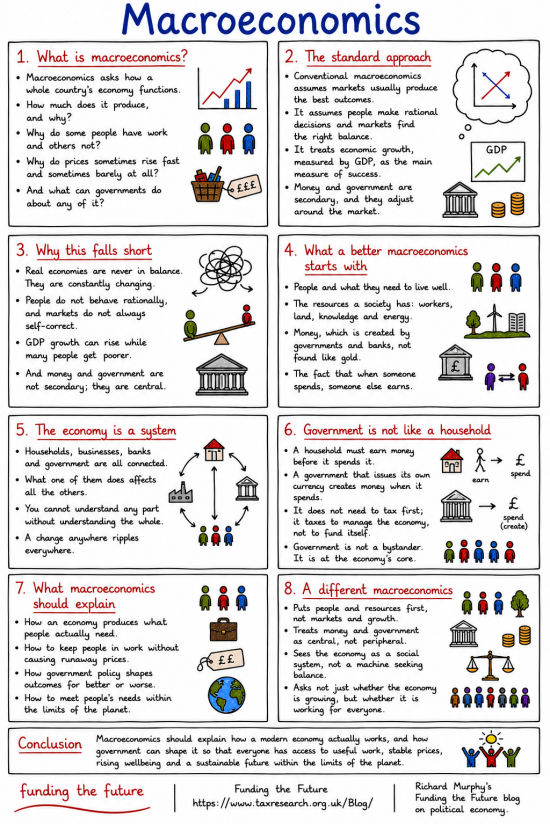
There is no Debate Ammunition for this video, but there is this infographic:
This is the transcript:
Hello, I’m Richard Murphy, and this is Understanding Economics.
We’ve been talking about ‘What is economics?’ ‘What is the economy for?’ And then I’ve made a video on microeconomics, which you might want to take a look at. Microeconomics is about how the bits of society work together to create economic well-being.
So, what is macroeconomics? Well, it’s not microeconomics, for a start. It’s about how a whole country’s economy functions as a whole.
So the questions it asks are things like:
- How much does the economy produce, and why?
- Why do some people have work and others do not?
- Why do prices sometimes rise fast, and sometimes barely at all?
- And what can the government do about any of this?
Conventional macroeconomics assumes markets usually produce the best economic outcomes. It assumes that people make rational decisions and markets find the right balance. In fact, the whole of conventional macroeconomics is based upon this assumption that markets work.
And it treats economic growth, measured by gross domestic product, as the main measure of economic success.
Money and government are treated as secondary, and they supposedly adjust around the needs of the market in this model of conventional macroeconomics.
But this model falls short.
Real economies are never in balance. They are constantly changing.
People do not behave rationally, and markets do not always self-correct.
GDP, our measure of national income, can rise while many people can get poorer.
And money and government are not secondary; they are, in fact, central to how the economy works, and that economy cannot do without them.
So what we need is a better model of macroeconomics. One that puts people at its centre and asks, what do they need to live well?
We have resources within our society. At a macroeconomic level, they are workers, or labour, as it’s sometimes called, plus land, knowledge and energy.
Money and government are not secondary. They are absolutely central to macroeconomics because it can’t work without them.
So, we need something better. And where we should start is where I start with everything in economics. I start with people and what they need to live well.
The macroeconomy has resources available to achieve this goal, including people themselves: after all, we can work to assist our own well-being. But there’s land and knowledge, and energy, which we add into that mix to create our well-being. And then there is money, which is created by governments to help us lubricate the whole system of the management of the macroeconomy.
And the fact is that what we do know is that in this macroeconomy, money works because when someone spends, someone else earns.
We have a system which is self-balancing in that everybody’s spending is somebody else’s income. And that’s the basis on which we build a macroeconomy.
And the economy is a system. Households, businesses, banks, and government are all connected. You can never imagine them in isolation. What one of them does always affects all the others. You cannot understand any part of the macroeconomy without understanding the whole. A change anywhere ripples everywhere. That is the most important thing you must remember when you’re studying macroeconomics. Always think about “What changes if I change this?”
This is important, and it’s just as important to remember that the government in this model is nothing like a household. A household must earn money before it spends it. We all know that. But a government that issues its own currency, and almost every country in the world is in that situation now, creates money when it spends.
It does not need to tax first. It does not need to have an income before it spends. It taxes to manage the economy and not to fund itself. And the government is not a bystander. It is at the economy’s core, not least because it provides the rules on the basis of which the economy works, and it provides the money which is used to make the economy go round. It is not, in that case, anything like a household, and to pretend it is, is just wrong. That’s why the study of the macroeconomy focuses so heavily on the role of government.
And what should macroeconomics explain as a result? Well, the things it needs to talk about are:
- How an economy produces what people actually need.
- How we keep people in work without causing runaway prices.
- And how government policy shapes outcomes for better or worse.
- And how to meet people’s needs within the limits of the planet.
Those are the issues we talk about in macroeconomics. And every single one of them is important, and every single one of them is connected.
We do then have to talk about a different macroeconomics.
We need one that puts people and resources first. Markets and growth are secondary.
We need a discussion of macroeconomics that treats money and government as central, and not as peripheral.
And we need to see the economy as a social system and not as a machine that automatically is in balance because it just isn’t.
And we need to ask not just whether the economy is growing, but whether it is working for everyone. That is the most important macroeconomic question of all.
Macroeconomics should explain how a modern economy actually works and how government can shape it so that everyone has access to useful work, stable prices, rising well-being, and a sustainable future within the limits of our planet. If we can do that, we can live well, and that is the goal of good macroeconomic policy.
Poll
Loading …
Thanks for reading this post.
You can share this post on social media of your choice by clicking these icons:
There are links to this blog’s glossary in the above post that explain technical terms used in it. Follow them for more explanations.
You can subscribe to this blog’s daily email here.
And if you would like to support this blog you can, here: