


Quick overview
- Gold (XAU/USD) is currently trading around $4,131, supported by weaker U.S. jobs data that has reduced the likelihood of an October rate hike.
- Despite a neutral-to-bearish near-term bias while gold remains below $4,172-$4,191, the long-term outlook remains constructive due to strong central bank buying.
- High Treasury yields and a firm U.S. dollar continue to limit gold’s upside potential, even as ETF demand and central bank purchases bolster its structural support.
- Key resistance levels for gold are identified at $4,172 and $4,191, while support is noted at $4,112, with a bearish outlook prevailing below these levels.
Gold (XAU/USD) is trading near $4,131, benefiting from dovish U.S. jobs data. The odds of a hike at the October FOMC meeting have plunged from around 70% a week ago to 22% currently. A December hike is still very much in play. An improvement in the macro outlook has lessened some of the headwinds for gold; however, elevated Treasury yields and a firmer U.S. dollar keep a lid on gold’s upside.
My near-term bias is neutral-to-bearish as long as gold trades below $4,172-$4,191. Despite the improving fundamental outlook for gold, with central banks continuing to pile into the market, I see the structural outlook for gold remaining constructive.
Weak Jobs Data Pushes October Hike Odds Lower
While falling short of expectations for the third month in a row, the U.S. jobs report was the largest negative surprise to date. The economy added just 29,000 jobs in September and the unemployment rate ticked higher to 4.2%. Average hourly earnings rose just 0.3% from August and 3.0% from a year ago.
The soft jobs data reduces the case for an immediate hike by the Fed. Bets for a hike at the October FOMC meeting have plunged from around 70% to just 22% recently. From a gold price perspective, it lessens a major headwind in the near term.
December Tightening Risk Has Not Disappeared
Although an October rate hike is now very unlikely, an increase at the next FOMC meeting in December is still fully priced in. As a result, a tightening of U.S. monetary policy is broadly expected in the second half of the year.
This is important because a stronger gold price recovery will happen only if expectations about the whole rate path lessen, not just the expectations for the upcoming September Fed meeting. Thus, the upcoming minutes from the Fed and fresh inflation data will be key to gauge if markets will strengthen the pause narrative or if they will just push out the target date for the next rate hike.
Treasury Yields Still Limit the Upside
Ultimately the ceiling remains the bond market. US 10-year Treasury yields are at two-decade highs, and the opportunity cost of holding gold remains elevated.
Thus, the lack of a greater response to weaker employment data can be attributed to the fact that while expectations for an October rate hike may be lower, long-term yields are elevated due to inflation, fiscal debt, and borrowing, and a higher risk of stagflation, which caps the upside for gold.
Central Banks Keep Gold’s Structural Story Intact
One of the more interesting parts of gold’s structural story is how well it’s held up through various constraint-oriented liquidity conditions. Officials from the Bank of Italy and the Bundesbank spoke at length about gold’s role in reserve and diversification strategies in a fragmented geopolitical environment, rising sovereign debt and broader credit risk at the London Bullion Market Association conference on October 5th.
Prior to 2022 central bank buying averaged about 317 tonnes annually. Officials expect buying to average about 720 tonnes annually through 2026. That tells me a large portion of new central bank gold buying is to establish strategic reserves.
China Remains a Major Structural Buyer
From a long-term gold thesis, China is one of the more supportive structures. In August, the People’s Bank of China bought 20.2 tonnes, the most since October 2023 and the 22nd straight month of gold buying.
That said, PBoC purchases aren’t responding to short-term fluctuations in yields or expectations. Rather, the purchases are part of a broader strategy to diversify its reserves. It’s also why gold’s traditional negative correlation with real yields has broken down.
ETF Demand Reinforces Institutional Support
Gold ETF holdings have also reached record levels, supporting the shift to longer-term, institutional-style ownership. Gold ETF flows often reflect fundamental portfolio shifts. So, gold ETF demand should continue to boost gold’s longer-term institutional ownership.
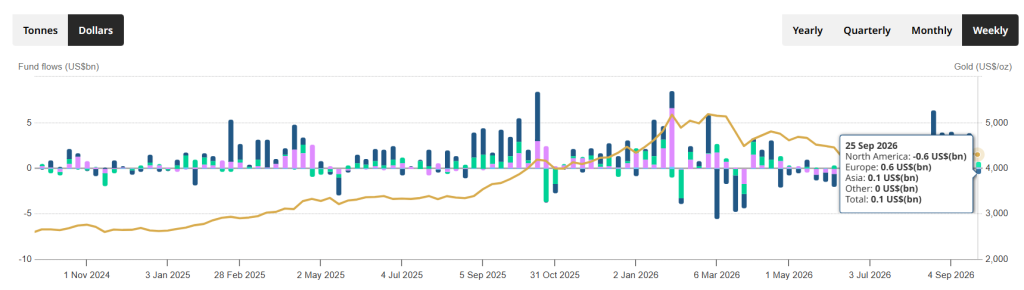
Gold’s long-term structural trends, led by higher central bank buying and strong gold ETF demand, offset many of the potential risks. Therefore, gold has become less reactive to shifts in the macro environment and sustained the $4,100/oz. support level in the face of higher yields and the U.S. dollar.
Gold Technical Analysis: $4,172 Is the First Recovery Test
Currently, gold is trading at $4,131 on the 4-hour chart and once again is in the process of testing the bottom side of its recent range and is also below both of its moving averages and a descending trend line. Higher lows are in place, however, a series of lower highs is also in place, indicating a lack of buyer control over the market structure, which would allow price to make a more sustained advance above $4,112.
An initial resistance area comes in at $4,172. A clean break above this area would open up the next resistance at $4,191 and beyond that at $4,227, with additional resistance possible at $4,244. Support comes in at $4,112, with the next support areas possible at $4,070 and $4,021.
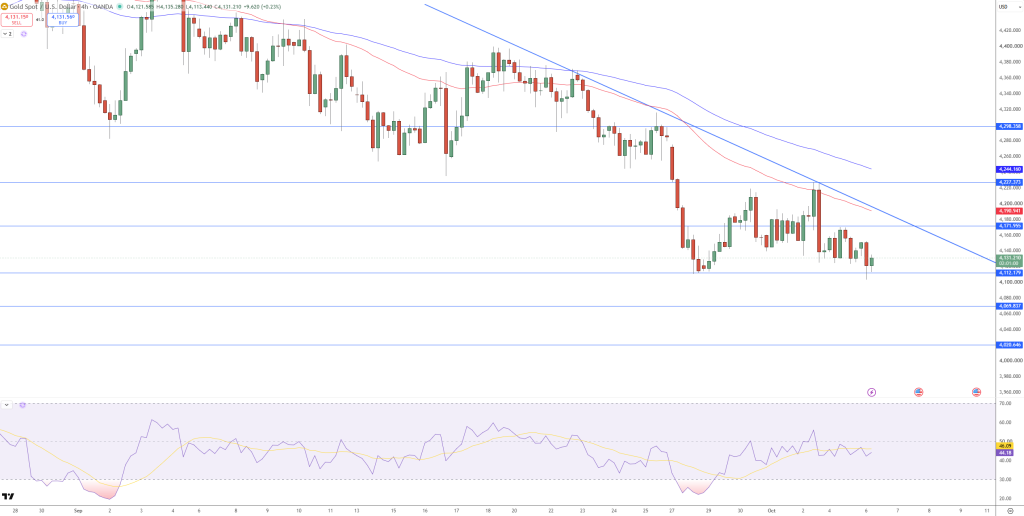
RSI remains in no man’s land, with 44 still below the 50 midline. While Momentum is drifting slightly oversold, I am still considered bearish while below $4,191. I would become bullish on a clear break above $4,227. A close below $4,112 would help support the bearish argument, with $4,070 likely to be next.
- Resistance is at $4,172, $4,191, $4,227 and $4,244.
- Support is at $4,112, $4,070 and $4,021.
Frequently Asked Questions
Why are Fed pause expectations helping gold?
Anything to ease expectations for tighter monetary policy is gold positive and soft U.S. jobs data took some odds off for a third consecutive Fed rate hike in October.
What is still limiting gold?
High Treasury yields and a strong U.S. dollar remain gold negative, and the Fed is still expected to hike rates in December.
What is the key XAU/USD breakout level?
The first key resistance is $4,172. A clear break above that brings the $4,191-4,227 area into play.

Arslan Ali Butt
Lead Markets Analyst – Multi-Asset (FX, Commodities, Crypto)
Arslan Ali Butt serves as the Lead Commodities and Indices Analyst, bringing a wealth of expertise to the field. With an MBA in Behavioral Finance and active progress towards a Ph.D., Arslan possesses a deep understanding of market dynamics.
His professional journey includes a significant role as a senior analyst at a leading brokerage firm, complementing his extensive experience as a market analyst and day trader. Adept in educating others, Arslan has a commendable track record as an instructor and public speaker.
His incisive analyses, particularly within the realms of cryptocurrency and forex markets, are showcased across esteemed financial publications such as ForexCrunch, InsideBitcoins, and EconomyWatch, solidifying his reputation in the financial community.