
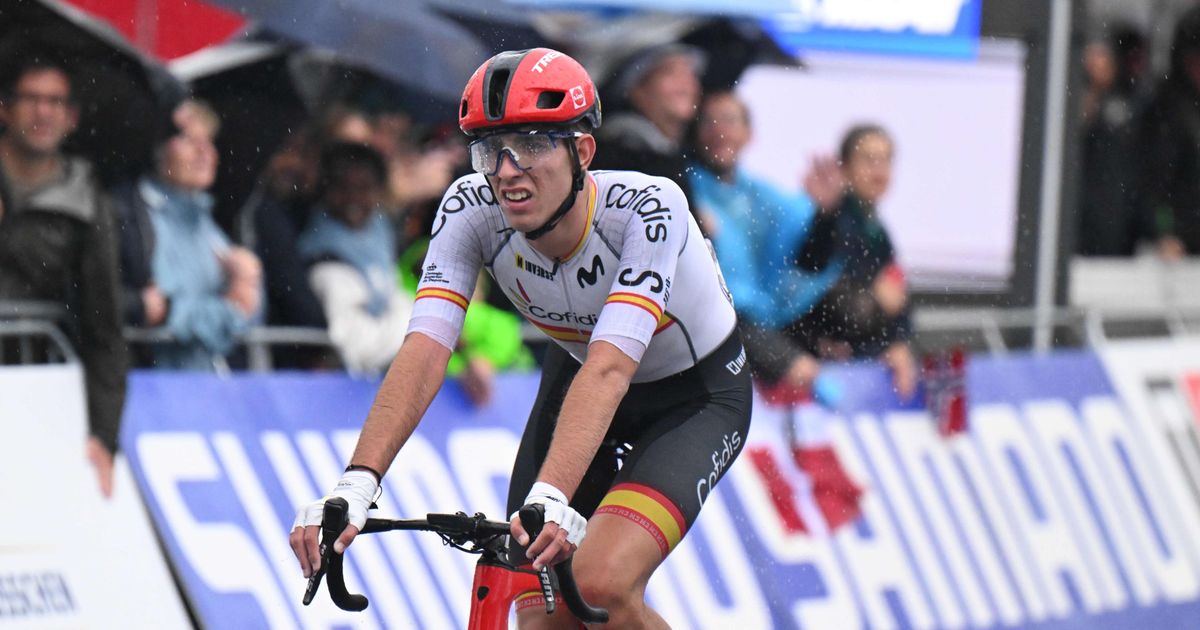
The disappointment was clear on the Spaniard’s face after the finish. Álvarez arrived in Montréal aiming for the title and leaves with a silver and a bronze, his first medals at a Worlds after several years coming close to the podium.
“It wasn’t enough, but I have to be happy. Now I have two medals at home. I’ve been chasing this for years; I was always very close to the medals. I had none and now I have two,” he admitted.
Not leaving empty-handed but not fully satisfied…
The Lidl-Trek rider does not hide that the aim remains to win the rainbow jersey. Silver does not change that ambition. “It’s true that I want that jersey, it’s something I constantly chase, but I should be happy,” he noted.
Álvarez also shared the credit with coach Markel Irizar, as well as with the entire Lidl-Trek team, who have backed him on the road to these Worlds.
“I want to thank, especially, Markel. The whole Lidl-Trek team supports me, but both Markel and I had been chasing this goal hard. We went through tough moments, we fought, we argued quite a bit… but now I see him and we’re really proud of what we’ve achieved,” he explained.
Despite the frustration of missing gold, Álvarez made it clear that his ambition remains unchanged after this race. The rainbow jersey will continue to be the ultimate target.
“Our main goal is still to become world champions, so we’ll try again and again until we make it,” he said.
The Spaniard had to settle for chasing from the group as Ashlin Barry carved out a sizeable gap. The question was whether Spain and the rest of the favourites erred by allowing that move so much rope.

Ashlin Barry won the Montréal Under-23 Worlds.
“Maybe we waited too long”
Álvarez refused to pin the defeat on a single factor. He acknowledged Barry’s strength, but also explained that the chase group reached a point where everyone was riding on the limit. “I don’t know. I think he was super strong today, but behind we were at the limit; we were all fully committed to the chase,” he said.
Spain did consider that the situation might flip with five laps to go, although the goal remained to bring back the lone leader. “It’s true that, with five laps remaining, maybe we started to think about the medals, but even then we were all-in on trying to catch him,” he noted.
The problem was the time bled in the early phases of the break proved too much. When the key favourites decided to take responsibility, there was not enough road left to close the gap. “We didn’t make it, so I think we came up short; it wasn’t enough,” Álvarez admitted.
The break was given too much leeway
The Spaniard explained that the group initially failed to sense the real danger. The move went very early and, on a circuit like Montréal, taking on the chase also carried a high cost. “When the gap was around two minutes, in the bunch we didn’t perceive the danger, because it was an early break,” he said.
Group dynamics also made it hard for anyone to take control immediately. Sitting on saved a lot of energy, while pulling meant absorbing all the workload. “Nobody wanted to take responsibility because, on this circuit, sitting on is a big energy saver, but nobody wanted to make the call to pull,” he explained.
Eventually, the strongest riders had to move to the front to try to reduce the gap, but by then the response was already too late. “When we went — the strongest — it wasn’t enough; so I think maybe we waited too long,” concluded Héctor Álvarez.
Worlds silver and the time trial bronze make Montréal the richest haul of Álvarez’s career at a World Championships, although he has made it clear his ambition does not end here: the rainbow jersey remains the goal.