
- Amid weakness in the altcoin market, crimecoins that posted sharp short-term gains — especially Rave DAO (RAVE) — have come into focus over price-manipulation allegations.
- Analysts warned that crimecoins resemble stocks controlled by concentrated holders, with extreme volatility and a high risk of steep losses.
- With altcoins stagnating, investors are being drawn to high volatility and the prospect of short-term high returns, but analysts said they should avoid being lured by artificially steep price charts and closely examine a project’s narrative.
Forecast Trend Report by Period
As the altcoin market remains mired in a slump, so-called “crimecoins” that post sharp short-term gains are drawing investor attention. The term combines “crime” and “coin” and refers to cryptocurrencies suspected of scams, including price manipulation and centralized token distribution.
Rave DAO, or RAVE, has become a prominent example after allegations of price manipulation emerged following its blistering rally. The token surged from $0.26 on April 9 to $26.6919 on April 18, a roughly 100-fold jump, or 11,166%, in nine days.
But on April 18, accusations surfaced that insiders had carried out a pump-and-dump scheme. RAVE plunged 96% in a single day, sending its market capitalization down to about $300 million from about $6.62 billion. That erased roughly $6.3 billion in value in one day. As of May 1, CoinMarketCap data showed RAVE trading at $0.7554 with a market capitalization of about $180 million.
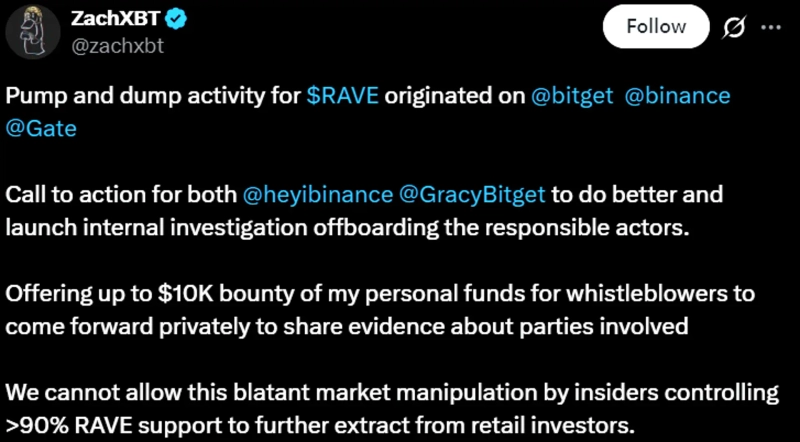
On-chain investigator ZachXBT wrote on X on April 18 that wallets linked to the Rave DAO team controlled 90% of the token supply and had transferred large amounts to exchanges, alleging possible insider manipulation. After the post, executives at major exchanges including Bitget and Binance replied that they would begin investigating, and RAVE began to slide.
ZachXBT also wrote that he would offer a bounty of as much as $10,000 from his own funds to whistleblowers who provide evidence against those involved in the alleged manipulation. He added that he could not tolerate schemes that openly exploit retail investors.
Community reaction to ZachXBT’s actions has been divided. While many agreed on the need for what they viewed as a public-interest effort to expose market manipulation, some retail investors expressed frustration.
After RAVE’s price collapsed, criticism of ZachXBT spread across retail-focused social media communities on X and Telegram. Some complained that he had ruined an opportunity to make money, asked why he was not exposing other tokens, and questioned whether he had been paid by a specific project.
Search engines aimed at identifying crimecoins like RAVE are also emerging. Tokens facing such allegations include Memecore (M), ranked 21st by market capitalization, along with Blockstreet (BSB) and Pieverse.
Analysts say the prolonged weakness in the altcoin market is fueling the phenomenon. As money flows into larger cryptocurrencies such as Bitcoin, altcoins have lost momentum, pushing investors toward highly volatile crimecoins. They caution that indiscriminate bets on volatility can lead to steep losses.
Yoon Seung-sik, a director at Tiger Research, said crimecoins are structured similarly to stocks dominated by concentrated holders, making them highly volatile. With the market lacking a clear narrative recently, investors are flocking to such assets in search of high short-term returns. If someone can drive prices higher, that also means they can send them plunging at any time, he said, adding that such a structure is highly dangerous because it can damage confidence in the broader market.
Kim Min-seung, head of Korbit Research Center, said most altcoins have recently been moving sideways, naturally drawing attention to assets with bigger price swings. Coins whose supply is controlled by a specific group can become vehicles for project insiders to cash out at any time. Investors should not be misled by artificially steep price charts and instead should closely examine a project’s narrative.