
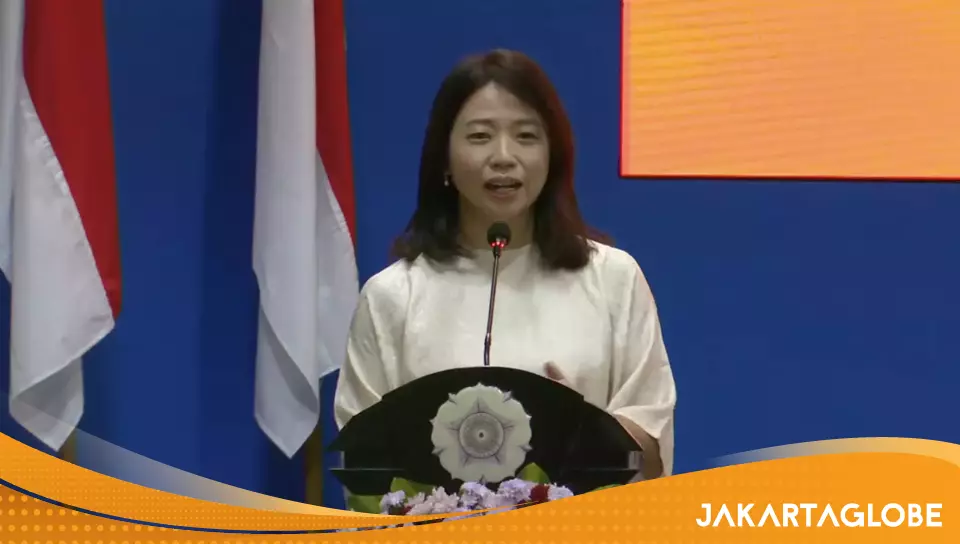
Yogyakarta. Economic growth across the ASEAN+3 region is expected to slow to around 4% in 2026 and 2027 as escalating geopolitical tensions, energy disruptions, and global trade uncertainty weigh on the outlook, according to Catharine Kho.
Speaking at a session titled ‘ASEAN Regional Economic Outlook and Fiscal Policy’ at Gadjah Mada University, Kho said the region is entering 2026 from a relatively strong position after performing better than expected last year despite global tariff tensions and trade disruptions.
“We would expect growth this year to be slightly slower at about 4% for this year and next and inflation to trend higher,” Kho said.
Kho, representing the ASEAN+3 Macroeconomic Research Office (AMRO) warned that the forecast remains highly uncertain due to ongoing risks stemming from the Middle East conflict, tariff developments, and the global technology cycle.
ADVERTISEMENT
“Key among these uncertainties is definitely the development in the Middle East,” she said.
Kho said that the escalating conflict in the Middle East has become the region’s biggest downside risk, particularly through its impact on global energy prices.
“The Middle East conflict is the most significant energy supply disruption that we have seen in decades,” she said.
She noted that the scale of disruption is already four times larger than what the world experienced during the Russia-Ukraine conflict in 2022.
Under AMRO’s scenario analysis, oil prices could average above $100 per barrel if the conflict spreads further across the region, potentially pushing ASEAN+3 inflation to 2.2%.
“The duration of the conflict even now is nowhere near certain,” Kho said.
Despite the mounting risks, Kho said ASEAN+3 economies remained resilient throughout 2025 due to stronger-than-expected domestic demand, low inflation, continued investment inflows, and robust exports driven by artificial intelligence-related semiconductor demand.
“AI-driven semiconductor demand was very strong and that lifted exports for almost half of our economies in the region,” she said.
Kho added that intra-regional trade within ASEAN+3 also helped cushion the impact of weaker exports to the United States.
“Intra-regional trade again ties in to the integration story … that provided us this buffer to weather the storm,” she said.
She emphasized that Asia is no longer merely “the factory of the world,” as the region has increasingly become a major consumer market itself.
“The old model that we all have in our minds that Asia is the factory of the world is no longer true today,” Kho said. “We have also increasingly become more regionally anchored.”
AMRO estimates the ASEAN+3 region now accounts for 28% of global final demand, making it collectively larger than the United States as a consumer market.
For Indonesia, Kho said ASEAN+3 economies account for nearly 60% of the country’s exports, underscoring the country’s growing dependence on regional trade linkages.
To navigate the increasingly uncertain environment, Kho urged governments to maintain policy flexibility and preserve fiscal and monetary buffers.
“The important thing right now is to ensure that these policies are calibrated to address the shocks that we are facing,” she said.
Tags:
Keywords: