

Close Menu
Aspire Market Guides
  • Home
  • Alternative Investments
  • Cryptocurrency
  • Economics
  • Equity Investments
  • Mutual Funds
  • Real Estate
  • Trading
What's Hot

3 Top-Performing Mutual Funds to Consider for Your Retirement Portfolio

September 12, 2026

US equity funds record nine-month high outflows as oil stokes inflation fears | The Mighty 790 KFGO

September 12, 2026

New market aims to boost south Brum economy

September 12, 2026
Facebook X (Twitter) Instagram
Trending:
  • 3 Top-Performing Mutual Funds to Consider for Your Retirement Portfolio
  • US equity funds record nine-month high outflows as oil stokes inflation fears | The Mighty 790 KFGO
  • New market aims to boost south Brum economy
  • EURUSD Day Trading Sept. 11, 2026 – Beware Murky/Sandy Areas
  • BSE Derivatives Boom Faces CAS, Low VIX Reality Check as MCX Rides Commodity Options Wave
  • Israeli demolitions threaten schools and homes in Masafer Yatta | Israel-Palestine conflict News
  • AMCs’ Views On AMFI Data
  • Bitcoin falls as macroeconomic pressures intensify
  • The Abu Dhabi Investment Authority ups hedge fund stakes
  • Azerbaijan’s macroeconomic resilience working group holds next meeting (PHOTO)
Saturday, September 12
Facebook X (Twitter) Instagram
Aspire Market Guides
  • Home
  • Alternative Investments
  • Cryptocurrency
  • Economics
  • Equity Investments
  • Mutual Funds
  • Real Estate
  • Trading
Aspire Market Guides
Home»Economics»IN CHARTS: How the stock market, economy grew under Noynoy Aquino
Economics

IN CHARTS: How the stock market, economy grew under Noynoy Aquino

By CharlotteAugust 19, 20264 Mins Read
Share
Facebook Twitter Pinterest Email Copy Link


(1st UPDATE) Bulls reigned supreme during the Aquino years, as the Philippines acquired investment grade status. Here are some charts showing the legacy of the late former president.

It was generally a good six years for investors during the term of the late former president Benigno “Noynoy” Aquino III.

Investors, position traders, and the so-called tsupiteros or day traders were among the biggest winners in those years. The Philippine Stock Exchange index (PSEi) started off at around the 3,000 level during the start of Aquino’s term in 2010, then skyrocketed to the 8,000 level in 2015.

On July 1, 2010, the first trading day after Aquino’s inauguration, the PSEi closed at 3,315. Barely three months into Aquino’s term, the PSEi broke past the 4,000 level.
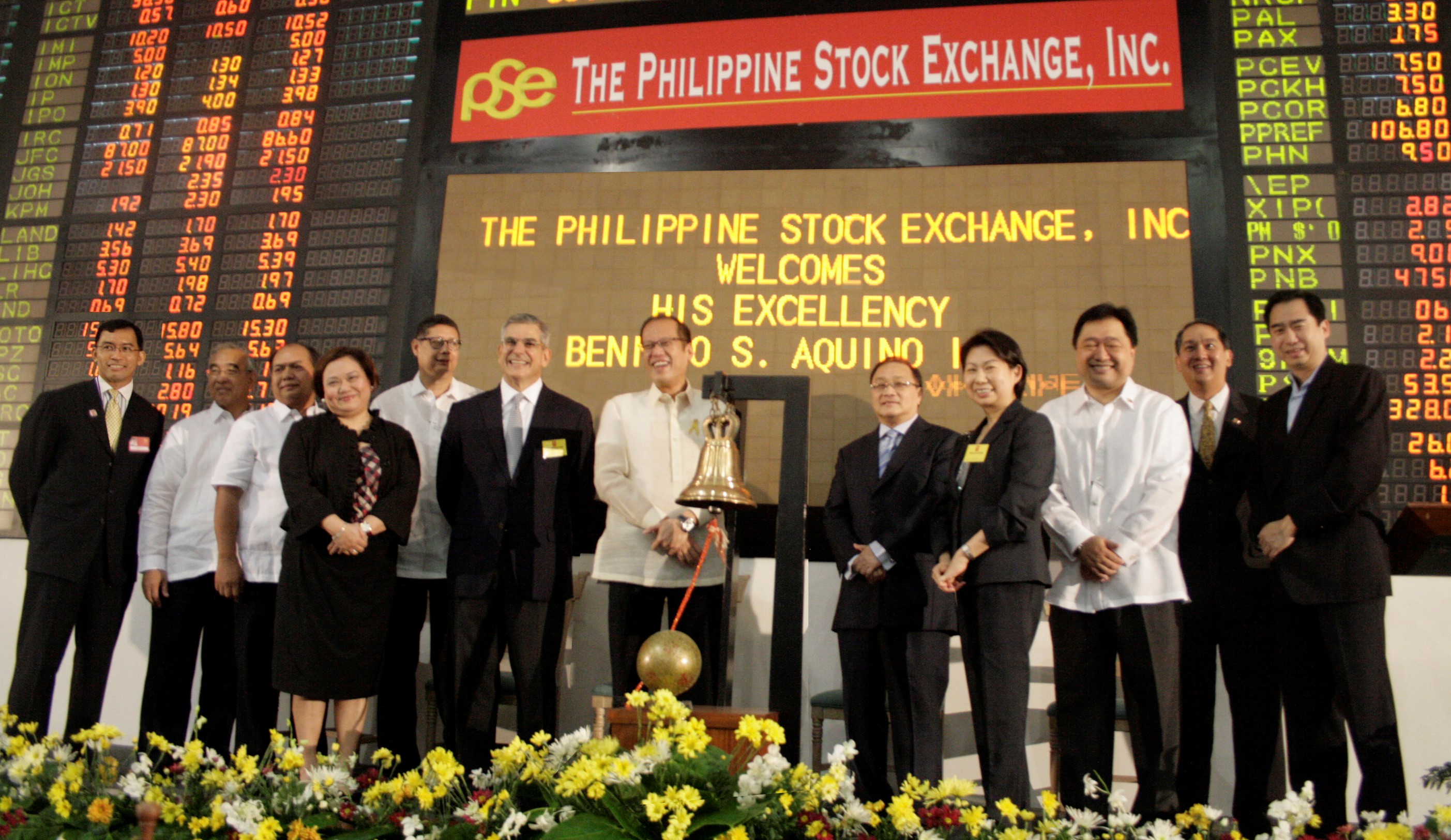
4,000. Then-president Benigno Aquino III leads the bell ringing ceremony as the PSEi breaches the 4,000 level in 2010.

Philippine Stock Exchange

The PSEi then went on to break several more milestones:

  • 5,016 – March 2, 2012
  • 6,044 – January 7, 2013
  • 7,120 – April 22, 2013
  • 8,053 – April 6, 2015

PSE data also showed that the index rose to an all-time intraday high 131 times and climbed to an all-time high at the close 119 times, with a maximum of seven consecutive days of breaching all-time highs.

“I fondly recall the time when I used to personally send stock market updates to President Aquino each time the market breached new milestones. We have to give credit to PNoy and his good governance drive which promoted political stability and transparency that translated well in [the] market’s strong performance,” said PSE chairman Jose Pardo on Friday, June 25.
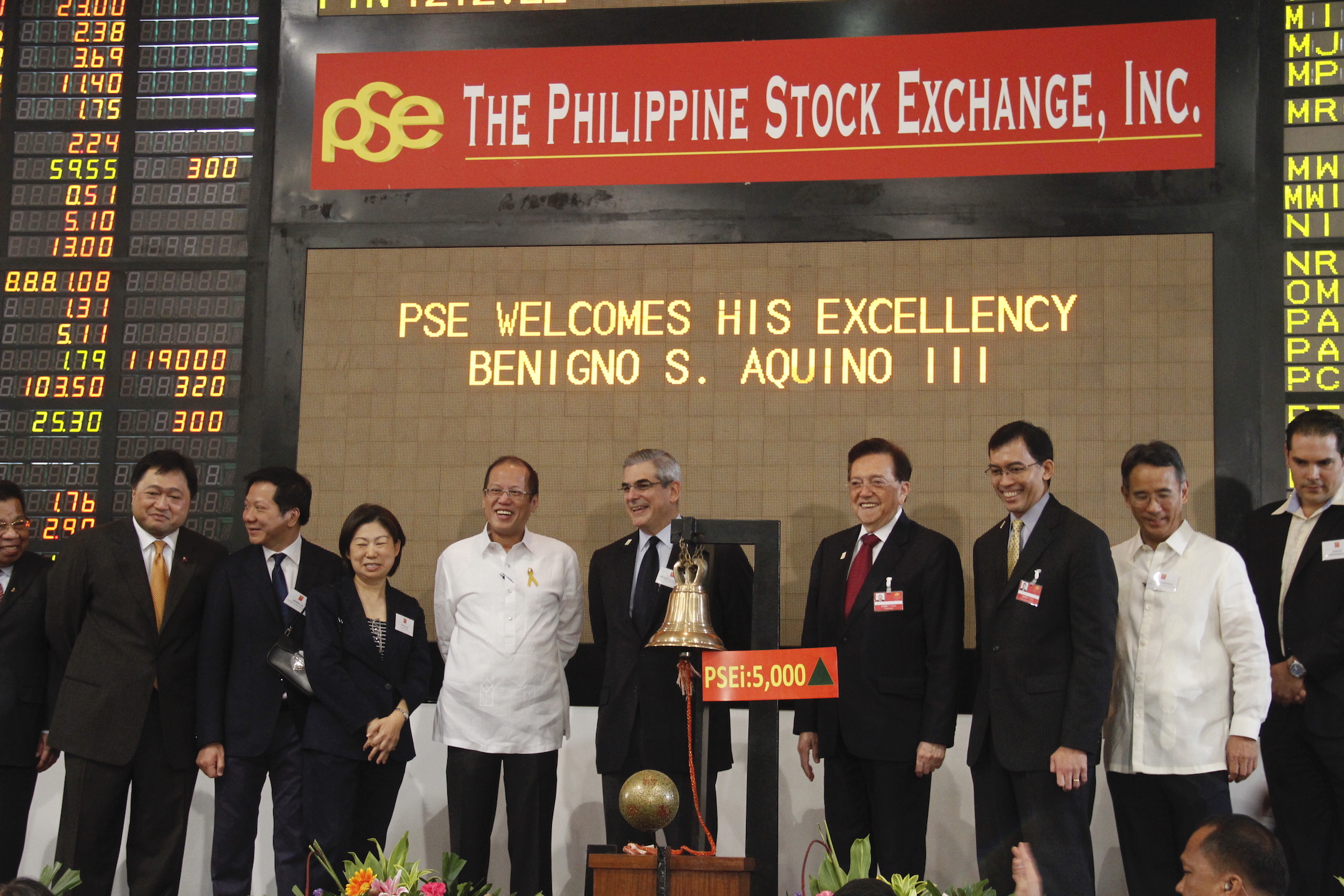
5,000. Then-president Benigno Aquino III and business leaders ring the bell in 2012 to mark the PSEi’s ascent to the 5,000 level.

Philippine Stock Exchange

It was also during Aquino’s time that the PSE reached the highest net foreign buying at P109.98 billion in 2012.

The highest total value turnover and average daily value turnover were logged in 2013 at P2.55 trillion and P10.52 billion, respectively.

The stock market gains came as the Philippines acquired investment grade status during the Aquino administration, effectively pushing down interest rates to 4%.

The lower cost of borrowing encouraged more personal, business, housing, and car loans in a consumption-driven economy.

The improved credit ratings attracted confidence in the Philippine market and growth in investments, particularly in business process outsourcing.
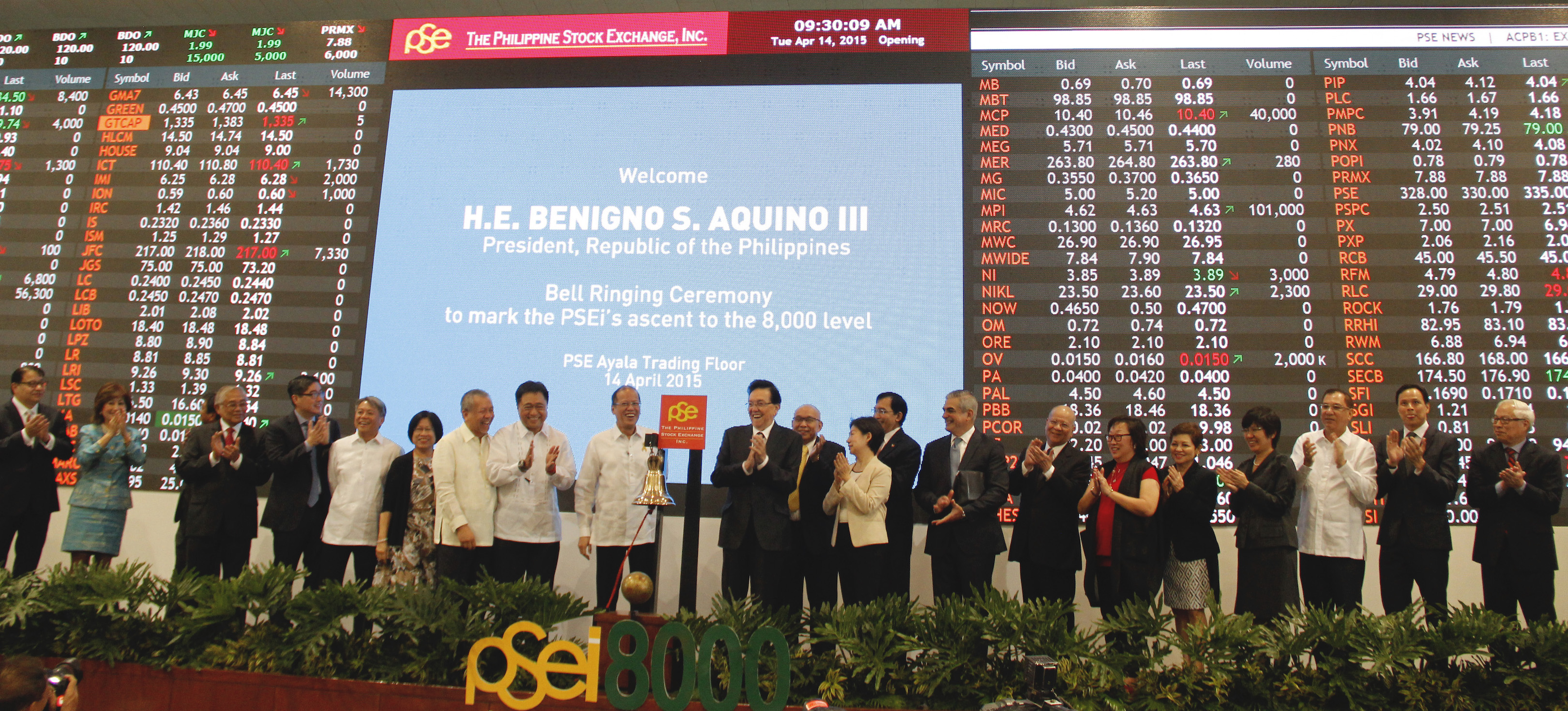
8,000. In 2015, then-president Benigno Aquino III graces the bell ringing ceremony to celebrate the PSEi’s breach of the 8,000 level.

Philippine Stock Exchange

The Philippines’ gross domestic product (GDP) grew an average of 6.2% during the Aquino presidency, even reaching 7.6% in 2010 and 7.2% in 2013.

The issue, however, is that growth was still grossly uneven, explaining why the poor still did not “feel” the numbers.

Unemployment gradually decreased during Aquino’s term, as foreign firms expanded operations. From 7.4% in 2010, unemployment went down to 5.4% in Aquino’s last year in office in 2016. (READ: World Bank: PH can end poverty in a generation)

But it was during the early years of President Rodrigo Duterte’s administration that unemployment dropped to an all-time low of 5.1% in 2019.

Due to the COVID-19 pandemic, unemployment soared to an average of 10.1% in 2020.

Aquino also continued his predecessor Gloria Macapagal-Arroyo’s conditional cash transfer program, which lifted around 7.7 million Filipinos out of poverty.  

Aquino worked with the private sector for several key infrastructure projects as well.

Some of these public-private partnership projects include:

  • Muntinlupa-Cavite Expressway (P2.2 billion)
  • School infrastructure projects (P14 billion)
  • Automated fare collection system for Metro Rail Transit Line 3 and Light Rail Transit Lines 1 and 2 (P1.7 billion)
  • Metro Manila Skyway Stage 3 (P26.5 billion)

Duterte, who promised the “golden age of infrastructure,” adopted several of Aquino’s projects.

Public Works Secretary Mark Villar has claimed that the Skyway project is part of Duterte’s Build, Build, Build program, when in fact, it was initiated way back in 2014 or during the Aquino administration. This project was built using private sector funds.


[ANALYSIS] 10 Build, Build, Build projects that started before Duterte

The government’s revenues also improved during Aquino’s term, with around P60 billion raised due to sin tax reform.

According to think tank Action for Economic Reforms, the sin tax reform law in 2012 “created the momentum for sustained tax rate increases throughout the years.”

“Aside from reducing smoking prevalence, this law created fiscal space, boosting revenues and leading to rapid economic growth until the pandemic hit,” added the group.

Before Aquino’s time, improvements in macroeconomic fundamentals had already begun during the Arroyo administration, particularly the value-added tax reform and expenditure compressions. – Rappler.com


Source link

Related Posts

Economics

New market aims to boost south Brum economy

September 12, 2026
Economics

Bitcoin falls as macroeconomic pressures intensify

September 11, 2026
Economics

Azerbaijan’s macroeconomic resilience working group holds next meeting (PHOTO)

September 11, 2026
Economics

Economic Hardship Reporting Project | KPFA

September 11, 2026
Economics

Pros and Cons of a Mixed Economy

September 11, 2026
Economics

Circular Economy: Recycling | NIST

September 11, 2026
Add A Comment
Leave A Reply Cancel Reply

Editors Picks

3 Top-Performing Mutual Funds to Consider for Your Retirement Portfolio

September 12, 2026

US equity funds record nine-month high outflows as oil stokes inflation fears | The Mighty 790 KFGO

September 12, 2026

New market aims to boost south Brum economy

September 12, 2026

EURUSD Day Trading Sept. 11, 2026 – Beware Murky/Sandy Areas

September 12, 2026
SUBSCRIBE TO OUR NEWSLETTER

Get our latest downloads and information first. Complete the form below to subscribe to our weekly newsletter.


I consent to being contacted via telephone and/or email and I consent to my data being stored in accordance with European GDPR regulations and agree to the terms of use and privacy policy.

Featured

US officials say economic pressure may hurt Iran more than bombs

July 28, 2026

Forget Bitcoin: Why USDT is the real hero saving Latin American savings

June 7, 2026

M&G Appoints Paul Haegy as Head of Infrastructure Debt and Private Placements

May 6, 2026
Monthly Featured

Strong consumer demand drives beef prices despite tighter cattle supplies | News – Farm Talk

July 1, 2026

JP Morgan: Participants Willing to Hand Retirement Planning to Professionals

July 15, 2026

LinkedIn executives cite macroeconomics for UK hiring slump

June 10, 2026
Latest Posts

3 Top-Performing Mutual Funds to Consider for Your Retirement Portfolio

September 12, 2026

US equity funds record nine-month high outflows as oil stokes inflation fears | The Mighty 790 KFGO

September 12, 2026

New market aims to boost south Brum economy

September 12, 2026
SUBSCRIBE TO OUR NEWSLETTER

Get our latest downloads and information first. Complete the form below to subscribe to our weekly newsletter.


I consent to being contacted via telephone and/or email and I consent to my data being stored in accordance with European GDPR regulations and agree to the terms of use and privacy policy.

© 2026 Aspire Market Guides.
  • Contact us
  • Privacy Policy
  • Terms and Conditions

Type above and press Enter to search. Press Esc to cancel.

SUBSCRIBE TO OUR NEWSLETTER

Get our latest downloads and information first.

Complete the form below to subscribe to our weekly newsletter.


I consent to being contacted via telephone and/or email and I consent to my data being stored in accordance with European GDPR regulations and agree to the terms of use and privacy policy.