

Credit: Deeneris
Jump to a section
Introduction
Life cycle assessment (LCA) information–all the information about a product, from its design to its production, use, and end of life (disposal or recycling)–is difficult to evaluate for plastic products. One key reason is the around what kind of impact plastics have when they reach the end of their useful life. Plenty of states and municipalities collect this information, but what they collect and how they collect it is not standardized. Additionally, new recycling technologies and approaches are being proposed or implemented, which could influence the impacts at the end of a product’s life.
The Life Cycle Assessment of Polymers to Improve Circularity project is targeting these uncertainties by assessing how LCAs of plastics can currently be completed, and targeting research and data gaps to improve the accuracy and transparency of life cycle evaluations. Together with Argonne National Laboratory (Department of Energy), this project is evaluating the tools and databases that currently exist for completing LCAs for plastics to identify areas for improvement including data and modeling gaps. By reducing these gaps, NIST will improve the standardization, robustness, and accuracy of data used to quantify the circularity of plastics, and in doing so, assist decision makers such as the US, states, and municipalities to improve their reuse and recycling infrastructures.
The project has three goals:
- Improve LCA data, research, and information systems
- Make LCA modeling methods more consistent
- Make federal Life Cycle Information (LCI) data more accessible to the public
Contribution to a circular economy
This project is part of NIST’s Circular Economy program, which supports the nation’s need to transition away from a model in which materials are extracted from the environment, manufactured into products, used, then discarded (a so called “linear economy”) toward one in which the atoms and molecules that make up those products repeatedly cycle within the economy and retain their value.
One goal of this project is to use LCA data to improve the circularity of plastics. At NIST, we are specifically looking at how circular plastics are when they reach the end of their useful life. Are they landfilled or incinerated, or do they go to a mechanical or chemical recycling plant and cycled back into the economy?
Learn more
- “The State of LCA in Plastics” (VitalMetrics)
- An NIST Government Contract Report (NIST GCR 22-032) by a contractor, VitalMetrics, has been published. A journal article based on the GCR is currently under review at Environmental Research Letters (coming soon).
- Supplement Material include Presentation Slides summarizing the internal report’s findings and Literature Review Spreadsheet that was the basis for the report.
- Plastic LCA Evaluation Across Available LCA Modeling Tools and Databases
- Journal article: Cross-database comparisons on the greenhouse gas emissions, water consumption, and fossil-fuel use of plastic resin production and their post-use phase impacts (Resources, Conservation and Recycling)
- Presentation: Taemin Kim, P. Thathiana Benavides, Troy R. Hawkins, Joshua D. Kneifel, Kathryn L. Beers, Life-Cycle Analysis Datasets for Regionalized Resin Production Pathways, ACLCA 2023 Conference, Burlington, VT, 9/28/2023.
- Plastic LCA Evaluation Across Available LCA Modeling Tools and Databases (forthcoming)
- Study will evaluate the most widely used life cycle assessment (LCA) modeling tools and life cycle inventory (LCI) databases to improve NIST’s understanding on the strengths and opportunities for improvement of LCA to evaluate a more circular supply chain with a focus on plastic materials and plastic waste.
- 5 polymers (plastics) across 3 software tools, 4 LCI databases, and 5 end-of-life scenarios
- Original dataset/models used for comparison
- Excel file comparing datasets and results
- PowerPoint summarizing findings
- Final report
- NIST-hosted Webinar: Life Cycle Assessment of Plastics (12/8/2022)
- Life-Cycle Analysis Datasets for Regionalized Plastic Pathways
- Develop region-specific resin production pathways to support estimation of greenhouse gas emissions, criteria air pollutant emissions, water consumption, and energy use, and will include characterization of electricity grid mix, fuel use by type, and input supply chains.
- Five resin pathways across four countries/regions (20 resin-location combinations in total).
- “Impacts of key plastic additives on major resins’ recyclability, health risks, and environmental burdens” (forthcoming)
- This study will (1) Categorize and identify key plastic additives that can prevent plastic recycling and potentially cause health and environmental issues, (2) Investigate the LCA impacts of at least six key additive production pathways, (3) Identify the culprit additives that pose technical difficulties in recycling and incur potential health and environmental issues during and/or after recycling processes of at least four major resins, and (4) Quantify the potential loss in mass and/or value of plastic recycling flow due to the presence of those culprit additives and estimate the potential environmental benefits of replacing those culprit additives with alternatives.
Need LCA for…
- Microplastics
- Plastic Additives
- EOL modeling
Plastics being compared:
- Polyethylene (PE)
- Polypropylene (PP)
- Polyethylene terephthalate (PET)
- Bio-PE
- Bio-PET
Metrics being used:
- GHGs (greenhouse gases)
- Criteria Air Pollutants
- resources (water, energy)
Existing modeling tools
The initial problem this project is trying to solve is the inconsistencies across LCA data and software for evaluating plastics. To do this, we’re investigating the Life Cycle Inventory (LCI) databases and Life Cycle Assessment (LCA) modeling tools that currently exist and how comparable they are to one another. In other words, we’re measuring the problem by surveying the data and tools that are currently used for LCA of plastics. The diagram below has the databases and software that are being evaluated as well as the potential end-of-life scenarios for plastics.
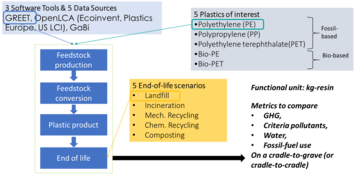
Credit:
Joshua Kneifel
One clear gap in the LCA of plastics identified by both the literature review and the assessment of existing databases and tools is a need for regionalized production pathways for different plastics. The most recent publication under this project developed LCA data for new pathways for production of plastic resins and other chemicals in other countries/regions to assist in evaluating circularity in the global plastics supply chain. The LCA data will improve the accuracy of quantifying the environmental impacts of plastic materials by providing more refined analysis through regionalization of data in the global plastic manufacturing process. Existing GREET models will be modified for countries with similar technologies to the U.S. with the appropriate electricity grid, fuels, and input supply chains (minimum 4 regions, 20 resin-region combinations in total). High volume plastic resin pathways analyzed were polyethylene terephthalate (PET), high-density polyethylene (HDPE), low-density polyethylene (LDPE), polypropylene (PP), and polyvinyl chloride (PVC) for four world regions: US, Western Europe, China, and Middle East – North Africa (MENA). One of the key drivers of variation across regions was differences in the electricity grid of the region.
The focus of the current study under this project is to assess key additives to determine their impact on recyclability and the associated environmental impacts. The study has begun by categorizing and identifying key plastic additives that can prevent plastic recycling and potentially cause health and environmental issues. The study will Investigate the LCA impacts of at least six key additive production pathways to identify the culprit additives that pose technical difficulties in recycling and incur potential health and environmental issues during and/or after recycling processes of at least four major resins. Finally, the study will quantify the potential loss in mass and/or value of plastic recycling flow due to the presence of those culprit additives and estimate the potential environmental benefits of replacing those culprit additives with alternatives.
Who is this helping?
The public and industry
Accurate and transparent Life Cycle Assessments are important for American consumers and the private sector because they allow producers to make accurate claims about a product and consumers to confirm these claims. For example, if a business is marketing their products as “sustainable,” then an LCA of those products can give that business data to back up the claim. The consumer, in turn, can look at the metrics that the business uses to back up their claim of sustainable–percentage of recycled materials used, approximate greenhouse gas emissions involved in production, gallons of water saved, etc.
Academics/non-profits
Reliable LCI data and LCA modeling tools will help the research and non-profit realms evaluate not only plastics, but other materials, like the steel, cement, and wood used in infrastructure and the built environment. NIST is also working with American and international standards development organizations to identify what kind of life cycle data and tools industry and governments need.