
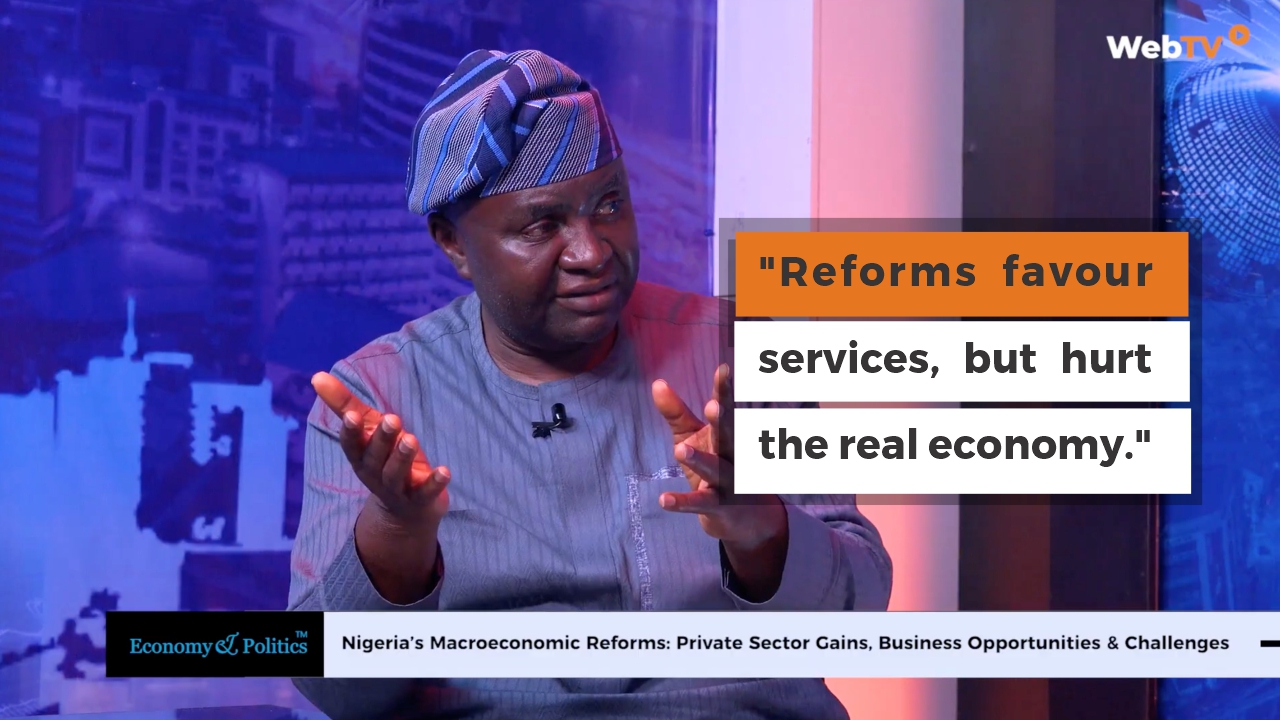
Nigeria’s ongoing macroeconomic reforms have delivered notable improvements in key economic indicators, but the extent to which these gains are translating into stronger business activity, investment, and productive capacity remains a critical policy question. In this edition of the Economy and Politics conversation, anchored by Ottoabasi Abasiekong, Dr Muda Yusuf, CEO, Centre for the Promotion of Private Enterprise (CPPE), provides a private-sector perspective on the reforms, examining developments in inflation, GDP growth, foreign exchange stability, interest rates, and overall business confidence.
While acknowledging the improvements in macroeconomic stability, Dr Yusuf notes that the benefits have been uneven across the economy, with the Services sector emerging as a major beneficiary, while productive sectors such as manufacturing and agriculture continue to face significant constraints. Energy costs, inadequate infrastructure, security challenges, logistics bottlenecks, and the prevailing high-interest-rate environment remain major impediments to businesses operating in the real economy, limiting their capacity to expand production, invest, and create jobs.

This edition of the Economy and Politics conversation, anchored by Ottoabasi Abasiekong, features Dr Muda Yusuf, CEO of the Centre for the Promotion of Private Enterprise (CPPE), who discusses Nigeria’s Macroeconomic Reforms: Private Sector Gains, Business Opportunities & Challenges.
Dr Yusuf provides a private-sector perspective on the impact of the country’s current macroeconomic reforms, focusing on the extent to which macroeconomic stability has translated into stronger business confidence, investment, production, and economic activity. The conversation explored developments in key economic indicators, including inflation, GDP growth, foreign exchange stability, interest rates, and business activity.
While he acknowledges the improvement in macroeconomic indicators, Dr Yusuf notes that the winners in the reforms phase are the Services sector, whereas the Productive sectors that depend heavily on energy sources are experiencing slow growth due to structural issues in the economy that need to be addressed.
He called for critical issues such as energy, security, logistics, and the country’s high-interest-rate regime to be addressed through a policy-alignment strategy to unlock the productive sectors of the economy, from manufacturing to agriculture.
Follow WebTV on YouTube at @webtvnigeria. Contact WebTV Programmes via [email protected]
Subscribe to Proshare for market intelligence notes for updates.