
Close Menu
Aspire Market Guides
  • Home
  • Alternative Investments
  • Cryptocurrency
  • Economics
  • Equity Investments
  • Mutual Funds
  • Real Estate
  • Trading
What's Hot

AMFI March 2026 data: Flexi-cap funds lead equity category for 8th month | Here’s how they differ from multi-cap funds

May 14, 2026

AIMA celebrates as Cayman becomes alternative investment hub

May 14, 2026

ICT sector top recipient of foreign investments in first quarter

May 14, 2026
Facebook X (Twitter) Instagram
Trending:
  • AMFI March 2026 data: Flexi-cap funds lead equity category for 8th month | Here’s how they differ from multi-cap funds
  • AIMA celebrates as Cayman becomes alternative investment hub
  • ICT sector top recipient of foreign investments in first quarter
  • 10 Best Altcoins Today: Unlock APEMARS With 1,390% ROI Potential
  • Gold and silver ETFs rally after import duty hike
  • Classroom to cornfield | UDaily
  • ASX 200 afternoon report: 14 May 2026 – ig.com
  • Silver slides Rs 3,300/kg, gold drops Rs 1,600/10g as Trump-Xi talks in spotlight amid Iran war; key levels to watch
  • Macroeconomic Leaders Warn of Significant Risks If Samsung Electronics Strikes, Urge Resolution Through Negotiation
  • Private equity backers slam ‘runaway’ legal costs from top law firms – Financial Times
Thursday, May 14
Facebook X (Twitter) Instagram
Aspire Market Guides
  • Home
  • Alternative Investments
  • Cryptocurrency
  • Economics
  • Equity Investments
  • Mutual Funds
  • Real Estate
  • Trading
Aspire Market Guides
Home»Economics»Strikes have no place in a competitive market economy
Economics

Strikes have no place in a competitive market economy

By CharlotteApril 23, 20265 Mins Read
Share
Facebook Twitter Pinterest Email Copy Link


Thursday 23 April 2026 5:56 am

 |  Updated: 

Wednesday 22 April 2026 4:16 pm

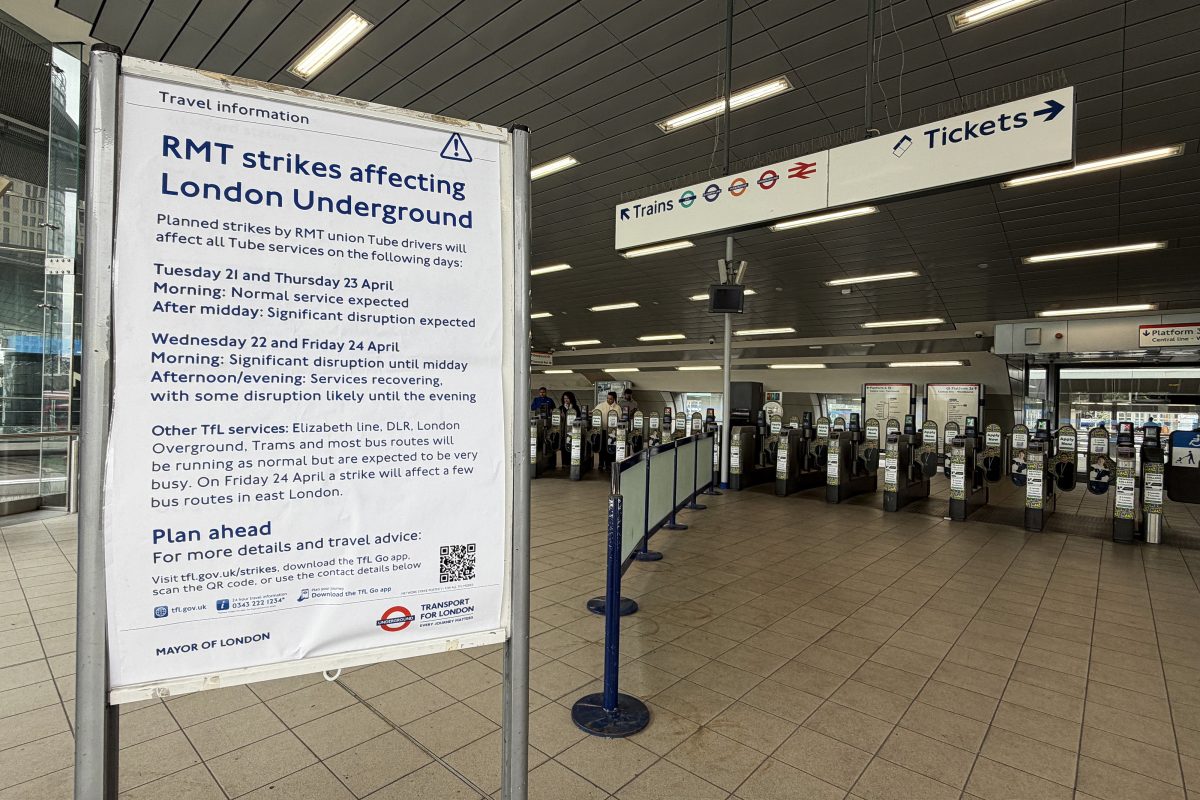
Crowded London Underground platform during tube strike with passengers waiting for limited train service amidst travel dis...

LONDON, ENGLAND – APRIL 20: A sign warns travellers at Stratford underground station of the upcoming industrial action by the RMT union, on April 20, 2026 in London, England. A series of 24-hour strikes by London Underground workers will start tomorrow, causing widespread disruption to the city’s transport system. Members of the Rail, Maritime and Transport (RMT) union recently voted for strike action in relation to a plan for a 4-day work week, citing concerns about shift lengths, working time arrangements and the impact of fatigue on safety. (Photo by Leon Neal/Getty Images)

There is no reason why Tube drivers on objectively high incomes with working conditions many would kill for are able to force their employers to ask of them even fewer hours and even more pay – and the employers are forbidden by the state from simply hiring other people, says Tom Harwood

I’m just going to say it. Strikes are dumb. Antiquated. Anachronistic. Utterly out of step with the modern world. And I’m not just saying this now because the RMT has been doing its best to ruin my week. Promise.

Yet while the Tubes beneath our feet have been ground to a grudging standstill this week, above the surface a revolution is quietly taking hold.

Like many Londoners, it’s with increasing frequency that I’m spotting Google’s autonomous Waymos whizzing about the city, now beginning to drive themselves. It’s to our international shame that we already have autonomous cars navigating our winding and packed medieval streets before we’ve cracked the automation of one-way trains in dedicated tunnels on single tracks.

This is, clearly, not an issue of technology. It’s one of unionised resistance.

Remarkably, of the entire underground network, just the Piccadilly, Bakerloo and Waterloo & City lines are not mostly automated today. For every other line, automation is such that the job of the “driver” is to simply open and close the doors, and to push a single button to initiate departure.

So here we are, held to ransom as a city by a small gilded elite of tube drivers often earning upwards of £80,000 for a four-day “working” week – whereby “working” is mostly the not all too taxing task of… operating the tube doors and occasionally making an announcement.

Overmanning and underautomating

Overmanning and underautomating is always the result of trade union action. Action that holds companies, cities, sometimes entire countries to ransom in order to drive up costs and drive down efficiency. Nobody wins, save for the few elite lucky enough to be employed by the company before their own union action drives it into the ground.

Read more

Tube strikes: Londoners braced for RMT walkouts from next week

Strikes seem to be something from a completely different age. Harking back to an era where entire settlements would be reliant on one sole employer. A time where, in many places, the only gainful employment that could be found was with a monopolistic provider – a steelworks, a dockyard a mine. Places where other than that one place of work, there was simply nowhere else to go.

Today we live in a competitive market economy. If you do not like your job, you are at liberty to seek another. I see no reason why Tube drivers on objectively high incomes with working conditions many would kill for are able to force their employers to ask of them even fewer hours and even more pay – and the employers are forbidden by the state from simply hiring other people who would accept their already generous terms. Why do we entrench incumbents and kneecap efficiency in the process?

The American journalist Richard Hanania recently wrote of a thought experiment. “Imagine that a group of customers of a store decided that they weren’t going to shop there until it reduced its prices… Now imagine that government requires that the store negotiate with this group, on everything from the products it carries to what hours it opens… If no deal is reached, it may lead to a shutdown of the store.”

It sounds absurd when we apply the logic of trade union strikes to customers rather than employees. Because we understand that customers, if they do not like a particular shop, can shop elsewhere. But the same is true of employees too.

Why does the law decide that a group of workers can hold their employer to ransom? Why is an employer forbidden from replacing workers that refuse their terms of employment? We should leave this sclerotic system of restrictions on free human action in the last century where it belongs.

In a 21st century city running a semi-automated transport system, it is absurd that well remunerated incumbents can still shut down a city while the law blocks replacement, reform and automation.

Tom Harwood is deputy political editor of GBNews and a City AM columnist

Read more

‘Disgraceful’: Khan and RMT in tube strike deadlock ahead of disruption

Similarly tagged content:

Sections

Categories

People & Organisations


Source link

Related Posts

Economics

Classroom to cornfield | UDaily

May 14, 2026
Economics

Macroeconomic Leaders Warn of Significant Risks If Samsung Electronics Strikes, Urge Resolution Through Negotiation

May 14, 2026
Economics

On the Nature of the Chinese Economic System – Monthly Review

May 14, 2026
Economics

Investigating a “post-peak” Chinese economy

May 14, 2026
Economics

Worldwide Giving: Improving quality of life and economic well-being

May 13, 2026
Economics

Why the U.S. job market is so hard, especially for recent college graduates – The Washington Post

May 13, 2026
Add A Comment
Leave A Reply Cancel Reply

Editors Picks

AMFI March 2026 data: Flexi-cap funds lead equity category for 8th month | Here’s how they differ from multi-cap funds

May 14, 2026

AIMA celebrates as Cayman becomes alternative investment hub

May 14, 2026

ICT sector top recipient of foreign investments in first quarter

May 14, 2026

10 Best Altcoins Today: Unlock APEMARS With 1,390% ROI Potential

May 14, 2026
SUBSCRIBE TO OUR NEWSLETTER

Get our latest downloads and information first. Complete the form below to subscribe to our weekly newsletter.


I consent to being contacted via telephone and/or email and I consent to my data being stored in accordance with European GDPR regulations and agree to the terms of use and privacy policy.

Featured

State economist gives mixed economic forecast at Kruse Way Economic Forum

May 1, 2026

Gold steady as Iran proposal lifts market sentiment, interest rate outlook caps gains

April 27, 2026

John Weymark Delivers Keynote Address in Shanghai | Department of Economics

April 27, 2026
Monthly Featured

Accordion buys A5 to deepen Salesforce consultancy

April 9, 2026

Ripple-linked token jumps 5% on bitcoin strength

April 8, 2026

How to Sell ITO Utility Token (IUT) | Sell ITO Utility Token

April 7, 2026
Latest Posts

AMFI March 2026 data: Flexi-cap funds lead equity category for 8th month | Here’s how they differ from multi-cap funds

May 14, 2026

AIMA celebrates as Cayman becomes alternative investment hub

May 14, 2026

ICT sector top recipient of foreign investments in first quarter

May 14, 2026
SUBSCRIBE TO OUR NEWSLETTER

Get our latest downloads and information first. Complete the form below to subscribe to our weekly newsletter.


I consent to being contacted via telephone and/or email and I consent to my data being stored in accordance with European GDPR regulations and agree to the terms of use and privacy policy.

© 2026 Aspire Market Guides.
  • Contact us
  • Privacy Policy
  • Terms and Conditions

Type above and press Enter to search. Press Esc to cancel.

SUBSCRIBE TO OUR NEWSLETTER

Get our latest downloads and information first.

Complete the form below to subscribe to our weekly newsletter.


I consent to being contacted via telephone and/or email and I consent to my data being stored in accordance with European GDPR regulations and agree to the terms of use and privacy policy.