
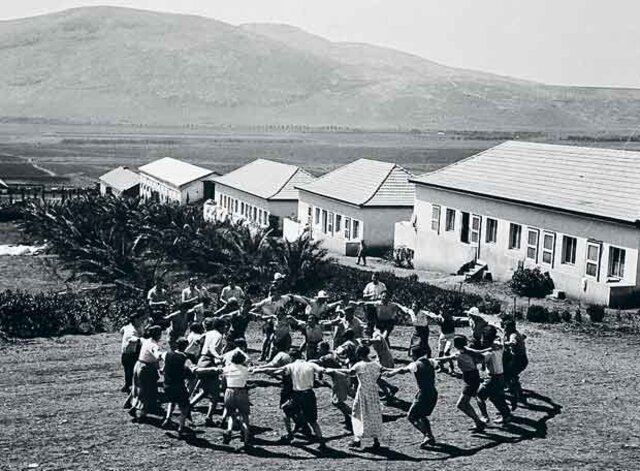
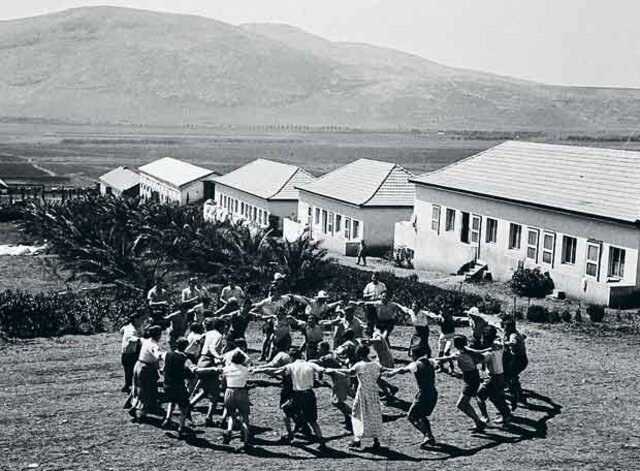
 The Israeli kibbutz have long been moving away from utopian socialism towards “renewing kibbutz”; a kind of cooperative in which member wages differ, consumption is unequal, many resources are privately owned but there is some mutual aid–a “safety net”–and some common ownership typically of land. Abramitzky et al. look at how kibbutz members vote and their expressed preferences after a kibbutz moves from a traditional model to a reformed or renewed model. The answer is that preferences for the market economy increased the more kibbutz members were exposed to the market economy but support for some redistribution to the poor (which was now less costly as the society was wealthier) did not decrease.
We find that labor market liberalization [i.e. new kibbutz model, AT] led to increased support of open labor market policies such as competitive labor market mechanisms, increased pay for overtime work, and differential wages. It decreased support for socialist policies, such as the joint ownership of the means of production. Still, it did not affect beliefs in the Marxist principle “from each according to his ability, to each according to his needs”, a principle which stands at the core of socialist egalitarian perception. At the same time, the reform also led to increased support for the safety net.
…The effects we document appear to be driven by an increase in living standards and work ethics that resulted from the reform. Equal sharing in the traditional kibbutz encouraged shirking and free riding. While strong idealism among founders helped kibbutzim reduce these problems in the past, idealism declined over time, and the second and third generations became less idealistic than the founding generation (see Abramitzky 2018 for a discussion). By the 1990s, before reforms took place, members complained about shirkers. As reported by members in surveys, our findings provide quantitative evidence that the reform improved kibbutzim’s members’ economic conditions and work ethics. These improvements might have, in turn, contributed to the more favorable attitudes of kibbutz members towards open labor market policies. Such improved economic conditions and work ethics might explain why even groups that stood to lose in relative terms from the reform, such as older and less educated members, supported it. The improved economic conditions and work ethics meant that even if these groups experienced declines in their relative income (as they found themselves at the bottom of the kibbutz’s income distribution), they may not
have lost in terms of absolute income. Moreover, these groups may have concluded that a shift away from equal sharing was inevitable for the long-term survival of their kibbutz, and accordingly became more favorable to market mechanisms after the reform.…We conclude that introducing market-based wages led to a shift in attitudes towards what we call a market economy with compassion, changing from their traditional democratic socialist model to a social democratic one. Although most kibbutz members support the differential pay reforms, they still want to maintain their core principle of mutual guarantee. When reflecting on how they want to live and build their society, most members want to live in neither a traditional socialist kibbutz nor a capitalist city. Most of them prefer something in the middle – a market economy within a compassionate society with a comprehensive safety net.
In short, the mixed economy is stable.