
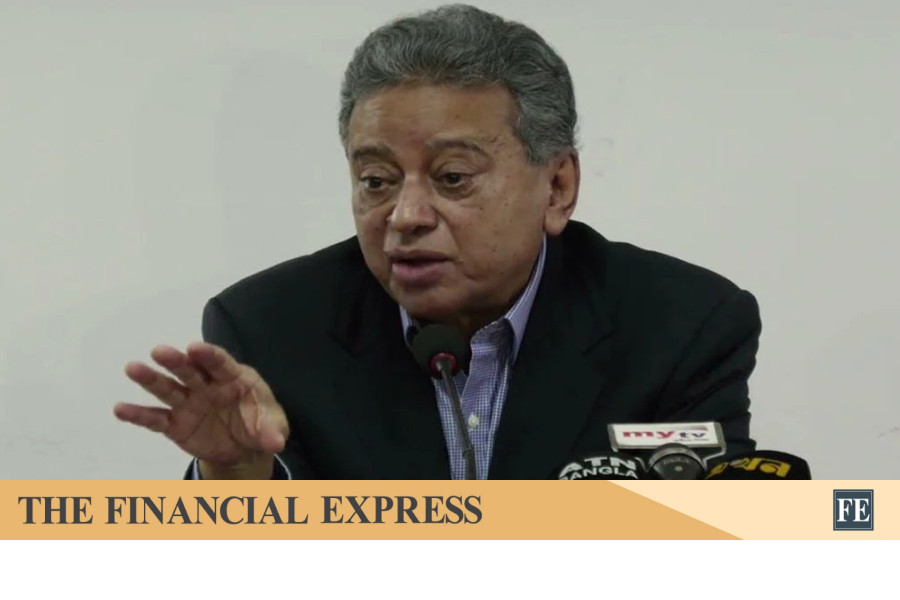
Now the government is bringing the economy and the capital market out of this dire condition, he said at the inaugural ceremony of World Investor Week at the Krishibid Institution in Dhaka.
The Bangladesh Securities and Exchange Commission (BSEC) organised the weeklong event, which will continue until October 12.
Mr Khosru said the capital market had never received the policy attention and coordinated support needed for sustainable development.
Initiatives taken after independence by then-president Ziaur Rahman to develop the Dhaka Stock Exchange and expand opportunities for mutual funds were “far-reaching ideas”, but the momentum was not sustained, he said.
The market subsequently failed to receive holistic policy and institutional support, with reforms being pursued largely on a piecemeal basis, he added.
“As a result, the capital market never really took off and grew as it should have,” Mr Khosru said.
Instead, both the government and private sector became overly dependent on commercial banks, often borrowing at high interest rates, he added.
The minister identified weak coordination among financial regulators as another major structural weakness of the capital market.
“Every regulatory body was functioning like an island, working in their respective spaces, but they never coordinated. That was another weakness of our capital market. Now, all regulators are sitting together every month,” he said.
He called for stronger coordination among the BSEC, Bangladesh Bank, National Board of Revenue (NBR), Insurance Development and Regulatory Authority (IDRA), stock exchanges, brokers and financial-reporting bodies.
Describing Bangladesh’s capital market as “shallow”, Mr Khosru said building sufficient market depth was essential to attracting quality companies and investors.
“If there is no depth in the market, where will you get turnover? You have to create the depth,” he said.
He also said fundamentally strong companies with good governance would not be willing to enter a market perceived as a “casino”.
“No good company will list in ‘a casino’. Those that are good companies, believe in good governance and practise self-regulation will not be part of ‘a casino’,” he said.
The minister urged market participants to strengthen self-regulation, professionalism, transparency and credibility rather than relying excessively on regulatory intervention.
“A financial system only works, trust and credibility only come when the stakeholders learn to self-regulate,” he said.
Speaking at the event, BSEC Chairman Masud Khan said the prolonged drought in initial public offerings (IPOs) was showing signs of easing, with a number of local and foreign companies preparing to enter the market.
“We are seeing indications that the IPO drought is coming to an end. A number of local and foreign companies have started the process of coming to the market,” he said.
Mr Khan said lengthy approval procedures had discouraged companies from raising funds through the capital market.
In the past, IPO approvals could take one to one-and-a-half years. The current commission has simplified the process and aims to complete approvals within three months, he said.
“The current commission has simplified the process. Now an IPO will be approved within three months,” he said.
The BSEC has also revised direct-listing rules to allow selected established and financially stronger companies to enter the market through the process, he said.
It is also working to empower the Dhaka Stock Exchange (DSE) and Chittagong Stock Exchange (CSE) in the listing process and introduce internationally accepted valuation methods to attract multinational corporations and large local companies, he added.
The commission has also introduced a hybrid listing model, allowing companies to raise fresh capital from the public while enabling some existing shareholders to sell part of their holdings, said the BSEC chief.
Mr Khan also called for expanded surveillance to detect scams, misleading information, social-media-driven manipulation and other harmful activities outside the traditional market framework.
Insurance companies and mutual funds could become major investors in corporate bonds, creating opportunities for long-term fixed-income investment and helping deepen the market, he said.
The BSEC is also working to introduce derivatives and strengthen the legal and regulatory framework, he added.
Financial Institutions Division Secretary Nazma Mobarek said restoring investor confidence was the key priority for the capital market and called for stronger investor protection and surveillance.
IDRA Chairman Mir Nadia Nivin said insurers could play a transformative role in deepening the capital market as long-term institutional investors.
Life insurers, with their long-term liabilities, could invest in government securities, corporate debt, infrastructure instruments and equities, providing long-term capital and greater market depth, she said.