
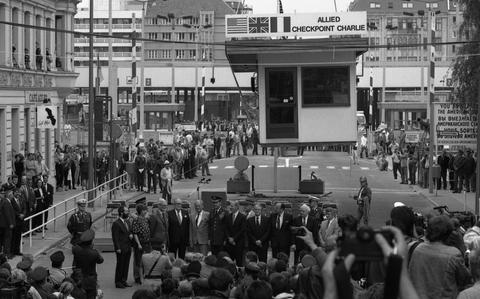
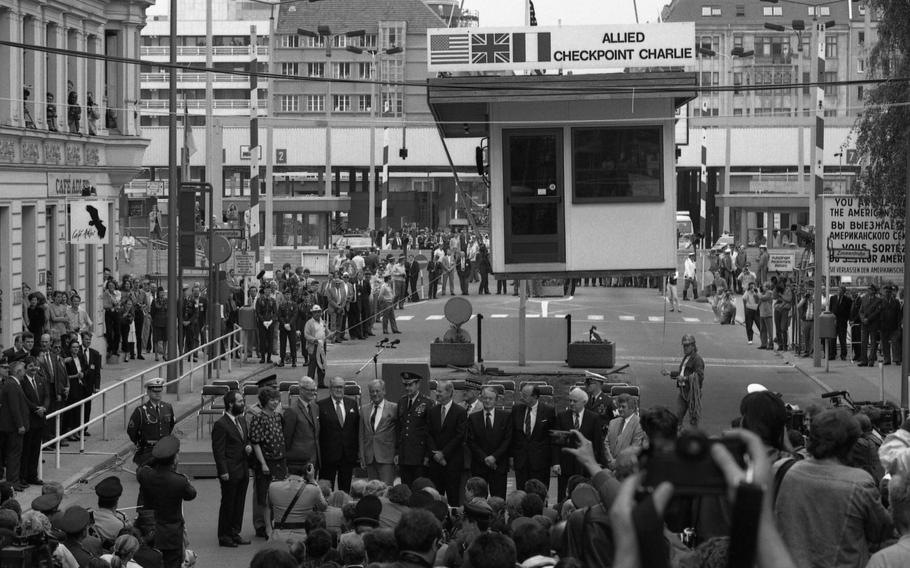
Dignitaries stand in front of Checkpoint Charlie as the historic guard post is being removed by a crane on June 22, 1990. The site of many daring escapes, one infamous showdown between U.S. and Soviet forces in 1961, and immortalized in hundreds of spy novels and films, the small guard house was the only gateway where East Germany allowed Allied diplomats, military personnel, and foreign tourists to pass into Berlin’s Soviet sector. The fall of the Berlin Wall in 1989 marked a big step on the way to the end of the Cold War. (Dave Didio/Stars and Stripes)
Is the contest in the world today between democracies and authoritarian societies an updated version of the contest between capitalism and communism? It has been clear for over three decades that we are living in a post-Cold War world, but it has not been clear what exactly is the shape of that post-Cold War world.
The shape is now finally clear.
Several of the authoritarian regimes are broadly communist, namely China and North Korea. But a number of them are not, notably Iran and Russia. On the democracy side, most of the countries — the United States, Canada, Mexico, Israel, South Korea, Japan, Australia, France, Germany, Italy, the Nordic countries — fall into the broad category of capitalist states.
Yet there is quite a range. For example, the Nordic countries, France and Germany are either social democracies or they swing back and forth between social democracies and more modest versions of the welfare state or a mixed economy. The United States oscillates between a progressive mixed economy and a conservative mixed economy.
In short, the division today is less about the kind of economy a country has than the kind of political system and whether there is a very strong executive or a broadly representative democracy. We might make a distinction between countries led by a rule-based order and those led by legitimacy conferred by the personal status of the leader.
Thus if you look at the -isms that divide the world today it is harder to pin them down than it was in the 1950s or 1980s, where capitalism and communism were the two basic -isms in the world. Global politics has evolved to a place where it is easier to describe and explain a political system less by the kind of economy it has than by the role of executive leadership and the system that it uses to pass laws and regulations.
The contrast, then, is striking from a historical point of view. The Cold War model basically followed a broadly Marxist view of history, namely one that saw the economy of a given state as basic and the political system as built on top of it in such a way to maintain it.
The capitalist system and the communist system have fundamentally different economies — broadly free market vs. controlled where the means of production are privately owned in the capitalist system and publicly owned in the communist system. Politics is driven by the goal of promoting the economic system.
Today, the chief democracies are all over the map, with the Nordic countries closer to social democracies or robust mixed economies, Germany and France are back in the center and the United States is moving more to the right in terms of its political system and its approach to civil liberties as well as its version of a mixed economy.
The chief authoritarian societies, China, Russia, North Korea and Iran, are also all over the map, with China a combination of state capitalism and Stalinist communism and Iran and North Korea radical dictatorships and Russia an oligarchy run by a strong-man dictator.
The world, in short, still has a fundamental clash between two major camps, but the countries are not driven by their economies and communism overall has weakened. If anything, socialism and social democracy have a greater presence in the democratic countries.
Iran and the United States are not at odds primarily over economic reasons, and the same holds for China and the United States. Economic issues are certainly intertwined with political issues, but they are not the basis of the conflicts the way they were during the Cold War.
The world today therefore has both the feature of being a multipolar world — as opposed to bipolar (U.S. and USSR) or unipolar (the U.S. in the 1990s) — with more than two major powers and the feature of having a clash between two very different political/economic systems. The Cold War, in contrast, had two superpowers and two different economic systems with two political frameworks maintaining the economic systems.
It is important to continue to separate ourselves from the binary Cold War decades because the shape of global politics today is more complicated than it has been for 70 years. It therefore requires a different framework to conceptualize it.
The world has many major powers and is multipolar, it nevertheless has a fundamental clash, and these two main camps are less held together by economic issues than values about governance and leadership.
Dave Anderson has taught political philosophy at the University of Cincinnati and George Washington University. He is editor of “Leveraging: A Political, Economic and Societal Framework” and co-editor with Michael Cornfield of “The Civic Web: Online Politics and Democratic Values.”