
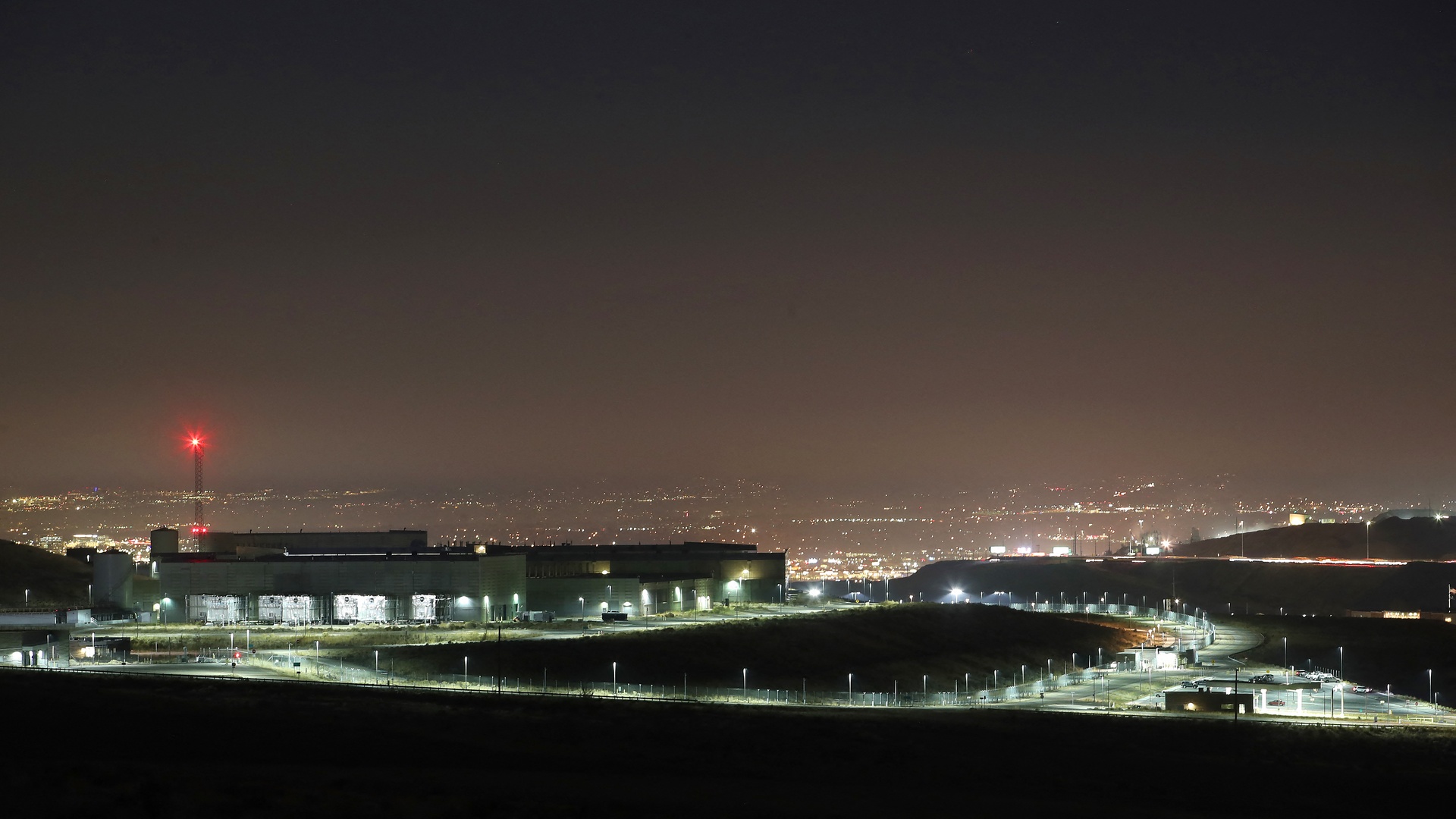
“The stars at night are big and bright, deep in the heart of Texas.”
So goes the unofficial state anthem, written in 1941 by June Hershey and famously performed by country music legend Willie Nelson.
But Nelson, 93, now worries those stars may become harder to see in his hometown of Abbott, Texas. In a recent social media post, he warned that a proposed “loud, water thieving, light polluting data center” threatens his rural community.

Download the Straight Arrow app today to get the stories that matter free from manipulation, bias or agenda.™
Point phone camera here
Nelson looked up into the expansive Texas sky, wondering what data centers could obscure. Economists Dany Bahar, a professor at Brown University, and Greg C. Wright, a professor at the University of California, Merced, reversed the view. They looked down from space, using satellite images to study whether data centers reshape the communities below.
Their findings, based on satellite imagery and economic data from nearly 800 facilities nationwide, reinforce a growing body of research showing that data centers can promise an economic boom but deliver little to no growth beyond their gates.
As data centers multiply across the country — and the resistance against them mounts — researchers see a growing divide between the communities that profit and those that bear the costs of powering the artificial intelligence economy.
A ‘bright dot’ that doesn’t spread
“When a data center comes in, from the satellite view, you see a massive increase in nighttime light output,” Wright told Straight Arrow. “But it’s a localized dot. It doesn’t spread.”
That matters because economists can use nighttime light as a proxy for economic activity.
Massive construction sites shine under floodlights. Cars and trucks stream in and out, and workers fill hotels and restaurants, brightening the surroundings.
Large manufacturing plants can generate widespread economic ripples by employing thousands of people and attracting suppliers, service businesses and new residents. Intel, for example, employs nearly 10,000 people at its sprawling semiconductor manufacturing complex in Chandler, Arizona.
In those instances, satellite imagery may show an initial dot of light at the construction site before, as Wright put it, “you see the larger community light up over time.”
Data centers work differently. After construction ends, they employ relatively few on-site workers, buy most supplies from regional or national vendors and deliver their products digitally, without needing new roads or other transportation infrastructure.
From space, Wright said, “you see a bright dot,” followed by little change in the surrounding lights.
The images Wright shared with Straight Arrow suggest that the facilities powering our digital lives generate relatively little economic activity in the communities around them.

Few local jobs
Large data centers contain billions of dollars worth of servers and equipment, but they require relatively few workers to keep them running. As a result, they provide only a modest bump in local jobs and wages.
Mayors across the country told Straight Arrow they either could not provide specific job figures or agreed that the number is relatively small. For example, in De Soto, Kansas, a 7,000-person town outside Kansas City, Mayor Rick Walker said data centers are expected to bring just 150 to 200 jobs.
Bayar and Wright found that counties landing their first large data center see total private employment rise by 4% to 5% over five to six years. Average wages rise by 3% to 4% for both existing workers and new hires.
A separate 2026 working paper by Georgia Tech researchers Daniel Yue and Yiyang Zeng found that after a data center opens, county employment rises by about 3.5%, wages by 5%, the number of businesses by nearly 5%, and household income by about 2%.
Those gains were small relative to the size of the investment and unevenly distributed. Metro areas capture more of the benefits than rural communities, the researchers found.
Wright added that data center jobs often go to workers outside the community, especially in rural areas, because building and operating the centers require specialized skills.
“They’re not hiring the local electricians to run them,” he said.
Mixed effects on housing
Research has not found a consistent effect of data centers on local housing prices, and the measured impacts are generally modest.
Baher and Wright’s research found no significant increase in home prices, but suggested that rents could increase 2% to 5% during a data center’s construction.
A separate George Mason University analysis found that homes near Northern Virginia data centers tended to sell for more. But the results may reflect the roads, utilities, airports and employers that attracted both data centers and homebuyers. The study did not establish that data centers caused the higher prices.
Experts said data centers can also have the reverse impact: Their constant hum, years of construction and unsightly appearance can lower nearby home values.
Yet data centers are rarely built on land that would otherwise be used for housing, said Howard Berry, principal and director of data center solutions at Avison Young, a commercial real estate firm.
“For large-scale data centers, you want to be near high voltage electrical infrastructure,” Berry told Straight Arrow, “which is not where people want to live.”
According to Avison Young research, sparsely populated, energy-abundant West Texas now has the fastest rate of data center growth in the country.

Who pays, and who benefits
How data centers affect residents’ cost of living and quality of life largely depends on the state, the utility system and the project, experts said.
“The variability of experience,” said Michael Hicks, director of the Center for Business and Economic Research at Ball State University, “is the story.”
A data center that pays its full property taxes, covers the cost of new electricity and water infrastructure, and buffers nearby homes from noise and emissions could leave residents significantly better off, Hicks told Straight Arrow.
In best-case scenarios, tax revenue from data centers can help fund local schools and other public services while reducing the tax burden on residents.
Loudoun County, Virginia, home to one of the world’s largest concentrations of data centers, says the industry generates nearly half of the county’s property tax revenue. The windfall has helped the county lower residential real estate taxes by 38% since 2010. The owner of a median-priced home, Hicks said, now saves more than $3,000 a year in property taxes.

Richland Parish, Louisiana, is collecting so much in taxes from a Meta data center project that the school system was able to award teachers bonuses as high as $50,000.
On the flip side, data centers that receive large tax breaks, shift energy and infrastructure costs to utility customers, and fail to control noise and emissions can leave residents worse off, experts said.
One large facility can use as much electricity as roughly 80,000 homes, according to a recent Georgia Tech study. In areas where the researchers could cleanly measure price effects, electricity prices rose by about 5% after a data center entered.
Other recent studies have found no increase and, in some cases, modest decreases in residential electricity prices. The effects depend heavily on available power capacity, utility regulation and whether developers and AI companies cover the costs of new power plants and transmission lines.
Concern about rising energy costs is among the reasons more than 7 in 10 Americans said they oppose building an AI data center in their area, according to a Gallup poll published in May. Respondents also cited environmental, cost-of-living and quality-of-life concerns as the industry expands at a dizzying pace.
Straight Arrow asked the Data Center Coalition, a trade group representing the data center industry, how these facilities impact local communities, including their effects on housing and other costs.
In response, Dan Diorio, the group’s executive vice president of state policy and government affairs, wrote, in part, that nationally in 2023, the industry supported 4.7 million jobs, contributed $727 billion to U.S. gross domestic product and generated $162.7 billion in federal, state and local taxes. These contributions, Diorio wrote, provided a “significant economic boost” to the national economy and helped “make life more affordable for Americans across the country.”
Diorio did not address how data centers impact local economies.
The deal can determine the outcome
Whether a data center helps or harms a community can hinge on the agreements negotiated before construction begins.
Hicks said officials in wealthier areas such as Northern Virginia may be better positioned to enlist experienced lawyers, development consultants and utility experts to broker advantageous deals with developers and Big Tech.
“They are sophisticated actors in this economic development world,” he said, in ways that county officials in other parts of the country might not be.
Virginia does not have the wide open spaces of West Texas, but it attracts data centers that require proximity to clients and tech workers.
“Videos of cats participating in the summer Olympics,” Hicks said, “can be processed anywhere in the world.” But he said sensitive data from air traffic control, national security systems or hospitals need to stay closer to users.
Historically, Wright said, data centers have had a modestly positive effect on local budgets, infrastructure and public services when they pay their way.
“They’re not drastically changing the community,” he said, “but they have been putting communities in slightly better fiscal health.”
But today’s data center hyperscalers, such as Google, Meta and Amazon, are bigger and “flush with cash,” Wright said, and could do more to invest in local communities and offset negative impacts of their rapid expansion.
The satellite images capture the challenge: A data center can light up the night without igniting the local economy. But how that light spreads could help illuminate who stands to profit in the accelerating race for AI.