
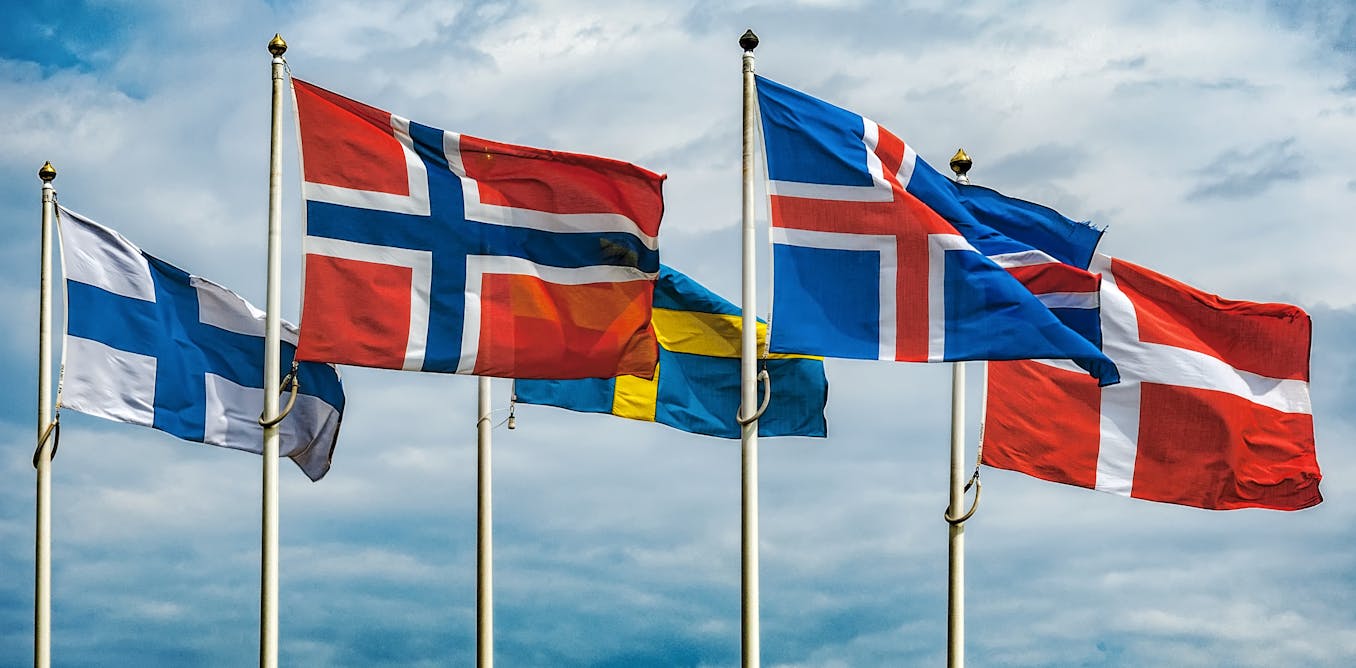
Rising inequality is one of the biggest social and economic issues of our time. It is linked to poorer economic growth and fosters social discontent and unrest. So, given that the five Nordic countries – Denmark, Finland, Iceland, Norway and Sweden – are some of the world’s most equal on a number of measures, it makes sense to look to them for lessons in how to build a more equal society.
The Nordic countries are all social-democratic countries with mixed economies. They are not socialist in the classical sense – they are driven by financial markets rather than by central plans, although the state does play a strategic role in the economy. They have systems of law that protect personal and corporate property and help to enforce contracts. They are democracies with checks, balances and countervailing powers.
Nordic countries show that major egalitarian reforms and substantial welfare states are possible within prosperous capitalist countries that are highly engaged in global markets. But their success undermines the view that the most ideal capitalist economy is one where markets are unrestrained. They also suggest that humane and equal outcomes are possible within capitalism, while full-blooded socialism has always, in practice, led to disaster.
The Nordic countries are among the most equal in terms of distribution of income. Using the Gini coefficient measure of income inequality (where 1 represents complete inequality and 0 represents complete equality) OECD data gives the US a score of 0.39 and the UK a slightly more equal score of 0.35 – both above the OECD average of 0.31. The five Nordic countries, meanwhile, ranged from 0.25 (Iceland – the most equal) to 0.28 (Sweden).
The relative standing of the Nordic countries in terms of their distributions of wealth is not so egalitarian, however. Data show that Sweden has higher wealth inequality than France, Germany, Japan and the UK, but lower wealth inequality than the US. Norway is more equal, with wealth inequality exceeding Japan but lower than France, Germany, UK and US.
Nonetheless, the Nordic countries score very highly in terms of major welfare and development indicators. Norway and Denmark rank first and fifth in the United Nations Human Development Index. Denmark, Finland, Norway and Sweden have been among the six least corrupt countries in the world, according to the corruption perceptions index produced by Transparency International. By the same measure, the UK ranks tenth, Iceland 14th and the US 18th.
The four largest Nordic countries have taken up the top four positions in global indices of press freedom. Iceland, Norway and Finland took the top three positions in a global index of gender equality, with Sweden in fifth place, Denmark in 14th place and the US in 49th.
Suicide rates in Denmark and Norway are lower than the world average. In Denmark, Iceland and Norway the suicide rates are lower than in the US, France and Japan. The suicide rate in Sweden is about the same as in the US, but in Finland it is higher. Norway was ranked as the happiest country in the world in 2017, followed immediately by Denmark and Iceland. By the same happiness index, Finland ranks sixth, Sweden tenth and the US 15th.
In terms of economic output (GDP) per capita, Norway is 3% above the US, while Iceland, Denmark, Sweden and Finland are respectively 11%, 14%, 14% and 25% below the US. This is a mixed, but still impressive, performance. Every Nordic country’s per capita GDP is higher than the UK, France and Japan.
Special conditions?
Clearly, the Nordic countries have achieved very high levels of welfare and wellbeing, alongside levels of economic output that compare well with other highly developed countries. They result from relatively high levels of social solidarity and taxation, alongside a political and economic system that preserves enterprise, economic autonomy and aspiration.
Yet the Nordic countries are small and more ethnically and culturally homogeneous than most developed countries. These special conditions have facilitated high levels of nationwide trust and cooperation – and consequently a willingness to pay higher-than-average levels of tax.
As a result, Nordic policies and institutions cannot be easily exported to other countries. Large developed countries, such as the US, UK, France and Germany, are more diverse in terms of cultures and ethnicities. Exporting the Nordic model would create major challenges of assimilation, integration, trust-enhancement, consensus-building and institution-formation. Nonetheless, it is still important to learn from it and to experiment.
Despite a prevailing global ideology in favour of markets, privatisation and macro-economic austerity, there is considerable enduring variety among capitalist countries. Furthermore some countries continue to perform much better than others on indicators of welfare and economic equality. We can learn from the Nordic mixed economies with their strong welfare provision that does not diminish the role of business. They show a way forward that is different from both statist socialism and unrestrained markets.