
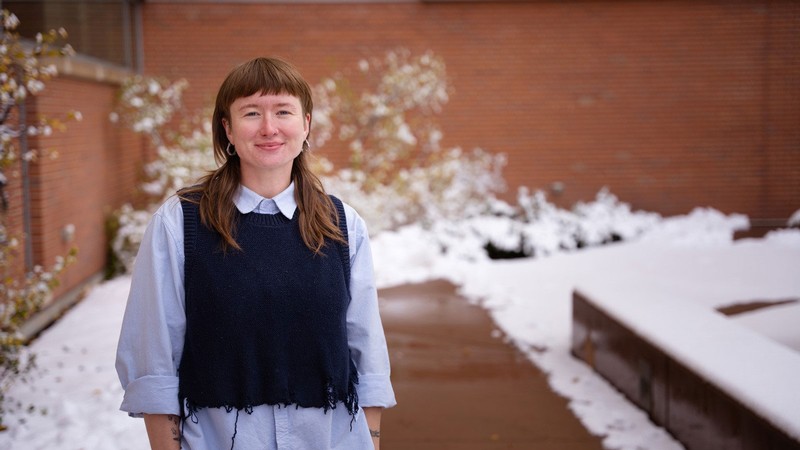
“At first, I hated it.”
That’s how Savanna Craig describes her first college economics class. The assessment is surprising, considering she now holds a master’s degree in applied economics from Utah State University.
During her undergrad years at the University of Portland, Craig explored a range of subjects — marketing, psychology, sustainability — trying to find her path. Initially, macroeconomic concepts like gross domestic product and inflation that are taught in introductory level economics courses did not really interest her.
She soon realized she had misinterpreted what economics is all about.
“I didn’t understand the potential that economics as a field has,” Craig said. “There is a general misconception that economists are all about Wall Street, stocks and finances. But economics is a social science, and in a way, it has a lot of similarities with fields like psychology, where you are trying to understand human behavior. That part of economics really hooked me, and being able to tie that into the environment was what really sold me about the field.”
With her shifted perspective, Craig transferred to Colorado State University and changed her major to natural resource economics.
During her time in Colorado, Craig also began an internship with Fort Collins Utilities, where she evaluated sprinkler systems for leaks and wasteful water use. She enjoyed connecting with the customers and educating them about how they could use water more efficiently. This experience inspired her future research at Utah State University, where she began working toward her master’s degree in applied economics after graduating from CSU.
Craig found Utah, with its rich array of natural resources, to be the perfect setting for her studies. Though moving to a new state was a leap, she quickly felt at home in the Department of Applied Economics within the College of Agriculture and Applied Sciences.
“Applied economics is an umbrella term for various kinds of economics research conducted on real-world issues,” said Steven Wilcox, assistant professor in the Department of Applied Economics and Craig’s mentor. “Applied economists ground their research in economic theory and often conduct sophisticated statistical analysis using real-world data that speaks to aspects of human behavior and policy effectiveness, among other things.”
Students in the Department of Applied Economics study agriculture, natural resources, environmental quality, regional development and other important topics, all through an economics lens.
“The way that I would distinguish applied economics is that it’s hands-on,” Craig said. “It’s much more micro-scale and you get to work with issues that you’re passionate about. It’s a way to apply your interest in a particular area, whether it’s agriculture, environmental conservation or water quality. It’s a very interdisciplinary way to look at the world.”
Craig found that USU’s Department of Applied Economics offered a collaborative and supportive environment. The program’s small size fosters close relationships between students and faculty, creating a real sense of community. This tight-knit atmosphere gave Craig the confidence to tackle complex research projects and explore real-world applications of the skills she was developing.
“I felt like I could go to any of the faculty members and have a real conversation with them,” she said. “They’ve made me feel confident in my studies and research. As you seek higher education, imposter syndrome can creep in. But to have faculty who are there to tell you that you’re excelling, it makes all the difference.”
Craig relied heavily on that faculty support as she dove into the research required for her master’s thesis.
Her thesis explored how tiered water pricing — charging more for higher water use — has been used in Utah over the last several decades to encourage conservation. She focused on whether this pricing approach has actually reduced water use in cities across the state.
Although economic theory suggests tiered pricing has the potential to encourage water conservation, whether it has happened is an open question in Utah. According to Craig’s current findings, there isn’t much evidence that tiered pricing has led to reduced use of water. One reason for this could be that people don’t easily change their water habits, even when prices go up, because water is such a basic need.
Craig’s findings highlight challenges for policymakers trying to conserve water while keeping it affordable. Her work does not imply that tiered pricing is necessarily a failed policy, but it does suggest that water prices in Utah may not be high enough to achieve desired levels of conservation.
“This is an important topic as water conservation issues are gaining increasing prominence in the state,” Wilcox said. “This was a difficult topic to explore as suitable data and empirical options are limited, but Savanna managed to combine existing and new data to conduct a rigorous study on the topic.”
Even after completing her thesis, she continues to refine and expand her work, collaborating with Wilcox to further improve the research and publish their findings.
“It was just so awesome to be able to do this research that I was really passionate about and to have his 100% support,” she said. “He taught me so much, not just about economics, but about the research process and how to organize your data. That is probably one of the most useful things that I’ve learned in my master’s program.”
Craig’s dedication to her studies and research secured her a job before she officially graduated with her degree. She now works as an economics research assistant at the United States Geological Survey. She studies post-wildfire debris flows — fast-moving mixtures of water, rocks, mud and other debris that rush down hillsides after a wildfire.
Craig’s job is to try to understand the value of being able to predict where and when these debris flows will occur. Understanding these issues can help save resources if, for example, the Department of Transportation or the Forest Service can know that information beforehand and make decisions to mitigate the damage. Using her expertise in economics and econometrics, Craig is helping protect infrastructure and allocate resources to help society.
With so many places where natural resources and economics converge, Craig has many options ahead of her for her future career. She plans to continue her educational journey with a Ph.D. in applied economics or natural resource economics. She envisions herself working for the federal government in the future, and maybe even passing on her passion for research to others as a professor, inspiring students just as her own professors inspired her.
“She’s the kind of graduate student that professors are lucky to have,” Wilcox said. “She has a bright future ahead of her.”