
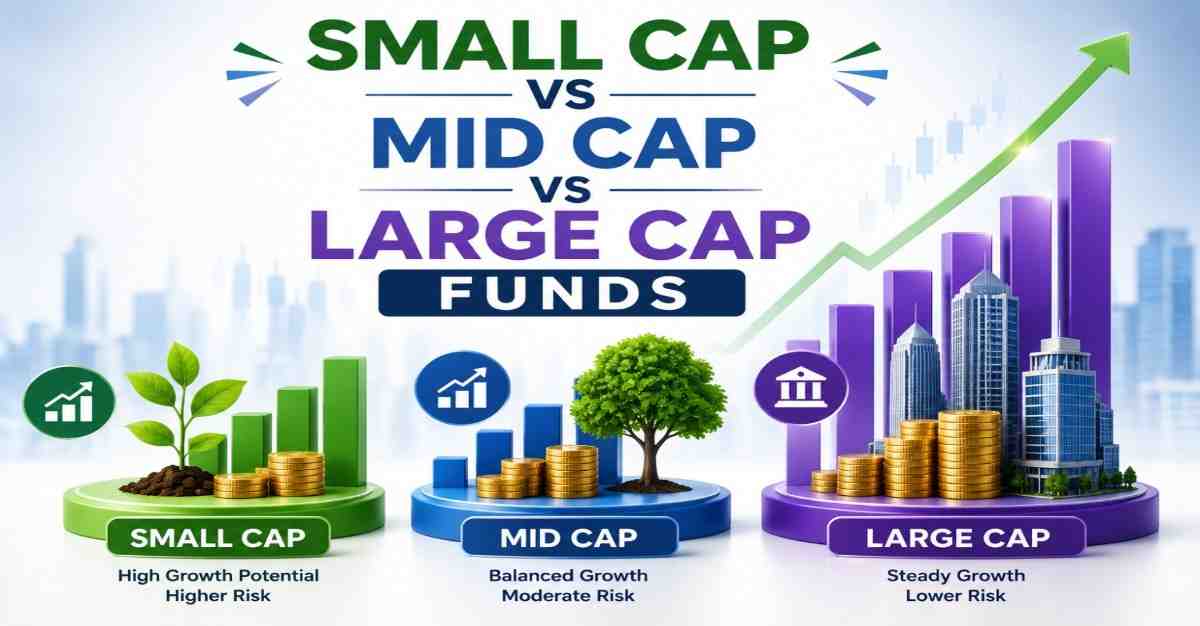
Small cap funds have delivered up to 22.18 per cent returns in 2026 so far, leaving mid and large cap funds behind. Here’s how the three categories compare and which one may suit your investment style.
The first half of 2026 has once again highlighted how different market capitalisation segments can produce very different outcomes for investors. While small cap funds have generated strong double-digit gains, mid cap funds have also posted healthy returns. Large cap funds, however, have struggled as blue-chip stocks remained under pressure. The performance gap reflects the different phases of the market cycle. Smaller companies have benefited from improving earnings, higher domestic liquidity and stronger risk appetite. Large cap stocks, on the other hand, have seen relatively muted gains amid global uncertainties and slower growth in heavyweight sectors.
Explore DSIJ’s Mid Bridge – a research-driven service focused on fundamentally strong mid-cap companies with robust business models and long-term growth potential.
What are Large Cap, Mid Cap and Small Cap Stocks?
Mutual Funds are broadly classified based on the market capitalisation of the companies they invest in.
– Large Cap Funds
Large cap funds invest at least 80 per cent of their assets in the country’s 100 largest listed companies by market capitalisation. These businesses are generally well-established, financially stable and industry leaders.
Risk: Low to moderate
Return potential: Moderate but relatively stable over the long term
Suitable for: Conservative investors and first-time equity investors
– Mid Cap Funds
Mid cap funds invest primarily in companies ranked 101st to 250th by market capitalisation. These companies are usually in the expansion phase and have greater growth potential than large caps.
Risk: Moderate to high
Return potential: Higher than large caps, with relatively higher volatility
Suitable for: Investors with a medium to long-term investment horizon
– Small Cap Funds
Small cap funds invest mainly in companies ranked beyond the top 250 by market capitalisation. These businesses are generally smaller, but they can grow rapidly if their business models succeed.
Risk: High
Return potential: Highest among the three categories, although returns can fluctuate sharply
Suitable for: Investors with a long investment horizon and higher risk appetite
How Have the Categories Performed in 2026?
Also Read – Top 5 Equity Index Funds Based on One-Year Returns
The year-to-date performance clearly shows that small cap funds have been the strongest performers, followed by mid cap funds. Large cap funds have lagged significantly.
|
Category
|
Highest YTD Return
|
|
Small Cap
|
22.18%
|
|
Mid Cap
|
13.79%
|
|
Large Cap
|
4.69%
|
The difference is notable. The best-performing small cap fund has generated more than four times the return of the best-performing large cap fund so far this year.
Top Performing Small Cap Funds (YTD)
|
Fund Name
|
Returns (per cent)
|
| Bank of India Small Cap Fund |
22.18
|
|
TrustMF Small Cap Fund
|
21.33
|
|
JM Small Cap Fund
|
18.35
|
| Union Small Cap Fund |
18.22
|
| Motilal Oswal Small Cap Fund |
17.76
|
Small cap funds have delivered the strongest returns in 2026 so far. Four of the top five funds have generated gains above 18 per cent, while the Bank of India Small Cap Fund has topped the category with a return of 22.18 per cent.
Top Performing Mid Cap Funds (YTD)
|
Fund Name
|
Returns (per cent)
|
| HSBC Midcap Fund |
13.79
|
| JM Midcap Fund |
9.66
|
| Invesco India Mid Cap |
9.17
|
| WhiteOak Capital Mid Cap Fund |
8.61
|
| Bandhan Midcap Fund |
8.47
|
Mid cap funds have also delivered healthy returns, although they trail small cap funds by a noticeable margin. HSBC Midcap Fund leads the category with a gain of 13.79 per cent.
Top Performing Large Cap Funds (YTD)
|
Fund Name
|
Returns (per cent)
|
| Quant Large Cap Fund |
4.69
|
| Invesco India Large Cap Fund |
0.92
|
| Bank of India Large Cap Fund |
0.30
|
| Taurus Largecap Equity Fund |
-2.23
|
| SBI Large Cap Fund |
-2.25
|
Large cap funds have witnessed a relatively subdued year. Quant Large Cap Fund has delivered the highest return in the category at 4.69 per cent, while some funds have posted negative returns.
Should Investors Shift to Small Cap Funds?
Although small cap funds have delivered the highest returns this year, investors should remember that past performance does not guarantee future returns. Small caps also tend to witness sharper corrections during market downturns. Rather than chasing recent performance, investors should choose a category based on their financial goals, investment horizon and risk tolerance.
The Bottom Line
Large cap funds may suit investors seeking relatively stable long-term wealth creation.
Mid cap funds can be suitable for investors looking for a balance between growth and risk.
Small cap funds may be appropriate for investors who have a long investment horizon and are comfortable with higher volatility.