
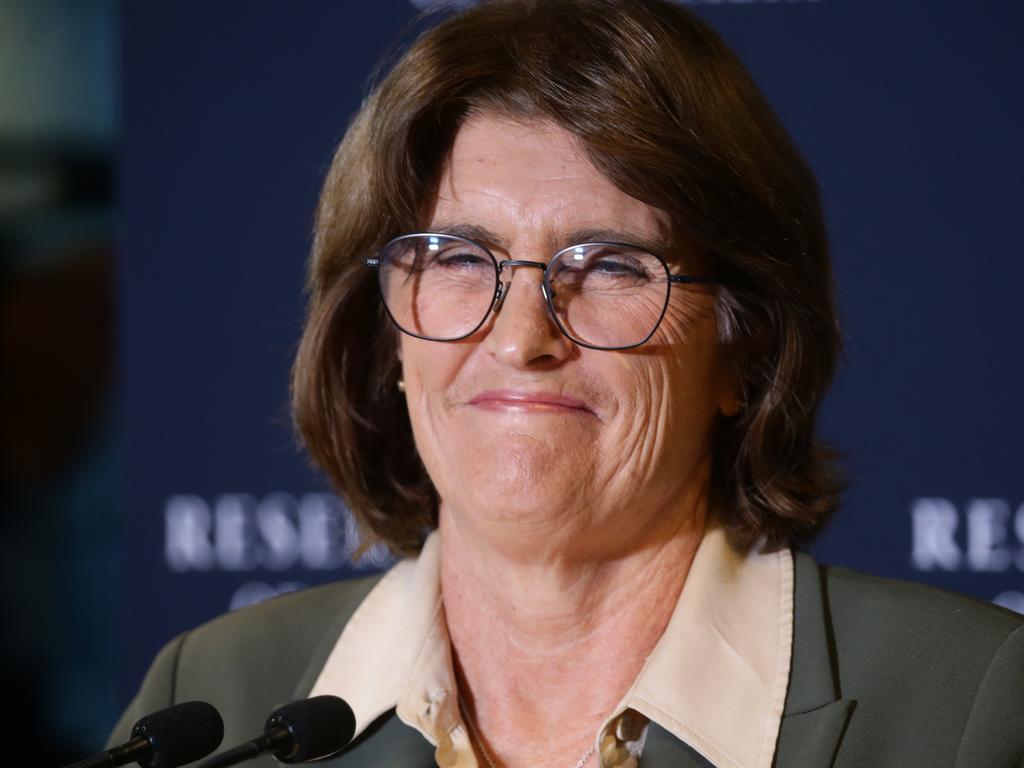

Reserve Bank of Australia Governor Michele Bullock. Picture: NewsWire / Christian Gilles
Australian homeowners are set for relief today with headline inflation expected to fall to its lowest level in months, driven by cheaper fuel – with Reserve Bank Governor Michele Bullock now widely expected to keep rates on hold.
The cash rate target is set to remain at 4.35 per cent when the board next meets on June 16, after a punishing stretch for borrowers off three rate hikes that added more than $360 a month to repayments on the average $800,000 mortgage.
RELATED: Tradie jobs crisis: One in three firms may cut staff
Ranked: Australia’s best and worst energy efficient suburbs
Headline CPI Inflation. Source: CBA Economic Update
The Australian Bureau of Statistics is today expected to confirm that annual headline inflation fell to 4.3 per cent in April, down from 4.6 per cent in March, according to the Commonwealth Bank of Australia’s forecasting team.
Cheaper fuel was the key driver, off the federal government’s fuel excise reduction which took effect on April 1 and is set to remain in place until 30 June.
CBA estimated petrol prices fell around 6.5 per cent over the month, and that without the excise cut, prices would have jumped by more than 7 per cent when the US-Israel war against Iran escalated.
Combined with a rise in the unemployment rate to 4.5 per cent released earlier, and easing pressure from Tuesday’s announcement of lower default electricity rates from July 1, the case for the RBA to lift its finger off the hike button on June 16 is now stronger.
“We continue to expect the RBA to remain on hold, with a move in June off the table,” CBA’s forecasting team said, adding “the August meeting remains a long 12 weeks away”.
Markets completely wiped out any chance of a rate hike in June on Monday, pricing in a 100 per cent chance of a hold by RBA, with the ASX Rate Tracker easing slightly to 96 per cent chance on Tuesday.
Monthly inflation showing fuel impacts. Source: CBA Economic Update
Canstar data insights director Sally Tindall said the data mix had shifted the outlook for the June board meeting, pointing to the April unemployment data as particularly significant for the RBA’s deliberations.
“The RBA is now looking to hit pause on the cash rate following the latest unemployment figures, which rose to a more uncomfortable 4.5 per cent in seasonally adjusted terms in the April data.”
“While this is just one result in one dataset, we already know from the May Board minutes that the RBA is well-positioned to hit pause on the cash rate hikes at its next meeting, to give the economy and households time to catch up on the last three rounds of hikes and the impact of the fuel supply shocks.”
Ms Tindall said the halving of the fuel excise was likely to push headline inflation lower, but flagged concern about core inflation potentially edging higher.
“With what the RBA has already said, combined with the employment data, it’s hard to see inflation moving the needle this time around when the Board next meets.”
Lowest variable home loan rates. Source: Canstar
The major banks remain split on the outlook beyond June though, with CBA and ANZ expecting the cash rate to remain on hold from here, while Westpac and NAB expect further tightening later in the year.
That uncertainty has not stopped lenders from acting, including out-of-cycle rate increases from banks moving independently of the RBA.
According to Canstar’s database, 24 lenders raised a combined 185 owner-occupier and investor variable rates this week by an average of 0.25 per cent, while a further seven lenders increased 142 fixed rates by the same margin.
That’s pushed the number of home loan rates below 5.75 per cent on Canstar’s database to just ten.
Two banks moved in the opposite direction – Australian Military Bank, which cut three investor variable rates by an average of 0.10 per cent, and Great Southern Bank, which trimmed seven fixed rates by an average of 0.14 per cent.
Ms Tindall urged homeowners not to wait for the RBA to act on their behalf and to actively shop around for a better deal.
Owner occupier rates on Canstart’s database. Source: Canstar
“After this rate hike is passed through – and some lenders will take until early June, not necessarily as a tactic but because their systems are set up to implement rate hikes on the first business day of the month – we expect the lowest variable rate will be 5.69 per cent, and there will be just a few variable rates under the 5.75 per cent mark.”
The data drop comes after Tuesday’s announcement of lower default electricity prices which gave further relief to most households.
Default electricity prices will fall from July 1 across most states, with New South Wales and southeast Queensland dropping between 3 and 7 per cent for flat-rate default plans, and Victoria falling by as much as 8 per cent – translating to a saving of up to $160 for a typical household over the next year.
But South Australians face a 1.3 per cent increase in default plans from July 1 due to higher wholesale costs in the state.
Ms Tindall said switching providers remained the most powerful lever for most households.
“It remains to be seen exactly how providers will respond to this set of price cuts. Will they drop new customer prices by more than those paid by existing customers? If there was ever a time to keep a keen eye on your electricity bill, it’ll be over the next few months.”