
Church’s first important painting, completed in 1846, was “Hooker and Company Journeying Through the Wilderness from Plymouth to Hartford, in 1636,” which depicts early Pilgrims (among them his ancestor Richard Church) seeking asylum from the Bay Colony government in Boston. The wooded, well-irrigated landscape, gilded by the light of the gloaming, is presented as a promised land. The painting may be the first appearance in art of the American doctrine of Manifest Destiny, a term coined the year before by the newspaperman and diplomat John O’Sullivan. Manifest Destiny entailed not just westward expansion but the spread of liberty and democracy, which O’Sullivan believed was nothing less than “Christianity in its earthly aspect.” Abraham Lincoln was wary of the doctrine, perceiving that any such notion of divine inevitability could be used to justify land grabs and war.
Church was not inclined to Cole’s pessimism. Where his teacher favored generalized nature, Church moved gradually toward greater specificity and empiricism, even as he continued to use landscape to explore ideas of liberty and American identity. When Church moved to New York, in 1847, he aroused interest as the only student of the famous Thomas Cole. Most of his early sales were to the committee of the National Academy’s rival organization, the Art-Union. Established in 1839, the Art-Union sought to connect New York’s art world with a national audience through a subscription system and an annual lottery. Church did not, however, neglect the National Academy, and in 1849—in the midst of bloody riots pitting nativists against immigrants and New York’s working class against the wealthy—he was promoted to full academician status. Three years later, his “New England Scenery,” which transposes the pastoral picturesque of the French artists Claude and Poussin to New England, was sold for thirteen hundred dollars, the highest price then paid for an American painting.
Church’s combination of talent, affability, and fine manners eased his way into New York’s élite, sometimes inspiring envy among his painter friends. (He “never knew what poverty was,” his friend Worthington Whittredge noted.) At the Century Association, a men’s club for artists and wealthy patrons (Twain called it “the most unspeakably respectable club in the United States”), he met with Cyrus Field, a merchant about to become famous for laying a telegraph cable across the Atlantic Ocean. In 1851, Church was travelling with Field and his wife, Mary, in Virginia when he first encountered the slave-owning American South.
Tensions over slavery were then ratcheting up everywhere. “There is infamy in the air,” Ralph Waldo Emerson wrote after a fugitive from slavery was brutally captured in Boston; the shame of complicity, he added, “robs the landscape of beauty, and takes the sunshine out of every hour.” Church and the Fields stayed at Shirley, a plantation just southeast of Richmond. Their host, Hill Carter, “considered himself an enlightened and benevolent man,” Victoria Johnson writes; he “occasionally sold children away from their parents, but no more often, he insisted, than he felt absolutely necessary.” During their visit, the first installment of Harriet Beecher Stowe’s “Uncle Tom’s Cabin” appeared in a Washington, D.C., newspaper. At Field’s urging, Church painted a view of Virginia’s Natural Bridge, the renowned geological formation alluded to in “Moby-Dick.”
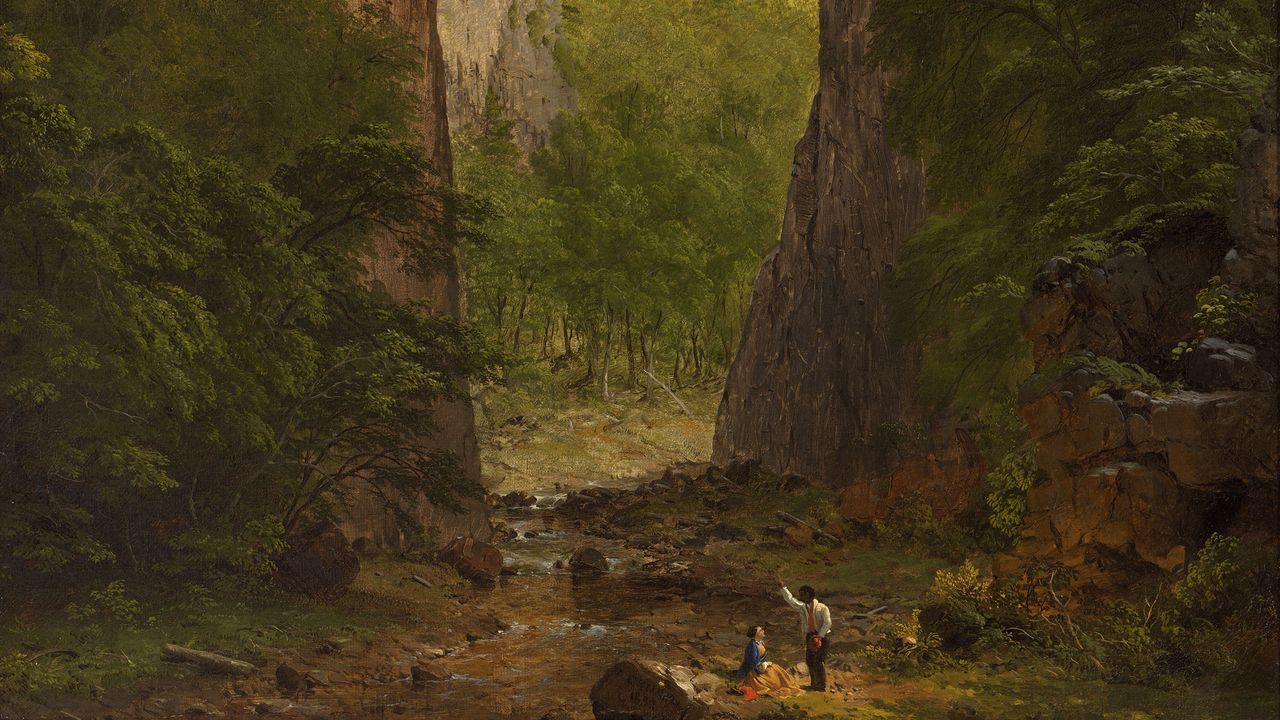
As a national icon, the Natural Bridge served as a quiet, Emersonian rebuke to Europe’s militaristic triumphal arches, reinforcing the naturalness of American democracy. Church depicted the high arch, which sits on land once owned by Thomas Jefferson, with scientific precision yet in a romantic, golden light. He signalled his support for racial equality by painting a Black man, picked out by light in the foreground shadows, standing while speaking to a seated white woman, his gestures suggesting pedagogical intent.
Church’s landscapes themselves had pedagogical intent, and the lessons were not just scientific but ethical, spiritual, patriotic. This intent aligned with the nation’s urgent emphasis on education as a defense against mob rule. It aligned, too, with the advice set out in Emerson’s rhapsodic 1836 essay “Nature,” which posited the natural world as an arena for moral instruction. Channelling Jean-Jacques Rousseau’s “Emile, or On Education,” Emerson stressed not just self-reliance but an innocent, childlike way of living, free from the “corruptions” of tradition. The influence on American culture of Emerson’s rallying cry—“Why should not we also enjoy an original relation to the universe?”—is hard to overestimate.