
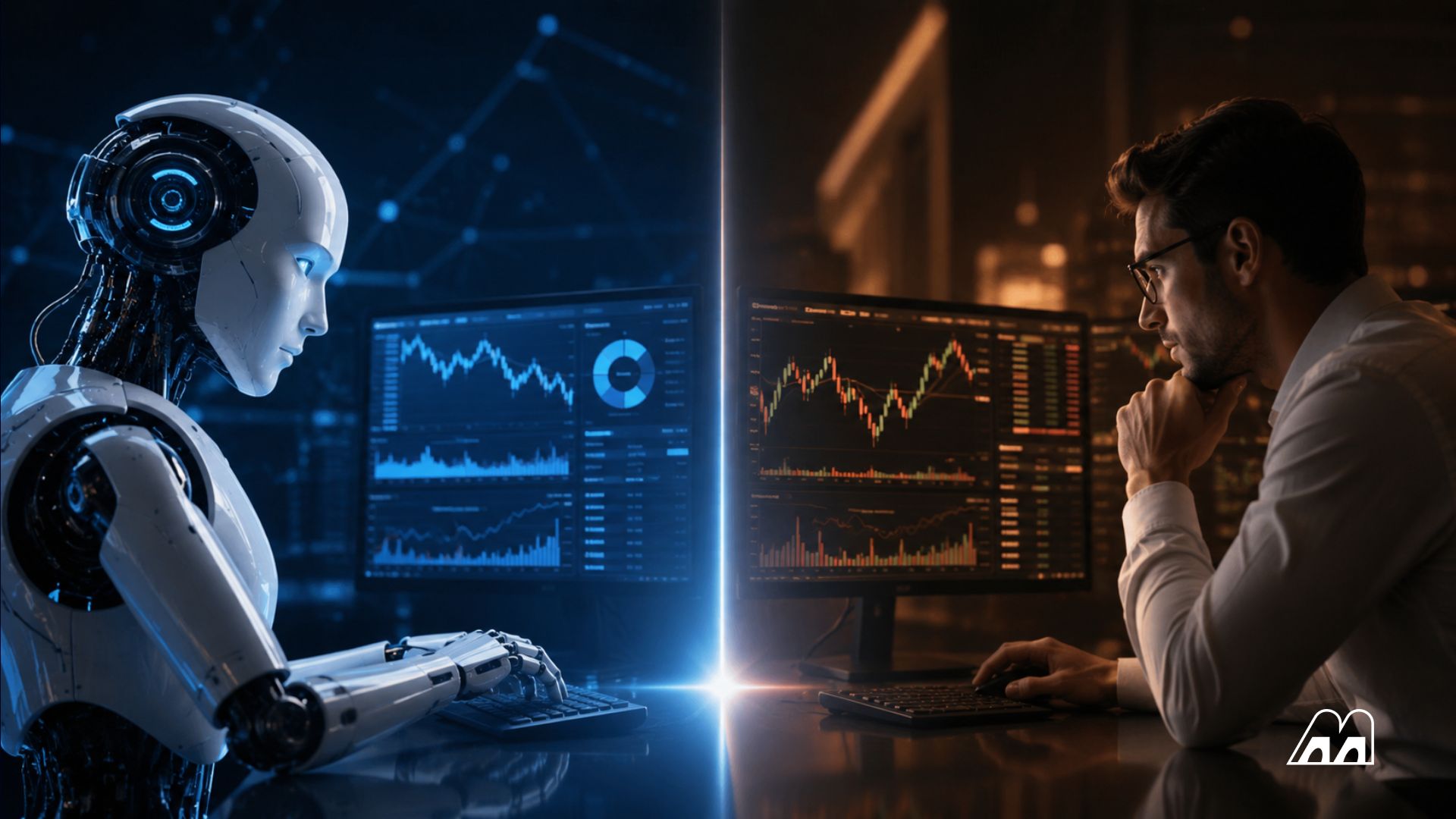
Algorithmic systems now power the majority of trades across global financial markets, yet the debate over whether AI trading bots can truly outperform human traders remains far from settled. On one side, institutional firms report near-flawless execution records. On the other, research shows that most retail traders using bots end up losing more money than those who trade manually.
So who actually wins when artificial intelligence goes head to head with human judgment? The answer depends entirely on context, and the data tells a more complicated story than either side wants to admit.
The Algorithmic Trading Boom Is Real
The growth of AI-driven trading is no longer speculative. According to IMARC Group, the global algorithmic trading market was valued at $18.8 billion in 2025 and is projected to reach $43.2 billion by 2034, expanding at a compound annual growth rate of 9.39%.
That growth is being driven by several converging factors:
- Retail adoption is accelerating. More individual investors are turning to automated tools as crypto and stock markets grow more complex and volatile.
- AI infrastructure is maturing. Deep learning models and real-time data processing have pushed trading bots well beyond simple rule-based scripts.
- Institutional dominance continues. Studies estimate that algorithmic strategies account for 60% to 75% of total U.S. equity trading volume, according to Quantified Strategies.
For retail traders in particular, 2026 marks a turning point. AI trading bots have gone mainstream, with platforms like 3Commas, Pionex, Cryptohopper, and Trade Ideas making automated strategies accessible to anyone with a brokerage account.
Where AI Trading Bots Outperform Humans
When it comes to speed, consistency, and data processing, automated systems hold a decisive advantage.
Execution speed is the most obvious gap. AI bots can place trades in roughly 0.01 seconds, while even the fastest human traders need 0.1 to 0.3 seconds to react. In high-frequency environments, that difference can separate profit from loss on every single trade.
Consistency under pressure is another strength. Bots follow programmed rules without emotional interference. They do not panic sell during drawdowns, chase momentum out of fear of missing out, or abandon strategies after a few losing days.
At the institutional level, the results speak for themselves. According to Traders Magazine, high-frequency trading firm Virtu Financial recorded just one losing trading day across 1,485 consecutive sessions over a six-year period. The firm attributed that record to the sheer volume and diversity of its algorithmic strategies rather than any single edge.
Data processing at scale is where bots are simply untouchable. A well-configured AI system can simultaneously monitor thousands of instruments across multiple exchanges, scan for patterns in real time, and act on signals that human traders would miss entirely.
Where Human Traders Still Have the Edge
Despite those advantages, AI trading bots consistently fail in scenarios that demand contextual judgment, adaptive thinking, and the ability to interpret events with no historical precedent.
This is not a theoretical concern. According to CoinDesk, data from Polymarket in early 2026 showed that while 37% of AI agents achieved positive returns, only 7% to 13% of human traders were profitable on the same platform. That sounds like a clear win for AI, but a deeper analysis by Bloomberg in April 2026 revealed a surprising detail: human traders actually picked the correct outcome more often than bots. They just entered trades later, at worse prices, and got outpaced on execution.
In other words, human judgment was superior, but human speed was not.
Here is where human traders consistently outperform:
- Black swan events. Bots trained on historical data struggle when unprecedented events break the pattern entirely. Flash crashes, geopolitical shocks, and sudden regulatory announcements can trigger losses that no backtest anticipated.
- Market regime changes. A bot optimized for a trending market can lose money rapidly when conditions shift to range-bound or highly volatile environments. According to Tradezella, overfitting is the most common failure mode for retail bots, where strategies memorize past patterns rather than learning generalizable principles.
- Contextual interpretation. A human trader can read an earnings call, assess political rhetoric, or sense shifting market sentiment in ways that algorithms still cannot fully replicate.

The Retail Bot Problem: Most Users Lose Money
The institutional success stories do not translate neatly to the retail world. An analysis by researchers at UC Berkeley and AnChain.ai found that on the platforms they studied, bots lost 77 times more money per user than human traders, according to UC Berkeley’s DataX initiative.
That data point deserves emphasis because it challenges the core marketing promise of retail AI trading bots. The reasons behind those losses are structural:
- Overfitting to historical data. A strategy showing a 70% win rate in backtesting can fail immediately in live markets because it was optimized for conditions that no longer exist.
- Hidden costs. Exchange fees, slippage, and failed transactions add up quickly. A bot earning 1% gross can easily become unprofitable after transaction costs.
- Marketing vs. reality. According to Power Trading Group, an estimated 95% of retail bots labeled as “AI” are actually rule-based scripts using basic moving average or RSI logic with artificial intelligence branding applied for marketing purposes.
- No “set and forget” option. Despite what ads suggest, most successful bot operators actively monitor and adjust their systems. In 2026’s volatile market environment, a bot left unattended for 48 hours can easily hit its stop-loss due to rapidly shifting conditions.
According to a separate Medium analysis, over 80% of retail bot users ultimately lose money, and the category generating the most hype (fully autonomous AI agents) has produced more headlines about catastrophic failures than about sustainable returns.

AI Trading Bots vs Human Traders: The Head-to-Head Comparison
| Category | AI Trading Bots | Human Traders | Edge |
| Execution speed | ~0.01 seconds | 0.1 to 0.3 seconds | Bot |
| 24/7 market monitoring | Yes | No | Bot |
| Emotional discipline | No emotional bias | Prone to fear and greed | Bot |
| Data processing | Millions of points per second | Limited | Bot |
| Black swan response | Often fails | Adapts in real time | Human |
| Contextual judgment | Limited | Strong | Human |
| Market regime adaptability | Poor without retraining | Flexible | Human |
| Retail profitability | ~20% profitable | Higher for disciplined traders | Human |
The 2026 Verdict: Human Plus Machine
The evidence across institutional data, prediction market performance, and retail trading outcomes points to one consistent conclusion. The most effective approach in 2026 is not choosing between AI and human, but combining both.
AI handles what it does best: fast execution, consistent rule-following, real-time data monitoring, and eliminating emotional mistakes. Humans provide what AI still lacks: strategic thinking, contextual judgment, and the ability to recognize when the rules themselves need to change.
Brett Singer, a research lead at blockchain analytics firm Glassnode, summarized this reality in a Cointelegraph interview when he described AI trading tools as functioning like “an associate or an intern that can work 24 hours a day” but still requiring human oversight for meaningful decisions.
For traders evaluating whether to adopt automated tools, the data suggests starting with AI-assisted analysis and execution support rather than fully autonomous trading. Use bots to eliminate human weaknesses, not to replace human strengths.
FAQs
Do AI trading bots actually work?
Yes, but results vary dramatically by use case. Institutional high-frequency trading firms have demonstrated near-perfect consistency over thousands of sessions. Retail bots show much lower success rates, with research indicating that over 80% of retail users lose money. Performance depends on strategy quality, market conditions, and active monitoring rather than the bot software itself.
Are AI trading bots profitable in 2026?
Some are. Well-configured rule-based bots on platforms like 3Commas and Cryptohopper report annualized returns of 12% to 25% in favorable market conditions. However, most retail AI bots fail to deliver consistent profits due to overfitting, transaction costs, and an inability to adapt to changing market regimes.
Can AI replace human traders entirely?
Not in 2026, and likely not in the near future. While AI agents outperform humans in execution speed and consistency, human traders demonstrate superior contextual judgment and adaptability during unprecedented events. Data from Polymarket shows humans choose correct outcomes more frequently, but bots profit more often because of faster execution.
What percentage of trading is algorithmic in 2026?
Algorithmic strategies account for an estimated 60% to 75% of total U.S. equity trading volume. The share is growing across crypto, forex, and commodities markets as well, with the global algorithmic trading market projected to more than double by 2034.
What is the biggest risk of using AI trading bots?
Overfitting is the most common and destructive risk. A bot optimized on historical data may show impressive backtest results but fail immediately in live markets because it learned specific past patterns rather than generalizable trading principles. Other significant risks include technical failures, hidden costs from fees and slippage, and the false confidence that comes from marketing claims about “passive income.”